

The shift from a family-sized home to an age-restricted neighborhood is not, for most buyers, a story about downsizing. It is a story about trading maintenance hours for time on a championship fairway, time in a ceramics studio, time on a pickleball court at first light, or time on a back patio that frames the Superstition Mountains in the morning. The state’s largest master-planned Arizona 55+ active adult communities built their reputations on exactly that trade, and the inventory has matured into one of the most varied retirement landscapes in the country.
This guide is the starting point for buyers exploring the section. It maps the regional geography, surveys the dominant community archetypes, names the master-planned 55+ neighborhoods that anchor each tier, and frames the financial and healthcare considerations worth weighing before a tour. Use it to orient, then click through to the city hub or community profile that matches your priorities.

The term active adult community carries some baggage. It is often confused with assisted living, with continuing care retirement communities, and with the broader category of senior housing. None of those are what the term means here. An active adult community is a residential neighborhood where age restriction is enforced under federal law, where homes are owned rather than rented as care units, and where amenities are programmed for adults who are still working, traveling, raising grandchildren, or running businesses from home. Residents drive themselves, prepare their own meals, and set their own schedules. The community provides the infrastructure for an unhurried lifestyle, not personal care.
The legal scaffolding for the category sits in the federal Housing for Older Persons Act of 1995, commonly abbreviated as HOPA. HOPA permits residential communities to restrict residency by age when specific occupancy and verification rules are met. The most common framework, used by virtually every master-planned 55+ neighborhood in Arizona, is the so-called 80/20 rule. At least 80 percent of occupied units must include one resident aged 55 or older, and the community must publish and enforce its age-restriction policy. The remaining 20 percent provides flexibility for adult children, full-time caregivers, or buyers who fall just below the age threshold.
A separate federal category, the 62-and-over community, requires every resident to be at least 62 years old. The 62+ framework is uncommon among new-construction master plans in Arizona; almost every modern community covered on this site operates under the 55+ HOPA framework. Buyers who are 50 or 52 and partnered with a spouse over 55 generally qualify under the 80/20 rule, though each community publishes its own verification process and may require periodic recertification. A community’s age-verification paperwork is one of the items the Arizona Department of Real Estate expects to see disclosed in the public report and the resale documents.

Arizona’s 55+ inventory clusters along three concentric arcs around the Phoenix metropolitan area. The first arc, established between the late 1950s and the early 1990s, sits in the northwest Valley and centers on the original Sun City, Sun City West, and the surrounding age-restricted enclaves. The second arc, built out between 1995 and 2010, pushed outward into Surprise, Goodyear, Buckeye, Peoria, Sun Lakes, and the East Valley. The third arc, still under active construction, extends into Buckeye’s Verrado corridor, San Tan Valley, Queen Creek’s eastern edge, Florence, Maricopa, and Wickenburg.
Geographic context matters more than buyers tend to expect. A West Valley community and an East Valley community can carry similar price points and similar amenity packages, but the drive to a major hospital, the morning light on a back patio, and the airport routing for seasonal trips will differ substantially. The site’s regional structure follows the freeway network that organizes the metro: Interstate 10 splits the Valley east-to-west, Loop 303 anchors the West Valley’s outermost ring, Loop 202 traces the East Valley and the south Valley, US 60 carries East Valley commuters past Mesa toward Apache Junction, and State Route 87, known locally as the Beeline, connects the northeast corner of the metro to the Rio Verde corridor and points north.
The northwest Valley remains the densest concentration of 55+ housing in Arizona. Sun City Grand in Surprise sits near the northern edge of the cluster, with roughly 9,800 homes wrapped around three championship golf courses. To its south, PebbleCreek in Goodyear delivers a similar scale under Robson Resort Communities’ management, with three golf courses and an amenity campus that opens onto views of the Estrella Mountains. Sun City Festival in Buckeye anchors the outermost ring along Loop 303 and represents Del Webb’s most recent large-format master plan in the West Valley. CantaMia, the 55+ village inside the broader Estrella master plan, layers a smaller-footprint design-forward community against the same Estrella backdrop.Buyers focused on this cluster can compare options through the Surprise 55+ communities hub and the Goodyear active adult neighborhoods hub.
East of Phoenix, the inventory tilts toward newer construction and resort-style amenity packages. Sun Lakes, the original Robson community south of Chandler, anchors the legacy East Valley cluster with roughly 9,800 homes across five named subdivisions. Trilogy at Encanterra by Shea Homes carries the resort-style banner into San Tan Valley, while Sun City Anthem at Merrill Ranch in Florence pushes the Pinal County corridor further south. Trilogy at Power Ranch in Gilbert provides a mid-sized East Valley option closer to Loop 202. The Sun Lakes hub, San Tan Valley hub, and Queen Creek hub cover the East Valley flagships in detail; the Florence hub and Maricopa hub cover the Pinal corridor.

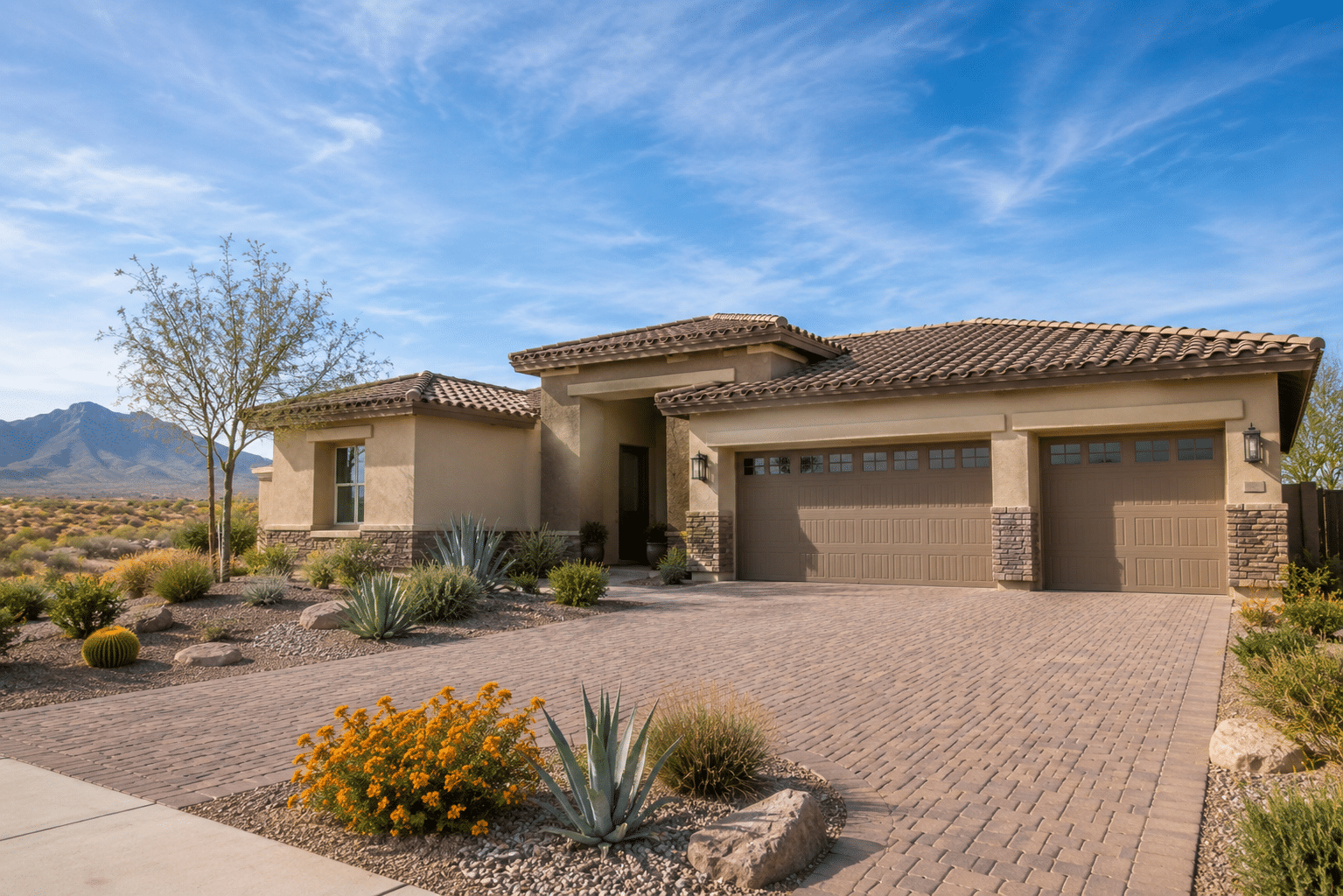
Active adult living is not a single product. The category contains at least five distinct archetypes, and most buyers find that one or two of them match their priorities while the others quietly drop off the list. Understanding the archetype taxonomy is the fastest way to narrow a search from forty candidate communities to a manageable shortlist of three to five.
The golf-anchored master plan is the foundational archetype. Sun City Grand built its reputation on three eighteen-hole golf courses woven through the residential footprint, with amenity buildings clustered around the course turns. Pebble Creek follows the same model with three Robson-managed courses and a similarly central amenity campus. Sun City Festival, Trilogy at Vistancia, and Sun City Anthem at Merrill Ranch all carry a golf-first identity. For buyers who play four or five days a week, the in-community course is more than a perk; it is the daily organizing principle of the home’s location, the floor plan, and even the choice between a corner lot and an interior lot.
Resort-style communities sometimes include golf, but the editorial center of gravity is the resort campus itself: oversize aquatic complexes, indoor and outdoor pools, demonstration kitchens, wine rooms, fitness centers with separate movement studios, and clubhouses sized for several hundred residents. Trilogy at Vistancia in Peoria and Trilogy at Encanterra in San Tan Valley are the cleanest examples of the type at the larger-footprint, higher-priced tier. Victory at Verrado in Buckeye delivers the same model at a slightly smaller scale with strong architectural detailing. The resort archetype tends to attract buyers who care more about the social calendar and the food-and-beverage program than the tee sheet.
The remaining three archetypes serve narrower audiences but matter to the overall map. Gated luxury communities, typified by Corte Bella Country Club near Sun City West and the boutique-scale Trilogy at Wickenburg Ranch in the high-desert Wickenburg corridor, prioritize architectural rigor, smaller home counts, and a higher entry price in exchange for restricted access and elevated finish levels. Browse the full subset through the Arizona gated 55+ neighborhoods guide. Condominium 55+ developments tend to appear inside or adjacent to the larger master plans rather than as standalone neighborhoods; they offer lock-the-door simplicity for buyers who travel for several months a year and have no interest in maintaining a yard. See the 55+ condominium guide for the current inventory. Manufactured-home 55+ parks, concentrated in Mesa, Apache Junction, and the older sections of the East Valley, remain the most affordable on-ramp into age-restricted living Province, the Meritage-built community in Maricopa, sits between archetypes and is worth a look for buyers who want resort amenities at a moderate entry price.

There is a recognizable amenity vocabulary across the category. Even buyers comparing communities at very different price points will see the same basic ingredients arranged in different proportions. Reading a community’s amenity map well takes some practice, and the easiest entry point is to separate recreation amenities from social and cultural amenities, then ask how much of each a community has actually built.
Pickleball has overtaken golf as the most-played activity in many Arizona 55+ communities. A flagship neighborhood now typically delivers between twelve and twenty-four dedicated pickleball courts, frequently lit for evening play. Resort-style pools are standard, often paired with a separate lap pool and a heated indoor pool for cooler months. Fitness centers in larger communities run between fifteen thousand and forty thousand square feet, with separate cardio, free-weight, and group-class spaces. Trail networks vary widely. PebbleCreek and Sun City Grand have extensive paved walking loops inside the gated footprint; Trilogy at Vistancia and Trilogy at Wickenburg Ranch back up to natural-surface trails along regional preserves.
The social and cultural layer is where larger communities pull ahead. Sun City Grand operates more than seventy resident clubs covering everything from quilting and woodworking to investment study and travel. PebbleCreek’s Tuscany Falls and Eagle’s Nest amenity campuses each host their own creative-arts buildings. Trilogy at Encanterra’s Algarve Spa and demonstration kitchen anchor a calendar of culinary events, wine pairings, and wellness programming. For buyers who plan to spend most of their indoor time on community grounds, the size of the clubhouse program is a closer match to long-term satisfaction than the size of the home itself. Smaller communities deliver the same categories at lower square-foot counts; the question is not whether a clubhouse exists but how much programming the membership generates.
A small group of national builders has dominated Arizona’s master-planned 55+ inventory for two decades, and their fingerprints are easy to read once a buyer has toured two or three communities. The builder shapes the floor plan library, the standard-versus-upgrade finish list, the warranty structure, and, to a meaningful degree, the long-term character of the homeowners association. The Arizona 55+ builder index covers the full roster.
Del Webb, the active-adult brand of Pulte Group, originated the Sun City model in 1960 and continues to operate the largest 55+ footprint in the state. Sun City Grand, Sun City Festival, Sun City Anthem at Merrill Ranch, Victory at Verrado, and the legacy Sun City and Sun City West neighborhoods all carry Del Webb’s identity. The brand favors a broad floor-plan library, a high standard-finish baseline, and a master-plan scale that supports multiple amenity campuses.
Robson Resort Communities, founded by Ed Robson, runs PebbleCreek in Goodyear and Sun Lakes south of Chandler and remains the only major builder in the state still operating golf-anchored 55+ communities as integrated resort properties. Robson tends to keep amenities under in-house management rather than outsourcing food, beverage, and recreation to third parties, which buyers either appreciate or find restrictive depending on their preferences.
Shea Homes’ Trilogy brand is the resort-style standard-bearer. Trilogy at Vistancia, Trilogy at Encanterra, Trilogy at Power Ranch, and the smaller, higher-priced Trilogy at Wickenburg Ranch share a design vocabulary built around demonstration kitchens, indoor-outdoor amenity transitions, and a calendar-driven social model. Floor plans run more contemporary than the Del Webb library, and pricing tends to skew higher.
Taylor Morrison participates through several smaller West Valley and East Valley communities and, through the CantaMia subsidiary at Estrella, operates one of the more design-forward smaller 55+ enclaves. Toll Brothers’ Regency series and a handful of additional regional builders fill the remaining tier, generally at higher price points and lower density than the Del Webb and Robson flagships.

Healthcare access is the single most overlooked variable in a 55+ home search. Buyers in their late fifties tend to weigh amenity quality first and rarely revisit the question of hospital proximity until a decade later, when it becomes urgent. The smarter move is to assess healthcare infrastructure during the original purchase, while drive times, specialist networks, and aging-in-place service availability can still steer the location decision.
Three hospital systems serve the bulk of the metro’s 55+ inventory. Banner Health operates Banner Boswell Medical Center in Sun City and Banner Del E. Webb Medical Center in Sun City West, both purpose-built around the original Del Webb retirement population. Banner Estrella Medical Center in west Phoenix and Banner Goldfield Medical Center near Apache Junction extend coverage into the West Valley and East Valley flanks. HonorHealth operates a network of hospitals across north Phoenix, Scottsdale, and the Deer Valley corridor, with Deer Valley Medical Center serving the Peoria and northwest Valley communities. Mayo Clinic Arizona, on the north Phoenix-Scottsdale border, draws buyers willing to relocate within driving range of its specialty hospital; many Trilogy at Vistancia and Sun City Grand residents factor Mayo’s specialty care into the original location decision.
Hospital proximity is the floor, not the ceiling. The aging-in-place layer matters even more for residents who plan to remain in their home for two decades or more. Most large master-planned communities now publish in-house wellness directories that include on-site physical therapy, partnerships with regional home-health agencies, and concierge medical services. PebbleCreek and Sun Lakes operate established wellness programs through their fitness campuses. Trilogy at Encanterra and Trilogy at Vistancia integrate wellness coaching into the resort campus. Buyers who anticipate caregiving needs, mobility changes, or single-level living requirements should confirm that any short-listed community offers a single-level floor-plan inventory and at least one paved-trail-and-no-steps route between the home and the primary clubhouse.

The published list price of an Arizona 55+ home is only one variable in the long-term cost equation. Homeowner association fees, capital reserve assessments, transfer fees, county property tax structures, and Arizona’s specific homeowner insurance environment together represent a second mortgage-sized line item over a fifteen-year hold. Buyers who model only the principal-and-interest payment will be surprised six months in.
Larger master-planned 55+ communities operate on multi-tier HOA structures. A master association covers the major amenity campuses, the gating infrastructure, and the common landscaping. Sub-associations cover individual product types, smaller condominium buildings, or specific clusters within the master plan. Monthly fees in the largest Arizona flagships range broadly: the lowest-fee Del Webb and Robson communities sit in the low hundreds, while Trilogy and gated luxury communities can exceed five hundred dollars a month once secondary fees are included. The fee itself matters less than what it covers. A higher fee that includes front-yard landscaping, exterior paint cycles, and roof reserve contributions is often a better long-term value than a lower fee that requires the homeowner to handle each line item separately.
Arizona’s property tax system is administered at the county level, with Maricopa County and Pinal County covering nearly every community profiled on this site. Effective rates are moderate by national standards, and Arizona offers a Senior Property Valuation Protection program for income-qualifying residents aged 65 and older. Homeowner insurance has tightened across the state over the past several years, with carriers adjusting wildfire exposure, hail risk, and roof-age underwriting. A roof more than fifteen years old can complicate a policy renewal, which is worth confirming during a resale-home inspection. The Arizona Department of Real Estate publishes consumer guidance on the resale process, including the public report and the seller’s property disclosure statement, which buyers should request and read carefully before any community-specific addendum is signed. The active adult buyer’s guide walks through the full closing checklist.
An active adult community is a residential neighborhood where age restriction is enforced under federal law, where homes are owned rather than rented as care units, and where amenities are programmed for adults who are still working, traveling, or running businesses from home. Residents drive themselves, prepare their own meals, and choose their own schedules. The community provides the infrastructure for an unhurried lifestyle, not personal care.
A 55+ community operates under the Housing for Older Persons Act of 1995, which requires that at least 80 percent of occupied units include one resident aged 55 or older. A 62+ community requires every resident to be at least 62 years old. The 62+ framework is uncommon among new-construction master plans in Arizona; almost every modern community covered on this site operates under the 55+ HOPA framework.
Most Arizona 55+ communities permit pets, with breed, weight, and quantity limits set by each community’s CC&Rs and HOA. Assistance animals are considered as a reasonable accommodation and are not subject to pet restrictions. Larger master-planned communities typically provide dog parks, paw-friendly trails, and on-site pet stations. Verify the specific pet policy at the community profile page before signing a contract, as rules vary by neighborhood and by sub-association within larger master plans.
Larger master-planned 55+ communities operate on multi-tier HOA structures. A master association covers the major amenity campuses, gating infrastructure, and common landscaping. Sub-associations cover individual product types or specific clusters within the master plan. Monthly fees range from the low hundreds to over five hundred dollars in resort-style and gated luxury communities. What the fee covers matters more than the dollar amount; a higher fee that includes front-yard landscaping and roof reserves is often a better long-term value
The Housing for Older Persons Act of 1995, commonly abbreviated as HOPA, is the federal law that permits residential communities to restrict residency by age when specific occupancy and verification rules are met. HOPA carves out an exemption from the familial-status protections of the Fair Housing Act. The most common framework is the 80/20 rule, which requires that at least 80 percent of occupied units include one resident aged 55 or older.
The Phoenix metropolitan area contains the densest concentration of 55+ inventory in the state. The northwest Valley, anchored by Sun City and Sun City West, holds the legacy cluster. Surprise, Goodyear, Buckeye, and Peoria carry the West Valley flagships. Sun Lakes, San Tan Valley, Queen Creek, and Gilbert anchor the East Valley. Florence and Maricopa serve the Pinal corridor, and Wickenburg holds the high-desert luxury enclaves.
We use cookies to improve your experience on our site. By using our site, you consent to cookies.
Manage your cookie preferences below:
Essential cookies enable basic functions and are necessary for the proper function of the website.
CloudFlare provides web performance and security solutions, enhancing site speed and protecting against threats.
Service URL: developers.cloudflare.com (opens in a new window)
Google Tag Manager simplifies the management of marketing tags on your website without code changes.
These cookies are used for managing login functionality on this website.
Statistics cookies collect information anonymously. This information helps us understand how visitors use our website.
Google Analytics is a powerful tool that tracks and analyzes website traffic for informed marketing decisions.
Service URL: policies.google.com (opens in a new window)
You can find more information about our Cookie Policy and Privacy Policy.