

Late afternoon at Ridgecrest reaches the ridge first. The sun crosses the Hieroglyphic Mountains to the west. Light shifts from copper to bronze across the rolling desert below. Lake Pleasant catches the last hour of glow on its eastern shore a few miles east of the gate. This is the quiet corner of metro Phoenix. Far enough north of Loop 303 that freeway lights are not visible after dark. Far enough off Vistancia Boulevard that the development pattern thins into desert washes and creosote flats. Ridgecrest is a boutique Shea Homes Trilogy community on this elevated stretch of north Peoria, smaller in scale than the larger Trilogy properties most buyers research first. Daily life here calibrates to that scale.
Buyers arrive at Ridgecrest after touring at least one of its larger sister properties, usually Trilogy at Vistancia a few miles south or Trilogy at Verde River across the metro to the northeast. What they often discover is that a smaller community can deliver the Trilogy lifestyle in a more concentrated form. The clubhouse sits within walking distance of every home. The activity calendar runs on resident-led energy rather than a thirty-page printed booklet. The trail systems open onto open desert rather than another phase of construction. This page walks through how the boutique scale shapes daily living, what the home product looks like, and where Ridgecrest sits on the north Peoria map. It also covers what owning at the community typically costs and how to plan a first visit.
The phrase “boutique Trilogy” is more than a marketing label at Ridgecrest. It describes a daily rhythm shaped by a smaller resident roster, a single primary amenity hub, and a setting that rewards walking and short drives over long shuttle routes. Residents often describe their first season as a recalibration. People who arrived from Trilogy at Power Ranch in Gilbert or from larger Del Webb properties in the West Valley typically find that the social geography here compresses. You see the same neighbors at morning coffee, at the pickleball courts on Tuesday afternoon, and at the weekend potluck on the patio. Faces become familiar within weeks, not seasons.
The compressed scale also shapes how residents structure activity. Larger communities can support dozens of clubs running in parallel because each club only needs a small share of the total population. Ridgecrest, at boutique size, operates differently. A handful of strong-pull activities form the spine of the calendar — pickleball, hiking, book group, wine evenings, occasional travel cohorts — and nearly everyone in the community participates in two or three of them. The result is a tighter social weave. Residents who prefer privacy can still find it here, since the desert setting and single-story footprints make for quiet streets, but the friendly default at Ridgecrest leans toward connection.
A common Ridgecrest day starts early. Walkers and cyclists head out before sunrise to take advantage of the cool desert air and the elevated desert ridges that open out in three directions. Mid-morning gravitates toward the clubhouse for coffee, mail, the morning workout class, or pickleball play. Afternoons split between errands run down toward the Loop 303 commercial corridor, time on the patio in shade, or a longer outing to Lake Pleasant for boating and shoreline walking. Evenings are quiet. The desert sky here is dark enough to see the Milky Way on most clear nights, a feature residents rarely take for granted.
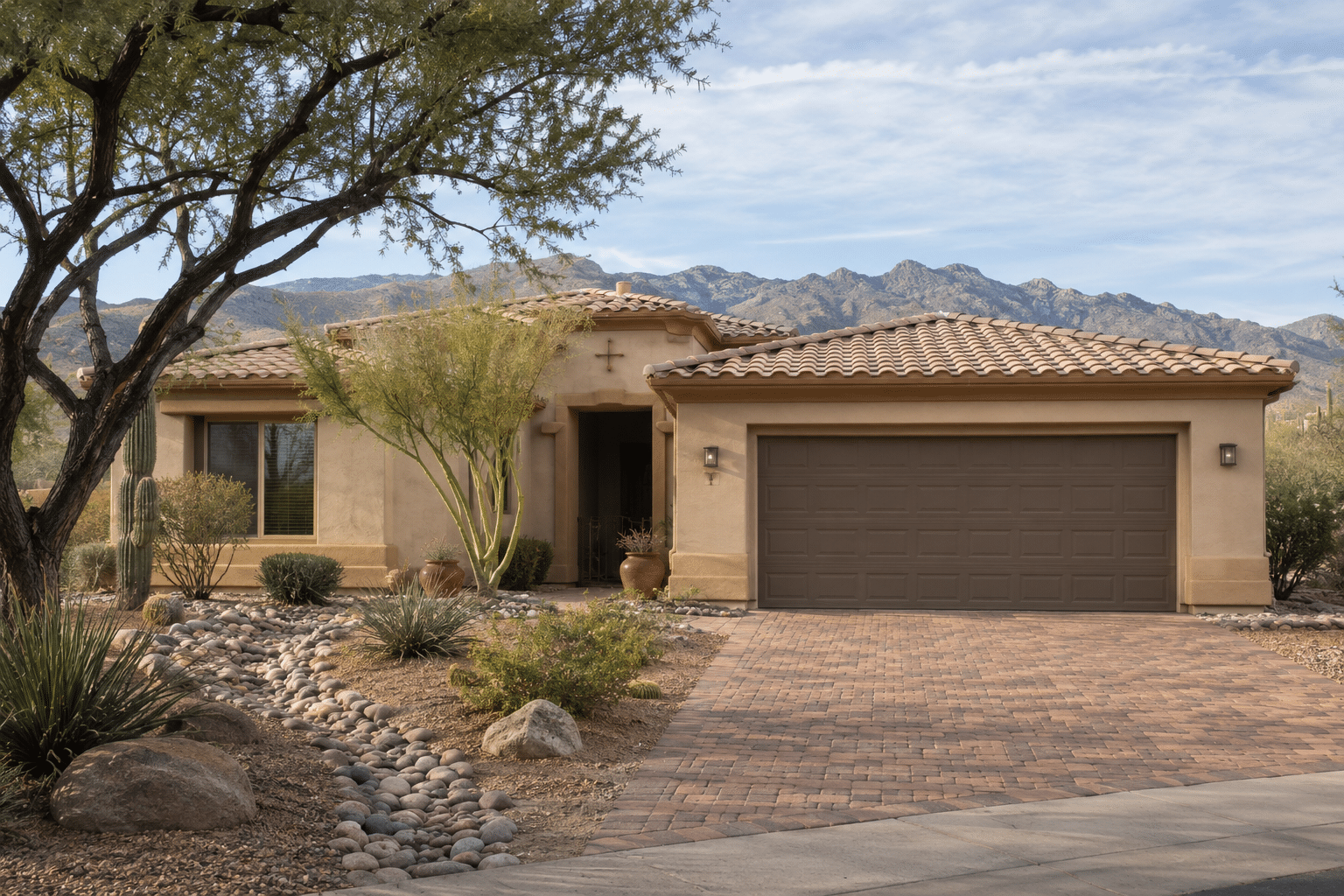
Shea Homes has shaped the Trilogy product across a quarter-century of refinement, and Ridgecrest reflects the brand’s mature design language. Specific floor plan names and exact square footages at Ridgecrest are not consistently published, so buyers should request the current plan sheet from the sales team. What is reliable is the design vocabulary buyers can expect when they walk a Ridgecrest model. Single-story layouts. Open kitchens that flow to a great room. A primary suite separated from secondary bedrooms for guest privacy. A dedicated study or flex room. A covered patio engineered for desert outdoor living. A two-car garage with an optional golf-cart bay or workshop bay where the lot allows.
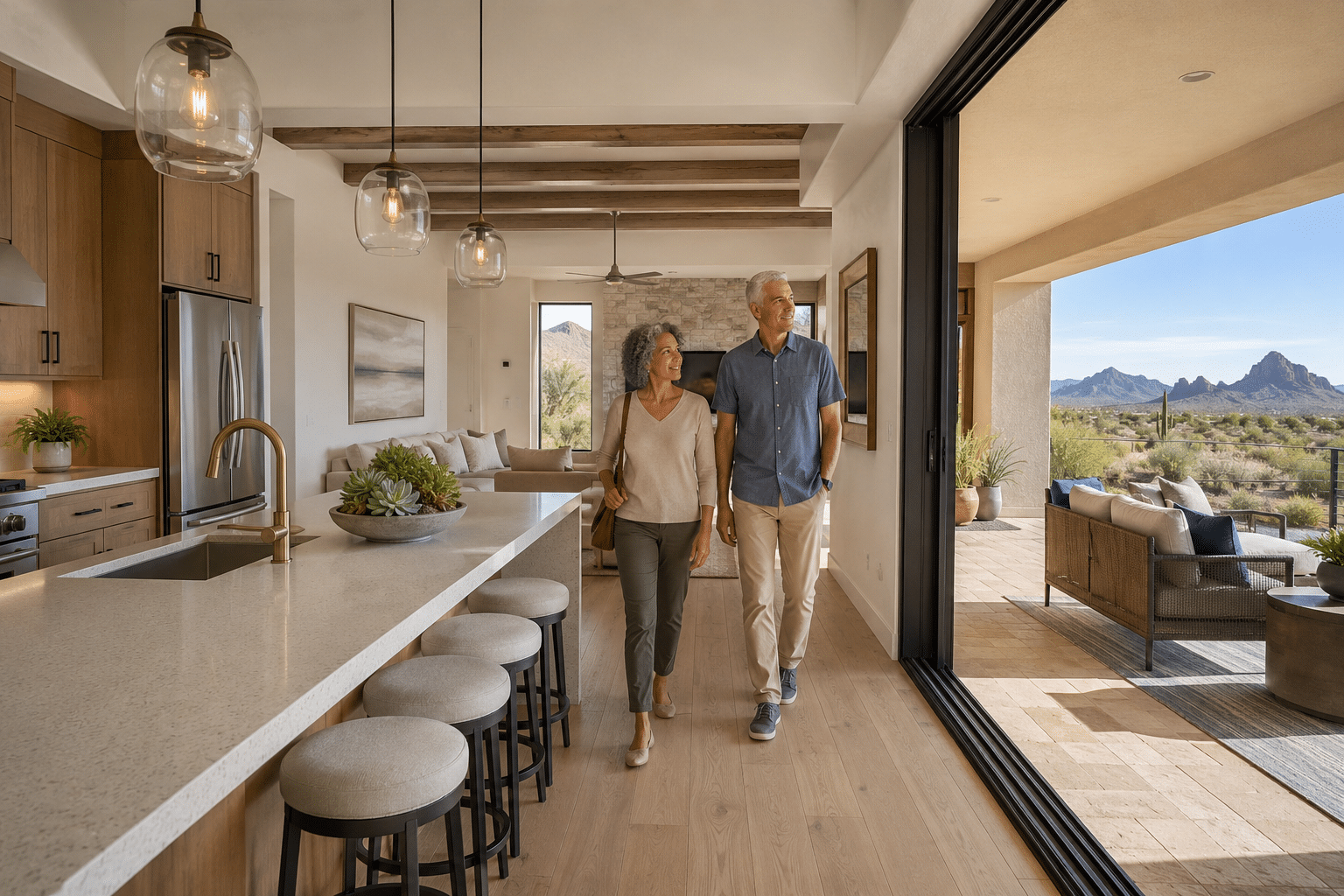
Ridgecrest home interiors follow the Trilogy emphasis on natural light, deep covered overhangs, and indoor-outdoor flow. Twelve-foot ceilings appear in great rooms on the larger plans. Sliding multi-panel patio doors are common upgrades. Kitchens center on islands with seating, and pantry placement gives priority to bulk storage for households that travel seasonally and load up on returns. Buyers comparing Ridgecrest to a Trilogy at Vistancia resale or to a newer Trilogy at Verde River build will find similar bones with different specific finishes by phase. Ridgecrest’s smaller footprint and elevated terrain produce a higher share of view-corridor lots than is typical for a flat-site Trilogy property, and lot premiums reflect that.
Most homes at Ridgecrest trade as resales rather than as new construction. Buyers should plan for variation in finish levels by build year and by previous-owner upgrade history. Several upgrades hold value through resale. The extended patio with built-in outdoor kitchen reads as a desert-living essential. The third-bay garage configured as a golf-cart or hobby bay carries a premium. The den-to-bedroom conversion serves households that host guests in winter. Quartz kitchen islands have largely replaced earlier granite installations on updated stock. Buyers who plan to remodel should budget realistically for desert-climate upgrades like reflective roof coatings and high-efficiency HVAC. Both materially reduce summer cooling costs across an Arizona ownership cycle.

Amenity programming at Ridgecrest concentrates around a single clubhouse complex rather than the dual or triple-clubhouse models found at larger Trilogy properties. That concentration is a feature, not a limitation. Residents walk to fitness, swim, courts, and gathering spaces from anywhere in the community, and the smaller social footprint means the spaces feel populated without ever feeling crowded. Specific square footages and exact court counts at Ridgecrest are not consistently published, and buyers should confirm during a site tour. The shape of the amenity program, however, follows the Trilogy template reliably.
The Ridgecrest clubhouse anchors morning, midday, and early-evening community life. A fitness room with cardio equipment, free weights, and stretching space typically opens early for residents who train before the heat. A movement studio supports yoga, Pilates, and aqua-fitness coordination with the pool deck. Casual gathering rooms host card play, book groups, mah jongg, and weekly social hours. A demonstration kitchen or catering space supports cooking nights and resident-hosted dinners. The clubhouse staff at a boutique Trilogy operates with a tighter ratio of programming per resident than larger properties can sustain. The practical effect is straightforward. Ad-hoc gatherings and short-notice events tend to get supported rather than scheduled into a queue.
Outdoor amenities at Ridgecrest typically include a resort-style pool with shaded lounge seating and a heated spa for cooler months. Pickleball courts drive much of the social calendar from October through April. Bocce courts host evening leagues during the cooler half of the year. Tennis is sometimes offered as a single court or multi-use surface depending on demand. The pool deck oriented toward the desert backdrop catches afternoon shade earlier than south-valley properties, an underrated comfort factor in summer programming.
The amenity that sets Ridgecrest apart from any Trilogy property in the metropolitan core is direct access to open desert. Walking and biking corridors connect the community to the surrounding Sonoran Preserve land and onward toward Lake Pleasant Regional Park. Residents routinely build a routine around morning trail walks of two to four miles before clubhouse hours. Boaters and lake users find the parking and launch facilities at Lake Pleasant a short drive away rather than a destination drive. The lake itself, the largest in the immediate Phoenix metro, supports a year-round boating, fishing, and shoreline-recreation community that gives Ridgecrest a recreational reach larger communities have to bus residents to.

The social architecture at Ridgecrest rewards residents who arrive ready to participate. Larger 55+ communities can absorb new buyers who prefer to lurk for a season before joining anything. A boutique property like Ridgecrest tends to surface newcomers faster, partly because the resident roster is smaller and partly because the welcome programming is intentionally personal. Most new residents report knowing fifty or more neighbors by name within their first six months, and many describe a tight inner social circle of ten to twenty households that anchors their week.
Charter clubs at Ridgecrest are resident-organized rather than activity-director-driven. Hiking groups, book groups, wine clubs, photography circles, women’s coffee, men’s coffee, and travel cohorts represent a typical lineup at a boutique Trilogy; ask the lifestyle staff for the current club list. Clubs at this scale rotate hosts by month, depend on shared volunteer effort, and generally avoid the formal committee structures common to thousand-home properties. The trade-off is straightforward: fewer specialty clubs at the very-narrow end of the interest spectrum, but a higher likelihood that the clubs that do exist are well-attended and welcoming.
Shea Homes operates Trilogy properties across multiple Arizona metros, and Ridgecrest residents can extend their social reach into the broader Trilogy network. Cross-property events let residents broaden their social and recreational horizon without changing addresses. Member visits to sister communities and shared programming reach Trilogy at Vistancia a few miles south, Trilogy at Power Ranch in Gilbert, and Trilogy at Verde River in Rio Verde. For seasonal residents, this network matters in a different way. The Trilogy lifestyle program acknowledges that buyers often own at one property and visit several others. It supports that pattern with reciprocity arrangements where the local rules allow.
The seasonal occupancy pattern at Ridgecrest deserves a fresh framing. Rather than treat the snowbird population as a separate cohort, the boutique community model integrates seasonal owners into the same calendar as full-time residents. Tax-structuring conversations — second-home filings, valuation protection eligibility for qualifying full-time owners, residency-establishment questions for buyers transitioning to permanent Arizona ownership — often surface in clubhouse conversations rather than in formal programming. Buyers from outside Arizona should plan to discuss residency timing and financial structure with a qualified Arizona tax professional rather than relying on community-circulated guidance.

Geography is the most defensible feature at Ridgecrest. The community sits on elevated terrain in the far northern reach of Peoria. Here the urban grid breaks up into desert preserve and lake recreation. The drive to Bradshaw Mountain country shortens dramatically compared to any flat-site West Valley community. Understanding Ridgecrest as a real estate decision requires reading three geographic layers. The immediate setting at the community gate. The Peoria municipal context that determines services and taxes. The regional drive-time map that frames where residents shop, fly, and seek medical care.
The immediate setting is high Sonoran desert. Native vegetation runs to creosote, bursage, palo verde, ironwood, and saguaro cactus on the rocky upslopes. The Hieroglyphic Mountains rise to the north and northwest. The southern view extends across rolling desert toward the suburban edge of Peoria. The eastern view drops toward Lake Pleasant and the dam infrastructure that created the lake. Late-summer monsoon storms reach this elevation with more drama than the lower valley sees, and winter mornings run several degrees cooler at this elevation than the central Phoenix basin. Residents typically wear a light layer at sunrise from late October through early March.
The road geometry connecting Ridgecrest to the rest of metro Phoenix runs through a small set of arterials. Vistancia Boulevard and Lake Pleasant Parkway form the primary connectors south to Happy Valley Road and onward to Loop 303 at the Lake Pleasant Parkway interchange. From Loop 303, residents reach Loop 101 in roughly fifteen minutes during off-peak hours, which puts the broader metro within a thirty-five to forty-five minute drive depending on destination. The Carefree Highway (AZ-74) provides an east-west alternative connecting the community to Cave Creek and the northeastern foothills without descending into the urban valley.
Day-to-day shopping and services concentrate at three nodes. The first is the Vistancia Marketplace and the broader Happy Valley commercial corridor a few miles south, which hosts grocery, pharmacy, urgent care, and casual dining. The second is the Arrowhead Towne Center area in Glendale-Peoria for larger shopping and the Park West open-air complex for dining. The third is downtown Surprise and Sun City West for established services. Most Ridgecrest residents settle into a rhythm of weekly errand runs to Happy Valley, monthly larger trips to Arrowhead, and quarterly outings down-valley to Phoenix or up to Sedona, Prescott, and Flagstaff.
Lake Pleasant Regional Park is the largest single recreational asset in the immediate Ridgecrest area. The park covers roughly twenty-three thousand acres of land and water. It supports boating, fishing, swimming, camping, and shoreline hiking. Seasonal events include sunset cruises, fishing tournaments, and shoreline volunteer days. Maricopa County Parks operates the park, and entry is straightforward by car from Lake Pleasant Parkway. Boating residents typically buy or rent a slip at one of the park’s two marinas. Non-boating residents use the park primarily for shoreline walking, sunset photography, and seasonal sandhill crane viewing in the wetland fringes.
The Hieroglyphic Mountains take their name from the petroglyph panels at Hieroglyphic Trail in the broader range. Those panels are a longer drive away, but the visible foothill ridges that frame Ridgecrest belong to the same geologic system and provide the dominant visual horizon from most homes in the community. Hiking and trail use in the Sonoran Preserve corridor west of Lake Pleasant supports a strong Ridgecrest hiking culture. Cyclists use the lower-traffic roads connecting the community to the lake and the Carefree Highway as a regular training loop.
For travel beyond the metro, Ridgecrest residents fly out of Phoenix Sky Harbor International Airport. Sky Harbor sits roughly a forty-five to fifty-five minute drive south depending on traffic and time of day. Phoenix-Mesa Gateway Airport in the East Valley is a longer drive and rarely the practical choice. Day trips to Sedona run roughly two hours via Interstate 17. The drive to Prescott takes about ninety minutes via the same corridor. Wickenburg sits closer to forty-five minutes northwest along US-60.

Medical access from Ridgecrest follows a layered model that residents tend to learn during their first year. Routine care happens at network primary-care offices along the Happy Valley corridor and within twenty minutes of the gate. Urgent care happens at network freestanding centers along Loop 303 and Bell Road. Hospital-level care happens at Northwest Valley anchor hospitals roughly twenty to thirty minutes away. Specialty care for heart, cancer, orthopedics, and other tertiary services happens at higher-acuity centers down-valley, with drive times in the forty to sixty-minute range. Residents who manage chronic conditions often build a small medical map of three to five providers across these tiers and then defend that map for years.
Routine and urgent-care anchors close to Ridgecrest include HonorHealth and Banner Health primary-care offices, freestanding urgent-care locations, and pharmacy-attached clinics along the Happy Valley and Loop 303 corridors. Buyers should map their preferred network at the time of purchase, since insurance accepted and provider rosters shift more often than the buildings do. Network preference is the most useful filter for new residents, and the local concentration of HonorHealth offices and Banner Health locations across the Northwest Valley gives residents real choice rather than a forced single-network outcome.
Specialty care for cardiology, orthopedics, and oncology typically requires a longer drive. Mayo Clinic Arizona at the Phoenix campus sits roughly forty-five to fifty-five minutes south depending on Loop 101 traffic. Many Ridgecrest residents establish a relationship there for high-acuity needs while keeping primary care closer. HonorHealth Sonoran Health and Emergency Center, HonorHealth Scottsdale Osborn, and Banner University Medical Center Phoenix represent the next tier of specialty access for residents who prefer not to travel north to Mayo. Residents without a tertiary-care need often discover that the community’s elevation and dry desert air support better daily wellness than they expected. That experience lowers the urgency of a tertiary relationship until specific health events require one.

The total cost of ownership at Ridgecrest sorts into three buckets. The first is acquisition: the resale purchase price plus any upfront capital contribution to the homeowners association at close. The second is HOA dues: the recurring assessment that funds amenity operations, common-area maintenance, and lifestyle programming. The third is carrying cost: property taxes, insurance, utilities, and any optional memberships or recurring services. Buyers from outside Arizona often underestimate the second and third buckets and overestimate the first.
Specific HOA dues at Ridgecrest are not consistently published in public sources and should be verified directly with the sales office or the most recent disclosure packet. Trilogy properties of similar boutique scale typically include in dues the clubhouse access, fitness center membership, pool maintenance, common-area landscaping, exterior road and lighting maintenance, and the activity-programming overhead. Some dues structures pass golf or other premium memberships through as separate optional fees rather than including them in the base assessment. Buyers should specifically ask whether the dues are quarterly, annual, or monthly, and whether any working capital contribution is collected at close.
Resale pricing at Ridgecrest moves with the broader north Peoria market and with view-corridor lot premiums specific to the community. Buyers should request a current market activity report from a 55+ specialist familiar with the property at the time of their search. Listing aggregator estimates can lag the real transaction picture. For a specific home’s property tax, look up the parcel on the Maricopa County Treasurer’s website. Arizona offers the Senior Property Valuation Protection Option for owner-occupants 65 and older who meet income and ownership-duration thresholds. Eligible owners can apply through the Maricopa County Assessor to freeze the limited property value used to compute most property tax components, which protects against valuation inflation across an ownership cycle. Pet policies at Ridgecrest follow standard Trilogy practice with reasonable limits set by the homeowners association and should be confirmed in the most current rules.
Ridgecrest is a 55-plus age-restricted community by Shea Homes under its Trilogy brand. At least one resident in each home must be 55 or older, with the remainder of household members typically 40 or older, in line with the federal Housing for Older Persons Act framework that Trilogy properties follow.
Specific HOA dues at Ridgecrest are not publicly listed and should be confirmed directly with the community. Trilogy properties of similar boutique scale typically structure dues to cover clubhouse access, exterior common areas, and lifestyle programming. Buyers should verify current dues, frequency, and inclusions during a sales appointment.
Pets are typically welcome at Trilogy communities, with reasonable limits set by the homeowners association. Assistance animals are considered as a reasonable accommodation and are not subject to pet restrictions. Buyers with pets should review the most current rules with the Ridgecrest sales team or association office to confirm species, count, and weight provisions before purchase.
Trilogy properties commonly feature controlled or gated entry points, and Ridgecrest sits in a quieter pocket of north Peoria where access pattern matters to residents. Confirm the current entry configuration directly with the sales office during your visit.
Ridgecrest residents draw on the Northwest Valley medical network. Routine and urgent care are accessible along the Loop 303 and Happy Valley Road corridors through HonorHealth and Banner Health locations, with specialty and tertiary care available farther down-valley at larger Phoenix and Scottsdale hospitals.
A first-visit plan to Ridgecrest works best as a deliberate half-day rather than a quick drive-by. The community is far enough from central Phoenix that visiting buyers benefit from arriving rested, planning the route in advance, and budgeting time for both the on-site walk and the surrounding context. Buyers who fly in from out of state typically book a midweek flight and drive directly from Sky Harbor up Loop 101 and Loop 303 to Lake Pleasant Parkway. The drive reaches the community in roughly an hour from the rental car counter. Buyers driving from Tucson or San Diego should plan a longer day. An overnight at a Peoria or Surprise hotel allows for an early-morning second look.
A same-day visit covers four things. The clubhouse tour. Two or three home walkthroughs across different floor plans and lot orientations. A resale inventory drive on the streets you would actually live on. A thirty-minute coffee with a 55+ specialist agent who has closed transactions at the community. A two-day visit adds three things. An afternoon at Lake Pleasant Regional Park tests the recreational reach. A drive to a network primary care office shows the practical commute. A second clubhouse visit at a different time of day reads the social rhythm rather than the empty-room version. Many buyers ultimately make their offer on the second visit rather than the first. For current prices, inventory and days on market in Ridgecrest Trilogy, see the market report linked on this page, which updates from ARMLS listing data. A 55+ specialist familiar with Ridgecrest can shape this two-pass cadence around your travel calendar.
We use cookies to improve your experience on our site. By using our site, you consent to cookies.
Manage your cookie preferences below:
Essential cookies enable basic functions and are necessary for the proper function of the website.
CloudFlare provides web performance and security solutions, enhancing site speed and protecting against threats.
Service URL: developers.cloudflare.com (opens in a new window)
Google Tag Manager simplifies the management of marketing tags on your website without code changes.
These cookies are used for managing login functionality on this website.
Statistics cookies collect information anonymously. This information helps us understand how visitors use our website.
Google Analytics is a powerful tool that tracks and analyzes website traffic for informed marketing decisions.
Service URL: policies.google.com (opens in a new window)
You can find more information about our Cookie Policy and Privacy Policy.