
Until this spring, the easiest way to dismiss Sun City Festival was to call it too far out. The Del Webb master-plan at Buckeye’s western edge stood thousands of homes deep on raw Sonoran desert. The White Tank Mountains were its closest meaningful neighbor. Buyers touring Pebble Creek in Goodyear or one of the Sun City properties along Bell Road would clock the I-10 mileage and quietly cross Festival off the list.
That objection had teeth through 2024. It no longer holds in 2026. The Verrado Marketplace opened ten miles south this spring, bringing Target, Safeway, Shake Shack, OHSO Brewery, and the Harkins BackLot cinema inside a fifteen-minute drive. The shopping argument that pushed West Valley buyers toward Surprise and Goodyear is now neutralized. What remains is the community itself — and the case for that has been quietly compounding for two decades.
Pulte broke ground at Sun City Festival in 2006, betting that Buckeye would grow west to meet the community by the time build-out arrived. That bet has largely played out. Festival is now well into the back half of its construction. Build-out targets approximately 7,200 homes, with final delivery projected for late 2027 or 2028 depending on Pulte’s release cadence.
The community sits in ZIP code 85396 at the foot of the White Tank Mountains, with Sun Valley Parkway running as the primary north-south spine. Terrain is genuinely flat. The sky reads wider here than anywhere else in the West Valley. Light pollution is minimal, and residents have organized actively to protect the dark-sky character of the back phases.
The community operates non-gated, though several individual neighborhoods inside the master plan maintain their own entry gates. Monthly HOA dues sit at approximately $175, typically billed quarterly. That fee covers access to both the Sage Center and the Senita Center, common-area desert landscaping, and the gate systems where they exist. Cost-conscious buyers reading Festival against PebbleCreek or The Grand in Surprise often note that the dues here run noticeably below comparable resort-style West Valley communities — a reflection of the smaller per-resident clubhouse footprint and Pulte’s still-active developer subsidy through final build-out.
Mornings at Festival generally begin at the Sage Center fitness floor, on the Copper Canyon driving range, or on a pickleball court. Lunch lands at the Indigo Grille or one of the small cafes around the Sage Center. Afternoons split between the woodshop, the studios at Senita, the pool deck, or a desert hike on the regional park trails to the south. Evenings trend social. The Indigo Grille functions as the community’s de facto living room, and the events calendar published through both centers keeps the Festival rhythm anchored without being prescriptive.
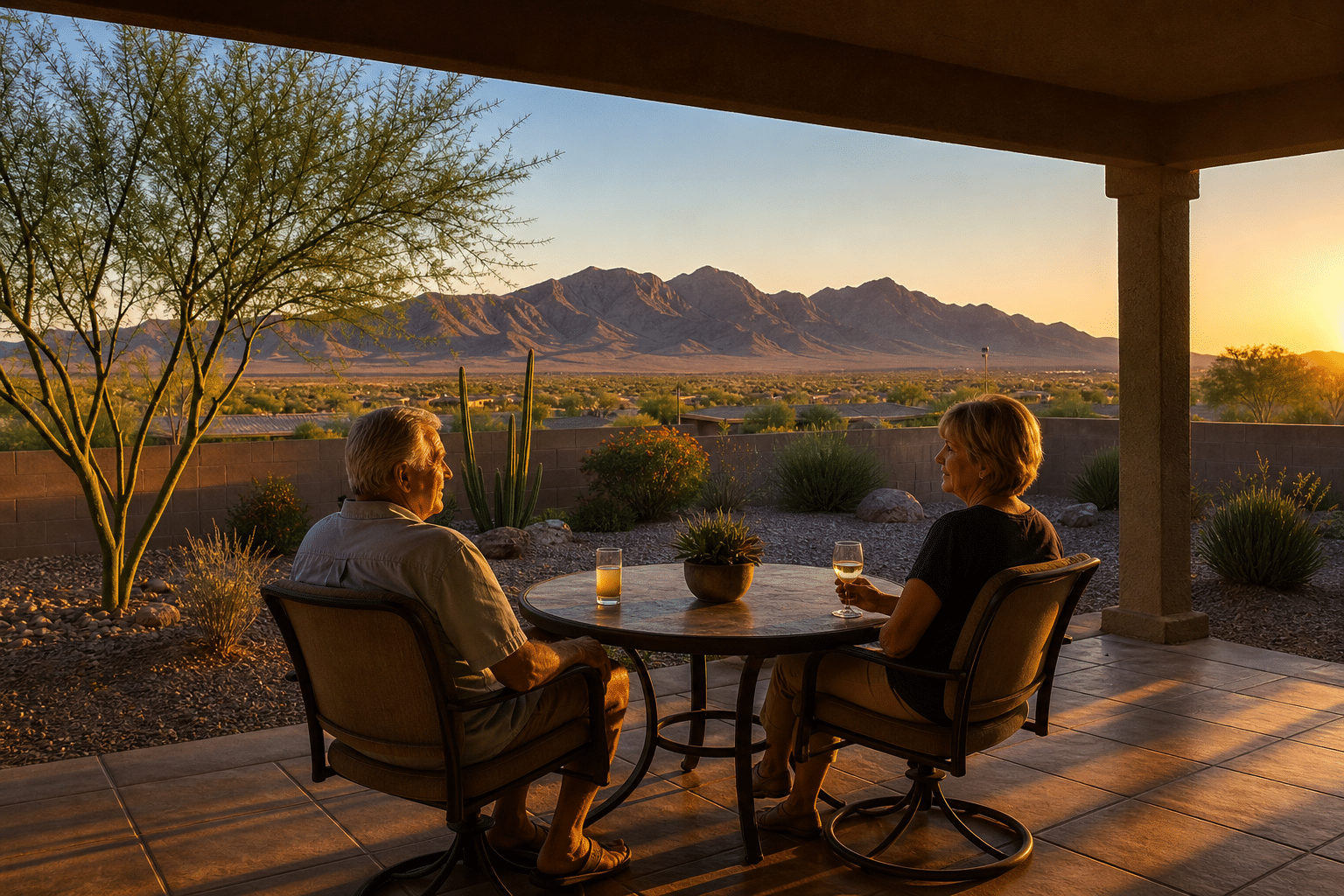
Festival’s housing stock is overwhelmingly single-story, age-in-place by design, and built around the three Pulte product tiers active at the community. The price spread is wide. As of April 2026, entry-level villas list from roughly $380,000, mid-tier homes settle in the high four hundreds to mid five hundreds, and premium custom builds on mountain-view lots have closed as high as $1.3 million.
The villa tier offers attached low-maintenance homes around 1,400 to 1,700 square feet, generally favored by snowbirds and lock-and-leave buyers. The Affirm and Enchant series sit in the middle of the lineup — detached single-story homes from roughly 1,800 to 2,400 square feet, usually two- to three-bedroom layouts with a flex room and a great-room core. These middle-tier homes are the most common transaction type at Festival and dominate the resale market.
The top of the market runs on lot premium. Homes backing the Mountain Nine of Copper Canyon or sited along the western edge with unobstructed White Tank Mountain views command meaningful upgrades over interior lots. Premium builds typically pair larger floor plans (2,800 to 3,400 square feet) with three-car garages, expanded patios, and upgraded interior packages. Both new-construction inventory and resale homes turn over here. The resale stream has matured enough that a 2018 owner relocating to a higher-elevation community can list an Affirm or Enchant the same week a Pulte release drops next door.
Most floor plans across all three tiers share a consistent design vocabulary: ten-foot ceilings in the great room, eight-foot interior doors, sliding glass walls onto the covered patio, and primary-suite layouts that separate the owner’s wing from guest bedrooms. Buyers walking the model homes at the Pulte sales center should pay attention to the patio orientation. North-facing patios extend usable outdoor hours through the summer; west-facing patios deliver the strongest mountain sightlines but bake from late spring through October.
Festival’s amenity footprint is built around two activity centers, a 27-hole golf complex, and a dedicated pickleball facility. The mix is deliberate. Pulte designed the community to give serious sport players, casual users, and arts-and-makers each their own anchor without forcing any one group through a single chokepoint clubhouse.
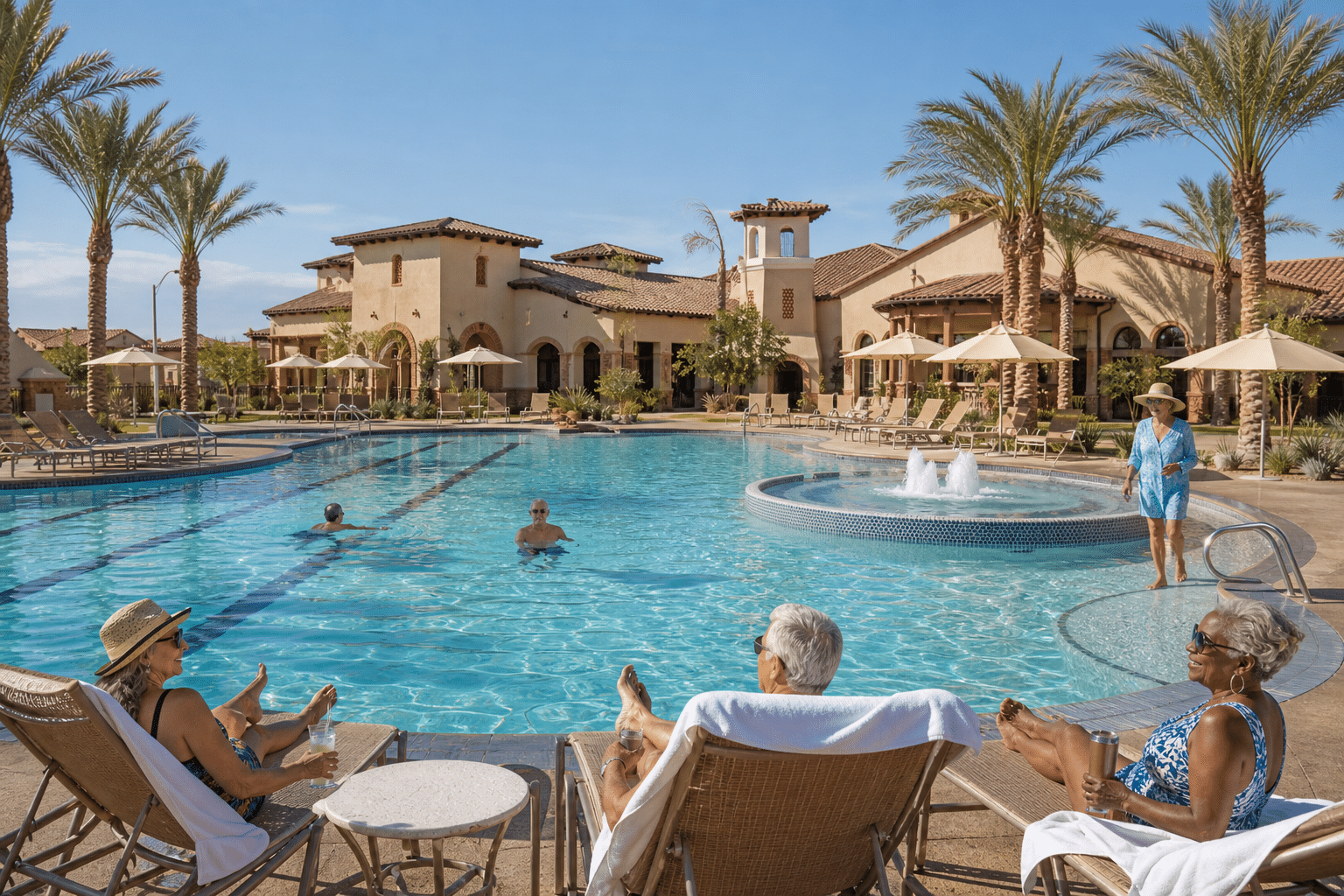
The Sage Center is the flagship. The 31,000-square-foot facility houses the resort-style pool, a fitness center with cardio and strength equipment, group exercise studios, and the Lifelong Learning Academy — a continuing-education program that runs cohort classes through the Festival calendar. The Oasis pool deck behind Sage hosts most of the community’s outdoor social life from October through April.
The Senita Center serves the makers and the cards-and-billiards crew. Its woodshop is among the most equipped 55+ shops in Arizona, with CNC machines, a high-end kiln in the adjacent ceramics studio, and dedicated bays for fine woodworking. The Players Club at Senita anchors the billiards and card programming. Residents who relocate here from the Pacific Northwest and the Midwest — two of Festival’s largest origin markets — consistently cite the Senita woodshop as a deciding factor in the tour-to-purchase journey.
Copper Canyon Golf Course is Troon-managed and runs three nines: Lake, Ridge, and Mountain. The Mountain Nine carries the most elevation change and the most striking sightlines, with several holes pressed up against the foothills. Resident play runs through the Indigo Pass program, which costs roughly $2,150 annually plus daily usage fees in the $39 peak-season range. Public guest play in the January-through-April window can reach $109 a round. The Indigo Grille at the clubhouse stays open through the day and pulls double duty as the social hub for golfers and non-golfers alike.

Sixteen dedicated pickleball courts at the central complex, an active softball field, and an events calendar that runs across both centers means newcomers rarely struggle to find their group. The trickier part for many residents is keeping the calendar from filling up.
The My Wine Club events held in rotation at the Indigo Grille are widely flagged by long-time residents as the fastest path to meeting the legacy crowd — the buyers who arrived in the 2008 to 2014 window and have built deep social roots. Resident-run clubs cover the predictable territory (golf leagues, pickleball ladders, book groups, photography, hiking) and a long tail of niche groups that surface and dissolve based on who is willing to organize. The softball league plays a competitive season on the on-site field, and the woodshop at Senita runs project cohorts that double as social tracks.
Phase 2, the section of Festival west of Sun Valley Parkway, runs noticeably quieter than the eastern phases closer to Sage. Through-traffic is lighter, the homes are newer, and the dark-sky character is most pronounced at this end of the community. Buyers who want full amenity access but a calmer street rhythm tend to gravitate here. The trade-off is a slightly longer drive to the centers and a thinner immediate-neighbor social mix in the still-building blocks.
The events calendar itself runs on a clear seasonal arc. The high season runs from October through April, when programming density peaks and most clubs hold their full schedule. May through September drops to a lighter rhythm, with indoor and early-morning programming taking over from the outdoor pool decks and tennis courts. New residents who arrive in November or December walk into a community at full velocity. Those who close in July or August get a quieter introduction and tend to spend the first season finding their pace before the calendar refills.

Festival’s 2026 location story is dominated by a single development: the Verrado Marketplace, which came fully online this spring along the I-10 corridor between Verrado Way and the master-plan’s southern edge.
The marketplace anchors include Target, Safeway, Shake Shack, OHSO Brewery and Distillery, the Harkins BackLot cinema-and-entertainment concept, and a roster of fast-casual restaurants and service retail that closes most of the daily-errand gaps that previously sent Festival residents to Surprise or to the Westgate Entertainment District. The drive from a typical Festival home runs ten to fifteen minutes depending on phase. That single change has more effect on the community’s ranking among West Valley buyers than any amenity addition the HOA could have made.
Beyond the immediate retail set, the I-10 spine south of Festival opens up the rest of Buckeye and Goodyear. The broader Goodyear 55+ corridor sits roughly 25 minutes east via I-10. Goodyear Civic Square, with its mixed-use anchor and Banner Health center, runs about 30 minutes. White Tank Mountain Regional Park is right at the community’s doorstep, with hiking, the Waterfall Trail, and the petroglyph viewing areas all within a ten-minute drive. Phoenix Sky Harbor International Airport runs about 50 minutes via I-10 — the one drive-time figure that buyers should weigh honestly, particularly travelers planning frequent flights.

Healthcare access from Sun City Festival operates in three concentric rings, and the buyer’s most useful question is not which hospital is closest but which ring of care matches the appointment.
The inner ring runs through Banner Health Center Verrado Way, roughly twelve minutes south of Festival along Sun Valley Parkway and Verrado Way. The center handles primary care, diagnostic imaging, and lab services — the routine touchpoints that account for most resident healthcare encounters. For Festival residents managing chronic conditions, this is the appointment they keep weekly or monthly. Banner Urgent Care locations along the same corridor cover after-hours and same-day needs at a similar drive radius.
The middle ring extends to Banner Del E. Webb Medical Center in Sun City West, roughly 25 minutes northeast. This is the West Valley’s primary cardiac and orthopedic referral hub for residents over 55, and most of Festival’s specialty appointments route here. Banner Estrella Medical Center in Goodyear runs at a similar radius for residents whose specialists practice on that side of the corridor. The outer ring — reserved for high-acuity work, oncology programs, and the deeper specialty tail — pushes into central Phoenix to Mayo Clinic Hospital and Banner University Medical Center, both at roughly 50 to 60 minutes via I-10. Most residents make the Mayo or Banner University drive a small handful of times a year for specialty consults, not weekly.
The wellness side of the equation runs through the Sage Center fitness program, the Lifelong Learning Academy’s health and aging cohort, and a resident-led culture of low-friction exercise that the master plan was designed around. The drive radius to formal medical care matters; the daily walk to the pool deck or the pickleball court matters more.
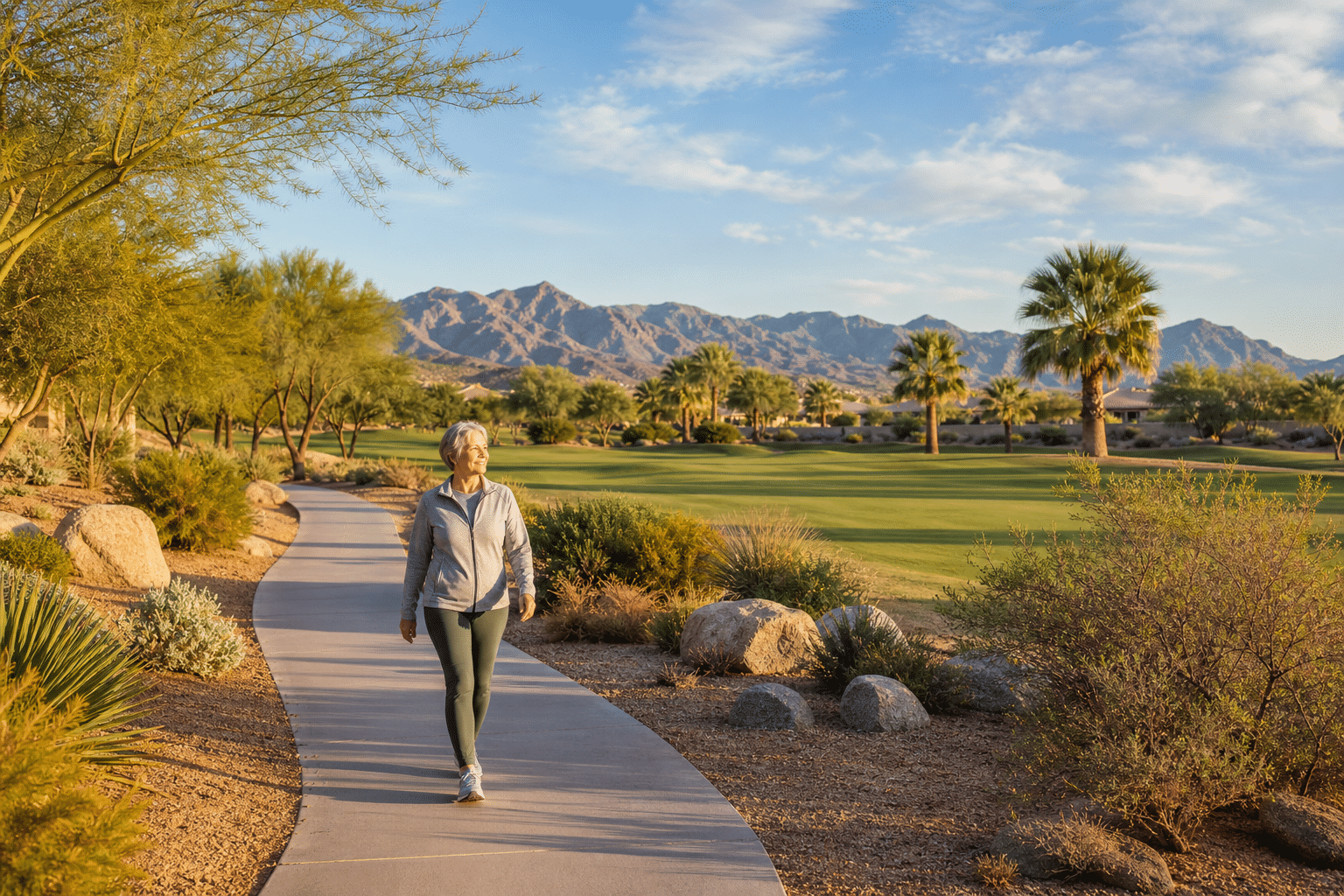
For a meaningful share of new Festival buyers, the community is not a retirement purchase — it is the back half of an equity-arbitrage move out of a higher-cost housing market.
The most common pattern Pulte’s sales team and local 55+ specialists describe runs from the Pacific Northwest. A Seattle or Portland seller closes out a long-tenured property at roughly $1.1 million, drops $650,000 into a high-spec Affirm or Enchant at Festival, and lands in Buckeye with a mortgage extinguished and several hundred thousand dollars freed for income generation, family transfers, or simply a deeper retirement runway. The same math runs in attenuated form from California, Colorado, and parts of the Midwest. It rarely runs in reverse.
The carrying-cost picture compounds the equity move. Arizona runs a flat 2.5 percent state income tax. Social Security retirement benefits are fully exempt at the state level. Buckeye’s effective property tax rate sits at approximately 0.85 percent of assessed value, considerably below the King County, Washington and Multnomah County, Oregon rates that PNW sellers are leaving behind. The Arizona Department of Revenue confirms a $2,500 state exclusion on federal, state, or local government pensions for the 2026 tax year. Stack the property tax differential, the pension exclusion, the Social Security exemption, and the $175 monthly HOA, and the all-in monthly cost of owning at Festival typically runs well below the seller’s previous primary residence — before the equity windfall is even deployed.
Worth noting: home prices and tax law change annually. Verify current property valuations through the Maricopa County Assessor’s office and current state tax positions before closing. The arbitrage is durable, but the specific numbers move.
Sun City Festival is an age-restricted community operating under the federal Housing for Older Persons Act. At least one resident in each home must be 55 or older, and no permanent resident may be under 19.
Monthly HOA dues at Sun City Festival are approximately $175, typically billed quarterly at $525. The fee covers access to the Sage Center, the Senita Center, and common-area desert landscaping. Confirm current figures with the community association before purchase.
Sun City Festival is pet-friendly within the standard guidelines for most Del Webb communities. Common rules include leash requirements, waste cleanup, and limits on the number of pets per household. Verify specific policies with the HOA before closing.
Sun City Festival operates as a non-gated master-planned community. Several individual neighborhoods inside the master plan maintain their own gates and entry control. The community as a whole is open-access through Sun Valley Parkway and the surrounding road grid.
Banner Health Center Verrado Way sits roughly 12 minutes south of the community for primary care, imaging, and lab services. Banner Del E. Webb Medical Center in Sun City West, about 25 minutes northeast, anchors higher-acuity cardiac and orthopedic care for residents.
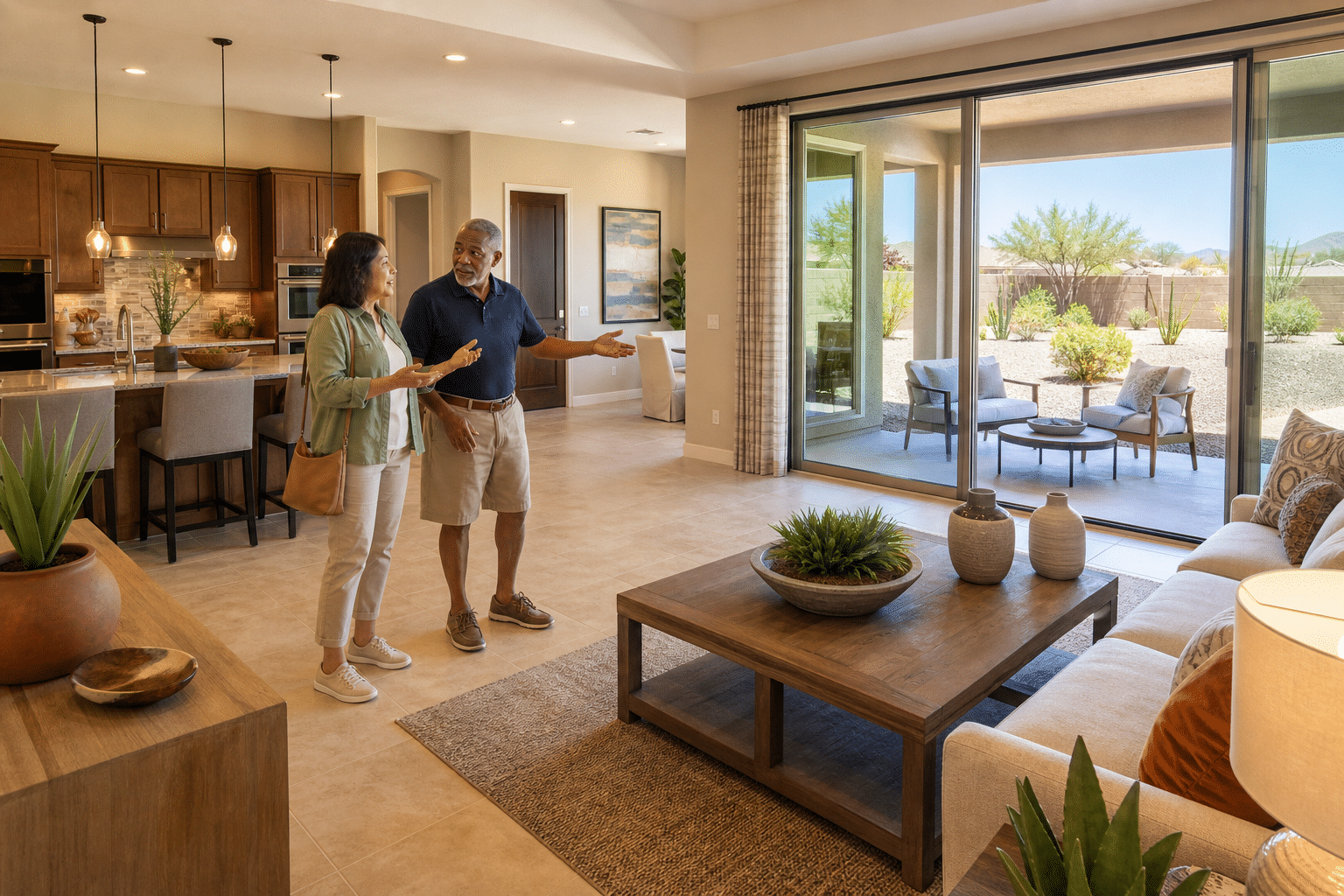
Most buyers who close at Festival do so after a structured two- or three-day visit, not a single drive-through. The community is large enough and the amenity footprint distributed enough that a half-day tour will miss what makes the place work. The itinerary that local 55+ specialists assemble for incoming buyers tends to follow a predictable arc.
Day one runs through orientation. Coffee and a first walk-through at the Sage Center, then a model-home tour with a Pulte agent or a resale walk with a specialist familiar with the active-adult corridor. Lunch at the Indigo Grille, where most residents will quietly answer real questions if asked. Late afternoon at the Senita Center — the woodshop in particular — to meet the makers and to test whether the community’s social texture matches the buyer’s idea of what retirement should feel like.
Day two is for the amenity test. Eighteen holes at Copper Canyon (Mountain or Ridge nines if available), a pickleball clinic at the sixteen-court complex, and an early-evening cocktail at the Oasis pool deck. Day three is reserved for the geography. A morning drive through the Verrado Marketplace, a slow loop through Phase 2 to see the quieter side of the community and the dark-sky views, and an unhurried look at three or four resale listings to anchor pricing against new construction.
Buyers comparing Festival against Trilogy at Wickenburg Ranch or Sun City Anthem at Merrill Ranch are evaluating three different far-edge masterplans, each with its own logic. A 55+ specialist with active experience in the Buckeye 55+ corridor and the broader West Valley active adult market can frame the trade-offs without selling against a competitor. The right next step is a phone consultation followed by a calendar block for the multi-day visit. The Festival case is best made on the ground — the I-10 drive, the Sage Center, the Mountain Nine, and the Verrado Marketplace, in that order.
We use cookies to improve your experience on our site. By using our site, you consent to cookies.
Manage your cookie preferences below:
Essential cookies enable basic functions and are necessary for the proper function of the website.
CloudFlare provides web performance and security solutions, enhancing site speed and protecting against threats.
Service URL: developers.cloudflare.com (opens in a new window)
Google Tag Manager simplifies the management of marketing tags on your website without code changes.
These cookies are used for managing login functionality on this website.
Statistics cookies collect information anonymously. This information helps us understand how visitors use our website.
Google Analytics is a powerful tool that tracks and analyzes website traffic for informed marketing decisions.
Service URL: policies.google.com (opens in a new window)
You can find more information about our Cookie Policy and Privacy Policy.