

The day starts at the first tee. A foursome rolls up in carts at six forty-five for a seven o’clock shotgun, the air still cool from the overnight low, the eastern horizon holding its dawn shadow above the eighteenth green. By eleven the round is in. Lunch is on the patio outside the on-site bistro. The afternoon is open to whatever the calendar holds — pickleball ladder play, a stained-glass workshop, a card tournament in the recreation center. Then the dinner sitting fills the dining room, and an evening cards game replaces the late-afternoon swim.
This is the rhythm Sunland Village East was built for, starting in 1985. Farnsworth Homes followed up the original Sunland Village across town with a 1,341-home Mesa 55+ golf community organized around an executive course rather than a performance auditorium. The two communities share a developer surname and a Mesa ZIP corridor. They were designed for different days. Sunland Village East was built so the course came first, the calendar second, and the rest of life arranged itself in walking distance of both.
A practical way to read Sunland Village East is to picture the executive course as the floor plan of the community. Streets fan around the fairways. The clubhouse, the recreation center, and the bistro all sit within a short cart ride of the first tee. Most residents who play do so in standing weekly groups — men’s leagues, ladies’ leagues, mixed couples on the weekends, and member-guest events twice a year. The rhythm of those groups sets the rhythm of the broader community calendar. A morning tee time creates an afternoon lunch table and, more often than not, a Friday dinner reservation.
That golf-led rhythm distinguishes Sunland Village East from its older sister community, where an auditorium and a performing-arts calendar do similar organizing work. Both models produce a high-engagement weekly schedule. They simply produce it through different doors. Sunland Village East residents who do not play golf still walk the cart paths in the early evening. They swim in the heated pool, sit in on bridge nights, take a shift in the woodshop, or join one of the charter clubs that meets in the recreation center. The community is small enough that newer residents can know most of their neighbors within a season. It is large enough that the calendar is full year-round.
The executive course is what most first-time visitors see before they see anything else, and it is what most residents reference first when they describe the community to a friend. A short loop, walkable for a fit golfer, par 60 across 18 holes — it suits an active retirement population that wants to play three times a week without spending five hours doing it. That tempo is the through-thread of the Sunland Village East proposition.

Unlike the original Sunland Village — which mixes single-family homes with mid-rise condominium towers and attached townhomes — Sunland Village East is a single-product community. All 1,341 homes are detached single-family residences, almost entirely single-story, built across roughly four years between 1985 and 1989. That uniformity is one of its quiet selling points.
A buyer touring the streets for the first time sees a coherent neighborhood scale. There is no stack of competing housing types pulling the eye. A resident moving from a larger home elsewhere in the country can buy in once and not face the renovation choices of a multi-decade community.
Floor plans range broadly across Farnsworth’s late-1980s design book. Smaller two-bedroom patio homes with attached two-car garages anchor the entry-level inventory. Larger three-bedroom plans with den or office options sit at the upper end of the original price points. Most homes use stucco exteriors with concrete tile roofs, low-pitched rooflines that catch less wind than steeper Northwest profiles, and covered back patios that open to landscaped yards or, in golf-frontage homes, directly to the course rough. Garage-attached configurations include the now-standard Sunland-region golf-cart bay alongside two car spaces.
Resale is the entire market here. The community completed build-out in the late 1980s, which means a buyer in 2026 is shopping a four-decade-old housing stock that has been variously updated, gut-renovated, or held in original-finish condition. That spread is itself part of the value proposition: a buyer who wants to renovate to taste can find a candidate; a buyer who wants move-in-ready will pay a premium for a fully refreshed kitchen and primary bath. For current prices, inventory and days on market in Sunland Village East, see the market report linked on this page, which updates from ARMLS listing data.
Buyers comparing single-product housing at Sunland Village East against multi-product communities should walk both before deciding. The original Sunland Village across Mesa mixes towers, villas, and single-family homes on one assessment. Sun Lakes in Chandler runs a five-village country-club model that operates closer to a private club than to a single HOA.

The amenity package at Sunland Village East is concentrated in a tight central campus that residents reach in minutes from anywhere on the property. The on-site executive golf course is the largest feature. The recreation center, swimming pool deck, and bistro sit adjacent to one another, which means a typical post-round morning includes a steam shower, a swim, and lunch in roughly the order a resident chooses to take them. The compactness of the amenity layout is not accidental — Farnsworth designed it so a resident could leave the car in the driveway for days at a time.
The course favors precision over distance, with shorter par 3s and modest par 4s sized to a walking pace. Greens fees for residents are bundled into membership options, and resident play volume runs heaviest October through April when overseeded winter rye gives the fairways their lushest playing surface. Many residents time their seasonal travel around that window: leaving Mesa for cooler ground in the high-summer Bermuda months and returning when the course transitions back to rye. That seasonal-course-condition rhythm is its own form of snowbird scheduling, distinct from the calendars of communities where the social hub is indoors year-round.
Inside the recreation center, residents find a fitness space, group exercise studios, card and game rooms, hobby spaces including ceramics and woodworking, a library, and meeting rooms for the charter clubs. The outdoor amenity deck typically includes a heated swimming pool, a separate spa, and a sun deck. Pickleball courts sit alongside tennis courts and shuffleboard pads, with the pickleball footprint expanded over the years as the sport grew across Arizona 55+ communities. Bocce, horseshoes, and a putting green round out the active-amenity surface.
The on-site restaurant addresses what older Mesa 55+ communities call the “drive-off problem” — the tendency of residents to leave the community for every meal and, in doing so, lose the small daily contact points that build neighborhood familiarity. A bistro inside the gates anchors lunch and dinner traffic, hosts league dinners and birthdays, and gives a returning snowbird family a place to bring grandchildren without leaving the property. Buyers used to the on-site restaurant model will recognize the pattern from communities like Trilogy at Power Ranch in Gilbert, where a similar dining footprint anchors the central campus.
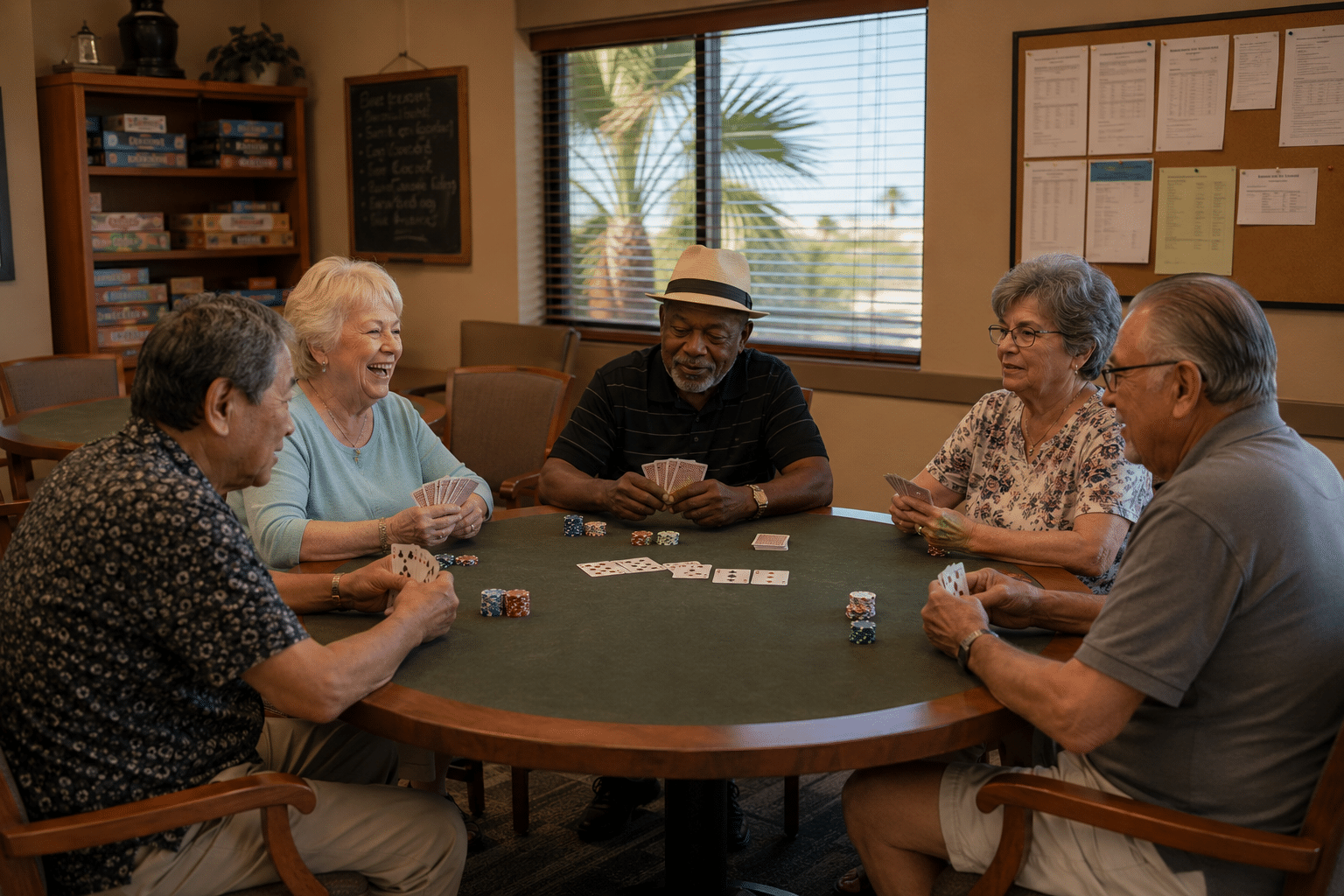
The social calendar at Sunland Village East runs on charter clubs and tournament play, with the weekly recreation schedule layered on top. Charter clubs are the formal organizing units — groups of residents that elect officers, run their own budgets, and maintain their meeting rooms. The active club roster typically covers cards (bridge, pinochle, euchre, hand-and-foot, mah jongg), needle and fiber arts, woodworking, lapidary, ceramics, ballroom and line dancing, photography, computers, and seasonal interest groups that come and go with resident leadership.
Golf tournaments are the largest scheduled events on the calendar. The men’s and women’s clubs each run a full season of weekly play, plus quarterly member-guest events and an annual championship that fills the course. Pickleball ladders run continuously with seasonal championship brackets. Tennis, while smaller in headcount, still maintains a regular ladder. Card tournaments rotate through bridge, euchre, and mah jongg; the most established tables have run for decades and absorb new members on rolling waitlists.
The indoor spaces inside the recreation center carry the calendar through the hottest months. Woodshop members produce finished cabinetry, toys for charity drives, and turned bowls that move through resident gift exchanges. Lapidary sets up cabbing and silversmithing benches. Ceramics fires twice weekly. Watercolor and oil-painting groups share studio time. The library hosts book clubs in three or four genres. None of these schedules is static — residents take over the running of any club they want to lead, and the menu adjusts each year based on volunteer hours.
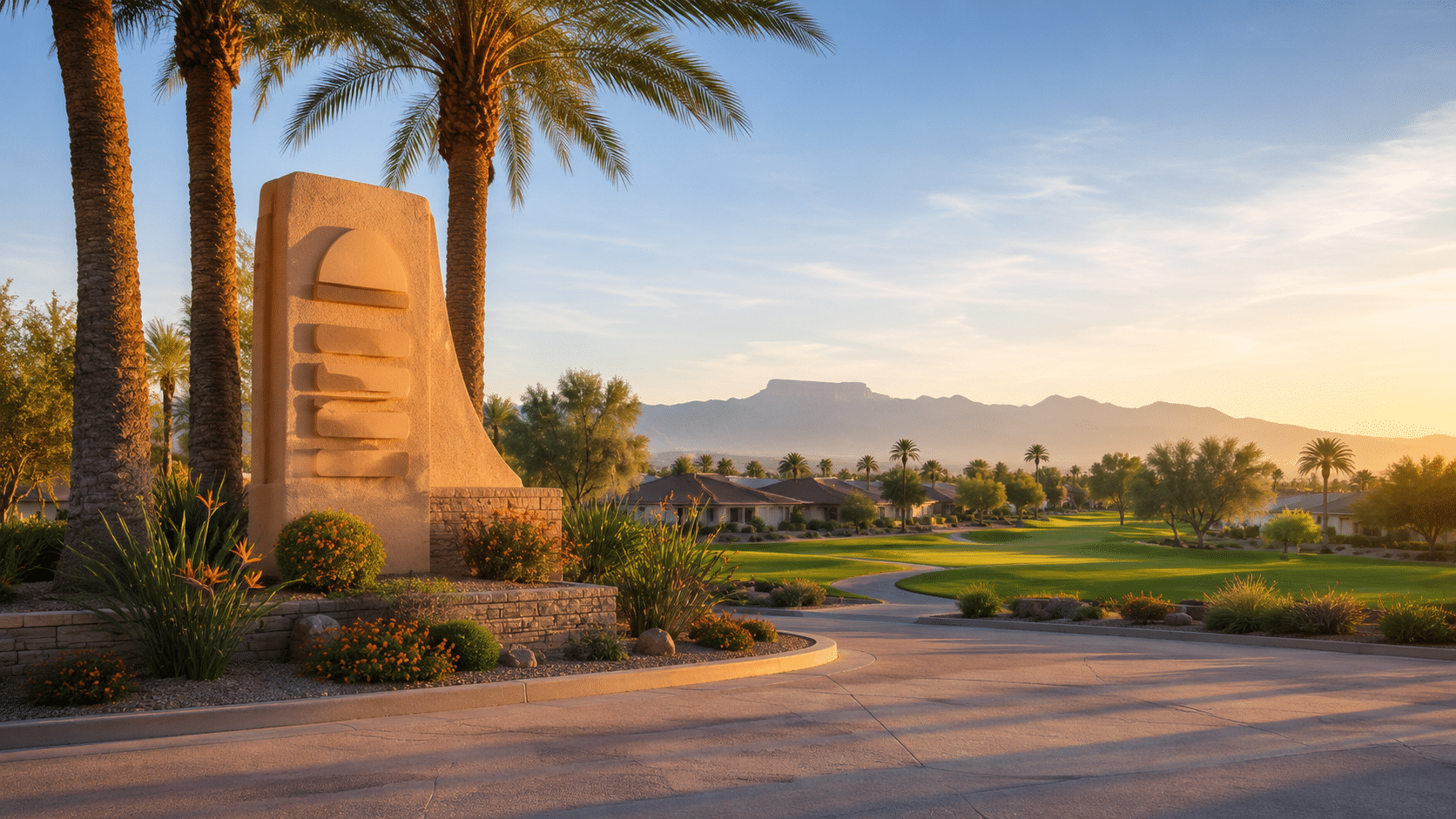
Sunland Village East occupies a southeast Mesa pocket bounded by Baseline Road on the south, Farnsworth Drive on the west, and the city’s mature suburban grid on its other sides. The 85209 ZIP corridor in which it sits has filled in steadily since the community broke ground. Shopping has clustered along Power Road. Dining lines Baseline. Established medical office buildings sit within a five-minute drive. Residents today live in a more walkable and service-rich pocket than the original 1985 site plan anticipated.
Buyers comparing southeast-Mesa addresses against other Mesa 55+ communities often find that this pocket sits closer to daily-errand infrastructure than the central-Mesa or far-east-Mesa alternatives.
Travel logistics favor the southeast Mesa address in two specific ways. Phoenix-Mesa Gateway Airport sits roughly 10 to 12 minutes south. It is served by Allegiant Air, Sun Country, and a rotating mix of low-cost carriers. Those routes make seasonal travel to the upper Midwest, Pacific Northwest, and Mountain West materially cheaper than the equivalent Sky Harbor itineraries.
Sky Harbor itself is roughly a 25- to 30-minute drive west via the US-60 Superstition Freeway and the Loop 202. The 60 is the workhorse for daily errands; the Santan freeway loop handles longer trips into Chandler, Gilbert, and the south-Phoenix corridor without crossing the central city. Power Road and Recker Road carry north-south traffic toward the Loop 202 Red Mountain segment that connects to Scottsdale and the northern East Valley.
Sunland Village East’s healthcare position is best framed as an urgent-care-first geography. An active golf community produces predictable patterns of routine and minor-injury care — twisted ankles, sun exposure, dehydration, occasional cardiac evaluations during summer swings — and the local provider network has grown to match. Same-day urgent care along Power Road, Higley Road, and Baseline Road sits within a five- to ten-minute drive of any home in the community. That density of first-line care is the practical infrastructure most residents engage with monthly, and it is the layer that determines how a routine medical event actually unfolds.
Banner Goldfield Medical Center sits east on US-60 and serves as a community-hospital anchor for the southeast Mesa and Apache Junction populations. Mountain Vista Medical Center is roughly four miles north on Recker and is the closest acute-care facility for the Sunland Village East address. Banner Heart Hospital in central Mesa picks up cardiac-specialty cases. Banner and Dignity urgent-care locations are scattered along Power Road, Baseline Road, and Higley Road, and most residents cycle through the closest one for after-hours respiratory infections, joint sprains, and routine evaluations. Primary-care offices in the Power Road and Recker Road professional buildings take new patients on a rolling basis.
For specialty conditions, the East Valley network reaches further. Banner University Medical Center Phoenix, Mayo Clinic Hospital in north Phoenix, and the surgical and oncology specialty centers of the Phoenix metro sit within a 30- to 45-minute drive depending on freeway conditions. Most residents structure their care so that frequent visits stay close to home and rare-but-major appointments are scheduled during off-peak driving hours. The geography rewards a buyer who plans the rings of care as a hierarchy rather than a single hospital choice.

The Sunland Village East cost picture has three components: the resale home price, the annual community assessment, and the optional golf membership. Each is independent of the others. A buyer who does not play golf can live at Sunland Village East at a meaningfully lower carrying cost than a buyer who joins the men’s or ladies’ golf club for the full season.
Resale prices in Sunland Village East respond to three main variables: home size, condition, and golf-frontage exposure. Smaller two-bedroom plans in original-finish condition occupy the lower end of the inventory band. Larger three-bedroom homes with renovated kitchens and primary bathrooms, lot upgrades, and views over the course command the upper end.
The annual community assessment funds the recreation center, the pools, the pickleball and tennis courts, ground maintenance for common areas, and reserve contributions for the long-term capital plan. Confirm the current figure with the HOA office before any offer; the budget cycle moves the number modestly each year, and the published amount is the only one that should anchor a financial plan.
Golf membership is optional and structured separately. Trail fees, cart fees, and seasonal play packages are priced a la carte. The total carrying cost for a non-golfing single-family home buyer typically falls well below comparable amenitized 55+ communities in Gilbert and Chandler, while a fully-bundled golf household pays in line with the East Valley golf-community average. Read through the Arizona 55+ HOA fee comparison guide before signing anything; the line items vary by community in ways that are not always obvious from the headline number.
Sunland Village East is a 55+ age-restricted community operating under federal Housing for Older Persons Act guidelines. At least one occupant of each home must be 55 or older, and all permanent residents must meet community age policies.
Sunland Village East charges an annual community assessment. HOA dues vary by sub-association; confirm current fees with the association or in the HOA disclosure during escrow. Specific dues figures move with the budget cycle, so confirm current numbers with the HOA office before any offer.
Sunland Village East permits dogs and cats under standard community pet rules, with limits on the number of animals per household. Assistance animals are considered as a reasonable accommodation and are not subject to pet restrictions. Specific weight and breed policies are documented in the HOA covenants.
Sunland Village East is not gated. The community uses a perimeter-wall model with public street access, typical of mid-1980s Farnsworth-built Mesa neighborhoods.
Sunland Village East sits within a short drive of Mountain Vista Medical Center on Power Road, Banner Goldfield Medical Center east on US-60, and a dense cluster of Banner and Dignity Health urgent-care locations across southeast Mesa and the Power Road corridor.

The most efficient way to learn whether Sunland Village East fits your retirement is to walk the executive course before stepping inside any home. The course is the community’s organizing principle. A forty-minute walk along the cart paths — not a round, just a walk — communicates the scale, the housing density, the resident demographic, and the daily tempo more quickly than any model home can. After the walk, a stop at the recreation center and a lunch at the on-site bistro fills in the indoor amenity layer and the social fabric. Touring two or three resale listings afterward gives the buying decision a concrete anchor.
When you call the Sunland Village East HOA office, ask for the current annual assessment, the optional golf membership tiers, the published charter-club roster, and the most recent reserve study summary. Ask which streets in the community currently have the highest resale activity. Drive the perimeter loop on Farnsworth Drive and the interior streets on a weekday morning when the social calendar is most visible. Walk the course one more time. Eat lunch at the bistro.
Read the City of Mesa services page, the ADOT corridor advisories for any planned freeway work along the US-60 and the Loop 202 Santan, and the Phoenix-Mesa Gateway Airport route map. If the community fits the rhythm of the life you want, the next steps unfold naturally from there.
Compare the experience with the original Sunland Village page across town, browse the full Mesa 55+ community index, or step out to the wider Arizona 55+ communities directory before scheduling your tour.
We use cookies to improve your experience on our site. By using our site, you consent to cookies.
Manage your cookie preferences below:
Essential cookies enable basic functions and are necessary for the proper function of the website.
CloudFlare provides web performance and security solutions, enhancing site speed and protecting against threats.
Service URL: developers.cloudflare.com (opens in a new window)
Google Tag Manager simplifies the management of marketing tags on your website without code changes.
These cookies are used for managing login functionality on this website.
Statistics cookies collect information anonymously. This information helps us understand how visitors use our website.
Google Analytics is a powerful tool that tracks and analyzes website traffic for informed marketing decisions.
Service URL: policies.google.com (opens in a new window)
You can find more information about our Cookie Policy and Privacy Policy.