

Three communities share the Rio Verde valley, and they are not interchangeable. The original Rio Verde Country Club opened in 1973 with 980 properties and Tom Lehman-designed golf at Quail Run and White Wing. Trilogy at Verde River, the youngest of the three, brought Shea’s resort-style template to the foothills in 2015 with the Verde River Golf and Social Club. Between them, opened in 1992 and built out across 695 acres, sits Tonto Verde — 717 homes, two championship courses by Gary Panks and David Graham, a 26,000-square-foot clubhouse, and one of Arizona’s only 18-hole natural-grass putting courses. The three communities share a post office and a private water utility. They diverge sharply in feel, in scale, and in the kind of golf and country-club culture each one supports. This page is a working tour of the middle community: how Tonto Verde reads on the ground, how its custom homes and Blue Sky patio homes differ, what the Peaks and Ranch courses ask of a player, the social calendar that fills out the rest of the week, the drive into Fountain Hills and Scottsdale for everything not on-site, and what a typical owner’s annual carry actually looks like.
Tonto Verde occupies the middle position in the Rio Verde valley. The community sits on gently sloping terrain at the eastern edge of the McDowell Mountain ridgeline, with the high-desert plain opening eastward toward the Mazatzal Mountains and Four Peaks on the horizon. The community’s 695 acres hold 517 single-family custom homes and 200 attached townhomes inside a gated boundary, set against the 2.9 million-acre Tonto National Forest at the community’s back fence.
The footprint reads larger than its 717-home count suggests. Lots run generously sized, the two-course golf complex stretches across a meaningful slice of the acreage, and the natural-grass putting course adds another open expanse that defines the central part of the community. Homes at Tonto Verde range from approximately 1,400 square feet at the smaller townhome end to over 4,000 square feet on the largest custom estates. Most owners are second-home or full-time retirees in their 60s and 70s.
The shared infrastructure across the three Verdes communities is real and useful. EPCOR provides water through Rio Verde’s private utility footprint, the Rio Verde post office serves all three communities, and a community-built nondenominational church holds Protestant and Catholic services. A general store and gas station sit at the entrance corridor for everyday needs. Each community has its own private equity country club; cross-community access is by reciprocity arrangement rather than automatic right.
For buyers comparing Tonto Verde to Rio Verde Country Club to the south or Trilogy at Verde River to the north, the practical difference shows up in three places. Scale and home variety land between the larger Rio Verde and the more uniform Trilogy. The Panks-Graham course design produces a different playing experience from Lehman’s Quail Run and White Wing or from the Verde River course. Annual carrying cost falls between the two neighbors, depending on country-club membership tier.
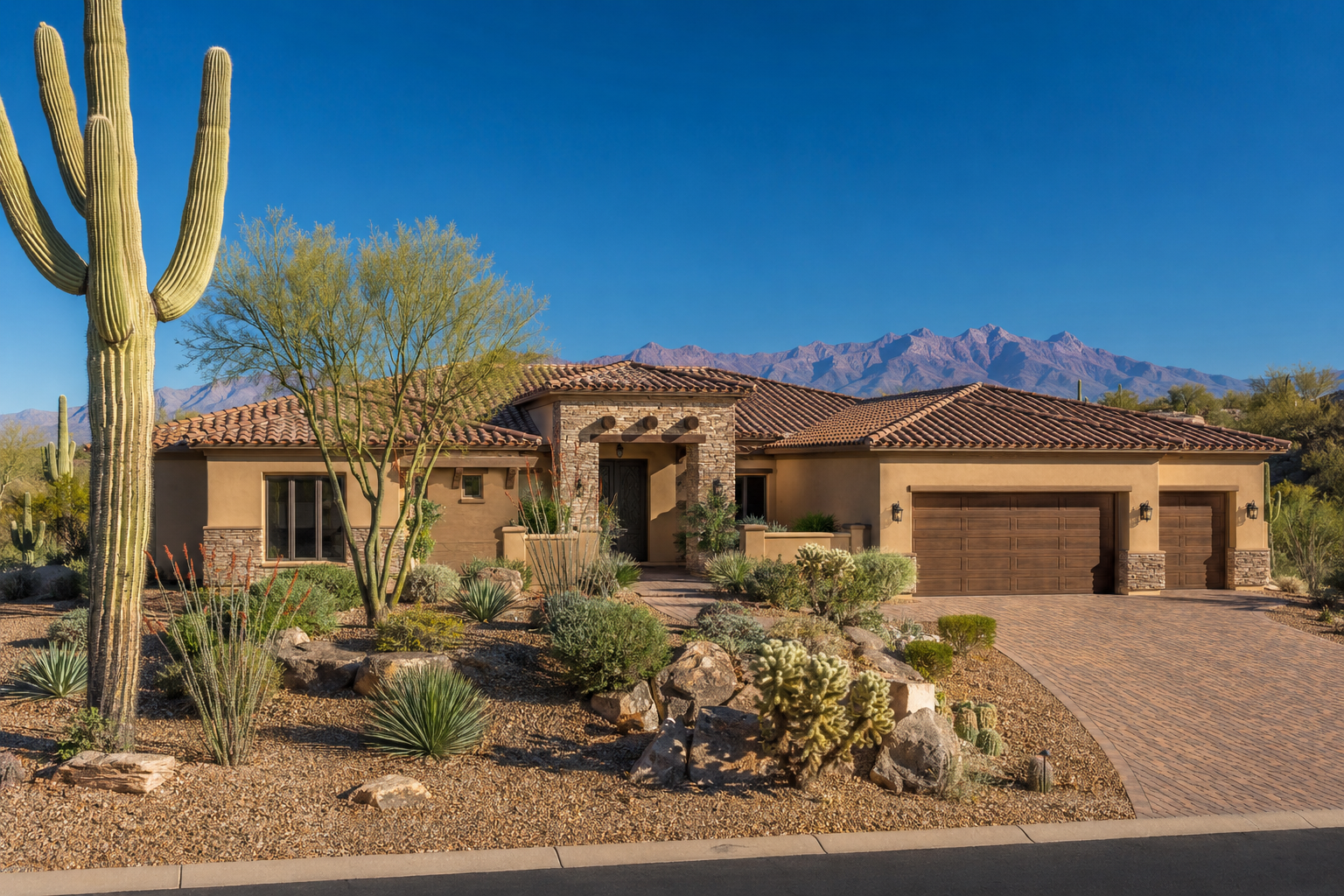
The home inventory at Tonto Verde is more varied than the marketing language sometimes suggests. The community is anchored by 517 custom and semi-custom single-family homes spread across multiple sub-neighborhoods, plus 200 attached townhomes, plus the more recent Blue Sky pocket of 30 small-footprint patio homes. Each segment serves a distinct buyer profile.
Single-family residences at Tonto Verde range from roughly 1,800 square feet at the smaller end up to over 4,000 square feet on the largest custom estates. Most homes feature two to four bedrooms, two to three bathrooms, attached two- or three-car garages, and architectural styling rooted in Sonoran territorial and contemporary-Southwest vocabularies. For current prices, inventory and days on market in Tonto Verde, see the market report linked on this page, which updates from ARMLS listing data. The custom-home stock varies more than at neighboring Trilogy at Verde River, where Shea’s narrower floor-plan menu produces more uniformity.
Lots run generous by metro Phoenix standards, often a quarter-acre or larger, with mature low-water landscaping built around saguaro, palo verde, ocotillo, and cholla rather than turf. Homes that sit along the Peaks or Ranch fairways command meaningful premiums, as do lots with unobstructed Four Peaks or Mazatzal mountain views. Buyers should expect that any home built in the 1990s or early 2000s will need careful inspection of the roof, HVAC, and any custom-feature systems (water features, putting greens, casitas) that have aged on Sonoran-Desert weathering schedules.
The Blue Sky enclave is the newest housing addition at Tonto Verde, a small gated pocket of 30 patio homes built by Taylor Morrison in 2019-2020. Two single-level floor plans run 1,394 and 1,528 square feet each. Blue Sky was designed for a buyer who wants Tonto Verde’s setting and amenity access but does not want to maintain a custom home or its associated yard.
The 200 attached townhomes scattered through other parts of the community offer another lower-maintenance entry point, with two- to three-bedroom layouts and townhome-specific HOA dues that cover exterior maintenance, landscaping, and exterior painting. Townhome resale pricing varies by location and view, with units near the clubhouse and along the putting course commanding the strongest values. Townhomes and Blue Sky homes together represent the community’s natural entry tier for buyers who want Tonto Verde’s full amenity stack at a smaller home and lower annual carry than the custom-estate inventory requires.

The amenity stack at Tonto Verde is built around the Tonto Verde Country Club. The 26,000-square-foot clubhouse is the social, dining, and golf hub, and the two championship courses plus the natural-grass putting course are the recreational anchors. A heated saltwater pool, fitness center, tennis courts, and miles of perimeter trails round out the rest.
Tonto Verde Country Club holds 36 holes of championship golf across two distinct 18-hole courses. The Peaks Course and the Ranch Course were both designed by Gary Panks and David Graham, two architects whose collaborative work in the Sonoran Desert is known for routing decisions that follow the natural land contours rather than imposing flatter parkland geometry. The Peaks plays through more elevated terrain with stronger mountain framing on tee shots; the Ranch sits on lower-lying ground with longer fairways and more gradual elevation changes.
Both courses were designed to be playable across multiple skill levels, with multiple tee sets that compress total yardage meaningfully for shorter hitters. The Mesquite Grill at the clubhouse handles post-round dining and patio service with views across the practice area to the Mazatzal Mountains beyond. Course access is tied to country-club membership rather than HOA dues; the club is a private equity club with limited public play available on a tee-time basis when conditions allow.
One of Tonto Verde’s most distinctive amenities is its 18-hole natural-grass putting course, which is one of only a handful in Arizona. The putting course is open to all residents with a social membership and functions both as practice infrastructure for the championship courses and as a social-evening amenity in its own right. A “putting and a pour” rhythm builds out across the cooler months, with residents working through the 18-hole loop in informal foursomes before drifting back to the clubhouse patio.
The outdoor heated saltwater pool and spa stays open year-round. The fitness center inside the clubhouse carries cardio and resistance equipment plus a regular schedule of group classes; a roster of personal trainers handles individual programming. Tennis courts on the property support the standing tennis program; a community ballroom (known locally as the Acacia Ballroom) hosts dancing, concerts, and the larger seasonal events. Lakes and ponds throughout the community add scenic infrastructure and support a low-key birdwatching and walking culture.
Tonto Verde’s trail network runs through the community and connects, by way of access points along the eastern boundary, to the broader trail systems in McDowell Mountain Regional Park (about 20,000 acres) and Tonto National Forest (2.9 million acres). The community’s outdoor amphitheater hosts seasonal concerts and events through the cooler months. Hiking, mountain biking, and equestrian access are all within a short drive of the gates, and the Verde River corridor sits roughly two miles east for paddling and riparian-habitat birdwatching.

Tonto Verde’s social calendar is built around the activities and clubs that residents themselves organize and run, with an Enrichment Committee that programs guided educational hikes, presentations from Arizona historians, cooking classes, and seasonal cultural programming.
Standing groups at Tonto Verde include Art Club, Bridge, Bunco, Book Club, Body Sculpting, Community Chorus, Cooking Classes, Cookouts, Wine Club, knitting and quilting circles, poker groups, and the tennis ladder. The Cardinals Football game viewings draw their regulars on the appropriate Sundays. The Acacia Ballroom converts for dancing on the heavier event nights.
For buyers comparing Tonto Verde’s social fabric to either of its sibling communities, the texture is closer to a private country club than a master-planned active adult village. Smaller average group size, more direct relationships across the standing roster, and a stronger orientation toward the country club’s calendar are typical. Newcomers tend to settle in through the social membership infrastructure and the Enrichment Committee’s open programs, then layer specific clubs on top as interest fits.
The year peaks October through April. The outdoor amphitheater hosts concerts. The tennis program runs full leagues. The hiking group leads educational walks into McDowell Mountain Regional Park. Cooking classes fill regularly through the cooler months. Holiday programming through November and December anchors the calendar’s high season, with New Year and spring desert-bloom events extending the program through April.
Summer cools the calendar but does not empty it. The heated saltwater pool stays open year-round, the fitness center keeps a steady class schedule, and the early-morning hiking and golf windows remain usable through the warmer months for residents who stay year-round rather than splitting time between Arizona and a cooler-summer second home.

Tonto Verde sits at the rural northeast edge of the metro Phoenix area, off Forest Road and Rio Verde Drive in the unincorporated community of Rio Verde. The setting is genuinely rural — low light pollution, dark-sky stargazing, and quiet evenings are real attributes here, not marketing phrases. Daily-life infrastructure is reachable but is not on-site at the scale a master-planned suburb provides.
Fountain Hills sits about eight miles south. The town carries the everyday commercial infrastructure that Rio Verde does not: full grocery stores, restaurants, pharmacies, banks, a post office, and the medical office building footprint. The town’s namesake fountain, one of the tallest fountains in the world at full height, anchors the central park. Residents typically run the eight-mile drive once or twice a week for groceries and routine errands.
North Scottsdale begins about 15 miles southwest of the community. Far-North Scottsdale shopping and dining (Pinnacle Peak corridor, Kierland Commons, Scottsdale Quarter) sits 20 to 25 minutes by car. In-town Scottsdale and downtown Phoenix run 35 to 45 minutes depending on traffic and time of day. Phoenix Sky Harbor International Airport is roughly 55 minutes from the community gates. The relative remoteness is a feature for the buyer who wants quiet desert evenings; it is a friction point for the buyer who expects urban amenities at five-minute reach.

Healthcare access from Tonto Verde follows a tiered structure. Fountain Hills carries the closest commercial medical office footprint. The major hospital network sits in the Scottsdale corridor 20 to 25 miles south.
The Rio Verde Fire District provides EMS service to all three Verdes communities. The Fountain Hills medical office footprint, eight miles south, holds primary-care, urgent-care, and several specialty practices that handle most routine and same-day needs. Banner Health and HonorHealth both operate clinic locations in Fountain Hills.
For acute and specialty care, HonorHealth Scottsdale Thompson Peak Medical Center sits about 20 miles southwest as the primary acute-care anchor for the Rio Verde corridor. HonorHealth Scottsdale Shea Medical Center is roughly 25 miles south and carries a broader specialty mix including cardiology and neurosciences. Mayo Clinic Phoenix is approximately 24 miles southwest and handles the highest-acuity specialty cases for residents needing tertiary care. The drive to any of the three runs 25 to 40 minutes in normal conditions.
The trade-off in this part of the metro is clear. Routine primary-care visits typically mean an eight-mile drive into Fountain Hills rather than a five-minute drive across a master-planned community. Same-day urgent care reaches eight miles. Acute hospital care sits 20 to 25 miles south. For residents managing stable chronic conditions or routine wellness care, the structure works well. Buyers can weigh these drive times against their own healthcare needs.

Owning at Tonto Verde involves two financial layers rather than one. The HOA structure handles community infrastructure and a baseline social-membership equivalent. The Tonto Verde Country Club membership, separate from HOA dues, controls golf access and country-club privileges. Buyers should price both layers in advance.
Tonto Verde HOA dues fund the gated entry, common-area landscaping, the heated saltwater pool and spa, the natural-grass putting course, the trail network, and community administration. HOA dues vary by sub-association; confirm current fees with the association or in the HOA disclosure during escrow. Townhome owners carry an additional sub-association fee for exterior maintenance, landscaping, and exterior painting.
The HOA budget covers a social-membership equivalent at the country club, which means residents have automatic access to the clubhouse social spaces, the pool, the fitness center, and the natural-grass putting course without separate club dues. Limited golf access on a fee basis is sometimes available to social members; full golf access requires a country-club membership.
The Tonto Verde Country Club is a private equity club. Membership tiers typically include full golf, social, and tennis-or-restricted-golf options, with separate initiation contributions, monthly dues, and trail or cart fees. Specific membership categories, current initiation amounts, and monthly dues are published by the club office and change with available capacity; verify current figures with the club before making any purchase.
Buyers planning to play golf three or more times a week should price a full equity membership; buyers who plan to play occasionally should price a social membership with pay-per-round access. Tonto Verde is a luxury-tier 55+ community; the financial profile reflects that positioning.
Tonto Verde is marketed as a 55+ community. The age rules, including how many residents in a home must be 55 or older and whether younger household members may live there, are set by the community’s recorded governing documents. Confirm the current rules with the Tonto Verde HOA before you buy.
HOA dues vary by sub-association; confirm current fees with the association or in the HOA disclosure during escrow. Tonto Verde Country Club membership is separate from HOA dues.
Pet rules are set by the Tonto Verde HOA, so review the current rules with the association before you buy. Assistance animals are handled as a reasonable accommodation and are not subject to pet restrictions.
Yes. Tonto Verde has a gated entry, which the HOA maintains. Confirm current entry arrangements with the association when you visit.
The nearby emergency room is HonorHealth Scottsdale Thompson Peak Medical Center, 7400 E. Thompson Peak Pkwy., Scottsdale. Fire and EMS service comes from the Rio Verde Fire District.

Touring Tonto Verde is not a thirty-minute walkthrough. The decision between Tonto Verde, neighboring Rio Verde Country Club, and Trilogy at Verde River usually requires a day or two on-site, ideally split across the three communities so the differences in scale, design, and country-club culture become legible.
A useful comparison day starts with the Peaks or Ranch course at Tonto Verde for a morning tee time or a guest-walk on the cart paths, then a clubhouse lunch at the Mesquite Grill. An afternoon visit to the natural-grass putting course is essential — this is the amenity that does not exist at either neighbor and that defines part of Tonto Verde’s identity. Drive south on Forest Road and Rio Verde Drive to either Rio Verde Country Club for a clubhouse tour or north to Trilogy at Verde River for a sales-center walkthrough. The goal is to feel the three different country-club cultures in one stretch of hours rather than across separate weekend trips.
End the visit with an evening at the Acacia Ballroom or the Mesquite Grill patio if a club function is scheduled. Tonto Verde’s social texture reads most clearly during the evening windows, when residents gather after the day’s golf, tennis, and trail activities. The community’s character does not show in a daytime drive-through; it shows in the conversation at the patio at sunset.
Serious Tonto Verde buyers benefit from working with an agent who has placed clients in all three Verdes communities and can speak to the practical differences in HOA structure, country-club initiation patterns, and resale liquidity for each. The right agent should be able to walk through the Peaks and Ranch course strengths versus Lehman’s Quail Run and White Wing at Rio Verde versus the Verde River course at Trilogy. Specific upgrade documentation — recent kitchen remodels, HVAC and roof replacements, and any custom-feature systems — supports stronger offers in this market segment, where buyer expectations are calibrated to the luxury-tier 55+ community price band.
Also see Tonto Verde Homes for Sale.
We use cookies to improve your experience on our site. By using our site, you consent to cookies.
Manage your cookie preferences below:
Essential cookies enable basic functions and are necessary for the proper function of the website.
CloudFlare provides web performance and security solutions, enhancing site speed and protecting against threats.
Service URL: developers.cloudflare.com (opens in a new window)
Google Tag Manager simplifies the management of marketing tags on your website without code changes.
These cookies are used for managing login functionality on this website.
Statistics cookies collect information anonymously. This information helps us understand how visitors use our website.
Google Analytics is a powerful tool that tracks and analyzes website traffic for informed marketing decisions.
Service URL: policies.google.com (opens in a new window)
You can find more information about our Cookie Policy and Privacy Policy.