

In 1982, a builder called UDC broke ground on Westbrook Village in what was then largely undeveloped north Peoria. The company is gone now — it dissolved after pouring the last slab of its 47th and final enclave in 1993 — but the 55+ golf-and-tennis community it built has done what very few age-restricted master plans get to do. It has aged into itself, decade after decade, with no developer left to rebrand or retrofit. Forty-plus years of residents have done that work instead. The result in 2026 reads less like a finished product and more like a slowly-cured neighborhood: forty-seven enclaves stitched into a two-square-mile footprint, two 18-hole courses laid through them, two recreation centers near the geographic poles of the property, and a charter-club roster that has had three generations of residents to grow into. Most buyers come away from a first visit talking about the same thing — the unhurried, lived-in feel of a community that no longer reports to a developer. Brochures cannot generate that. Only time can.
What follows is a long-form look at what shapes life inside Westbrook Village today, who buys here, what it costs, and how it fits into the broader 55+ communities across the Valley.
Forty years is enough time for a community to become its own kind of authority. Westbrook Village’s 55+ active adult living model now reads as a baseline — the version against which newer Peoria neighborhoods, including Trilogy at Vistancia up at Vistancia Boulevard, get measured. The community is not guard-gated, which surprises buyers used to a more controlled feel. Instead, the entry monuments and the consistent enclave architecture do the work of signaling that the visitor has crossed into a managed-membership environment. Inside the perimeter, residents move on a daily rhythm shaped by golf tee times, ballroom programming, and the open sport courts at both centers. Snowbirds arriving in October tend to need three or four weeks before they settle into the cadence. Year-round residents have it on muscle memory.
The tone of the place is friendly without being effortful, established without being calcified. Newcomers get folded into clubs by week three. Long-tenured residents — some of whom have lived here for twenty or thirty years — still treat the courses, ballrooms, and bistros as their daily working environment.
UDC built Westbrook Village before the Northwest Valley boom that defined Peoria after the 2000s. When the first homes opened, Loop 101 had not been completed in this stretch. The master plans up north toward Lake Pleasant Regional Park would not break ground for two more decades. The community was a frontier project — a serious 55+ golf bet on the rural edge of metro Phoenix. UDC committed to two championship courses and two recreation centers up front, which set the operating model for the next forty years. When the builder dissolved, the Westbrook Village Association assumed the keys: master-association governance, courses, recreation centers, gates and entry monuments, and the long task of capital reinvestment. Capital decisions move through committees of homeowners, not a builder’s design council. Renovations at the Lakes and Vistas centers proceed when the membership funds them. The clubs that anchor the social calendar were started by residents, not seeded by an amenity package. Buyers in 2026 are evaluating a community that has had four decades to mature into its own version of itself.
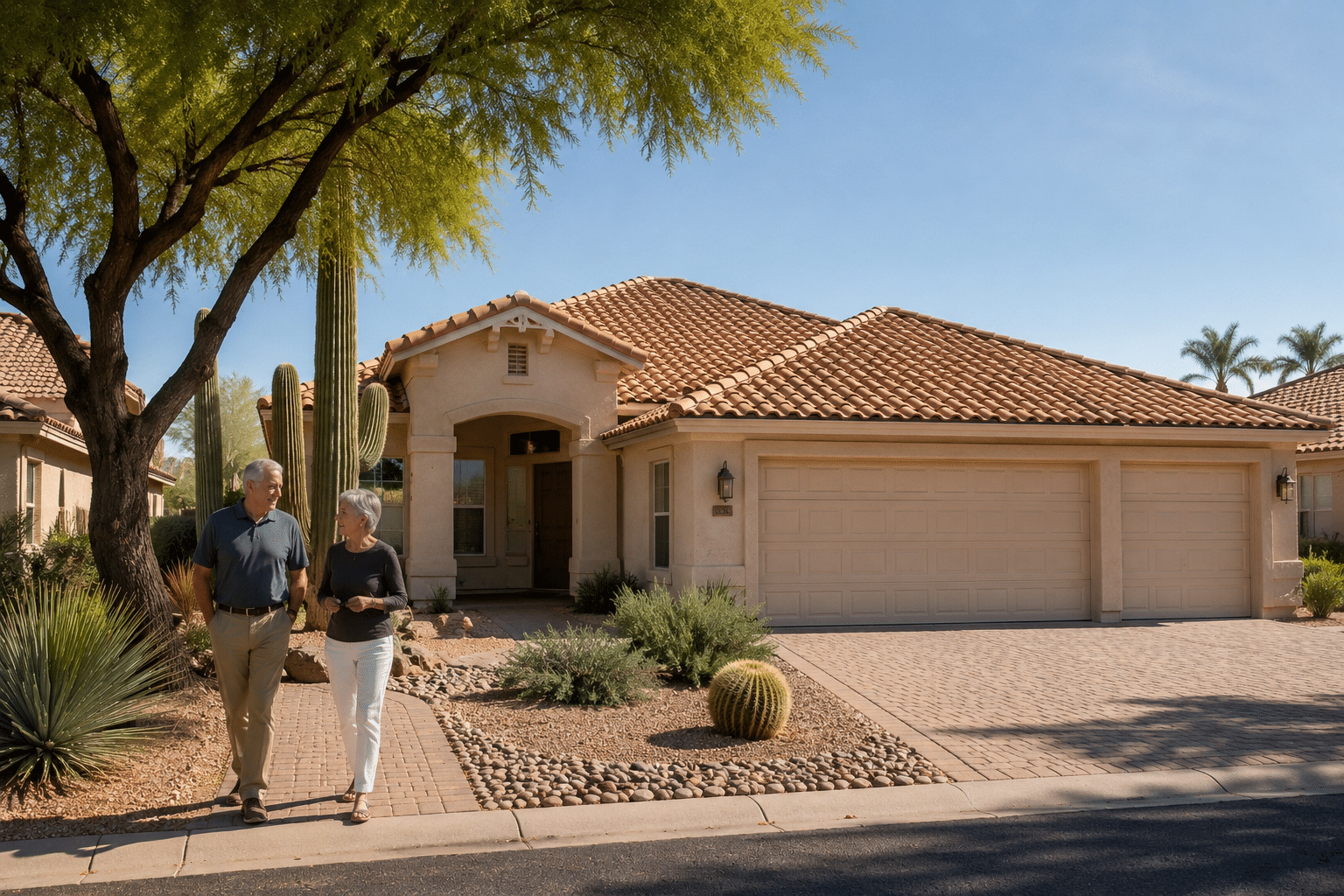
The Westbrook Village housing inventory exists almost entirely as a resale market. With UDC long gone and the community physically built out by 1993, every transaction here is between an existing owner and a new buyer. There are no model homes in the developer sense, no quick-move-in inventory program. What buyers see when they tour is what they will own. The relevant question is not which floor plan to choose but which of the existing 3,900-plus homes match the buyer’s interior preferences after thirty to forty years of owner-driven updates.
The mix runs across three broad categories. Each has its own price arc, its own enclave concentration, and its own carrying-cost profile. Buyers who walk both courses on the same day usually end up testing two of the three before they settle.
The smallest homes at Westbrook Village are condominiums and casita-style attached residences in the 1,000-to-1,800-square-foot range. These cluster in specific sub-associations — Vista Crossing is a representative example, with sixty-four casita residences in an intimate enclave layout. They appeal strongly to seasonal owners who want a true lock-and-leave footprint. Exterior maintenance, roof reserves, and yard care fall to the sub-association. Owners arrive in October to find irrigation already running and lawns already mowed. Pricing here typically runs at the lower end of the range, with a corresponding step-up in monthly carrying cost because the sub-association funds more of the upkeep.
Most of Westbrook Village’s inventory sits in the patio-home and single-family categories. Patio homes are detached or semi-detached single-story residences with private courtyards and lower-maintenance lots. Single-family homes range from compact two-bedroom layouts to larger custom builds along the Vistas Course fairways with three-car garages and golf-course frontage. The custom builds skew older but have often seen multiple kitchen, bath, and HVAC cycles. Buyers willing to absorb a forty-year-old shell in exchange for a renovated interior find their best value here. Buyers who want a turnkey single-family home generally focus on properties refreshed in the last five to seven years, where the new roof, modern HVAC, and updated finishes are reflected in the asking price but the lot maturity and golf-course adjacency cannot be replicated in a newer 55+ community.

The two recreation centers at Westbrook Village are not redundant. They split the day. The Lakes Recreation Center, the older of the two, anchors the southern half of the community and houses the ballroom, aerobics studio, hobby studios, billiards room, and the Sunset Bistro at the Lakes restaurant. Its outdoor amenities include a heated pool and patio, tennis courts, and horseshoe pits. The Vistas Recreation Center anchors the northern half. It carries its own ballroom, fitness center, pickleball complex, and pool deck, plus the Vistas restaurant. Most full-time residents pick a “home center” within their first season and develop a daily route around it. Snowbirds tend to use both, depending on which course they tee off from on a given morning.
The Westbrook Village Golf Club operates as a semi-private member-owned facility with public play available. The Lakes Course is a traditional par-71 layout with mature trees, water hazards on roughly half its holes, and bunkers that reward course-management over distance. The Vistas Course runs to roughly 6,400 yards as a links-style desert par-72, with more roll-out, less water, and more wind in play. Each course has its own pro shop, practice facility, and full-service restaurant. Members can select 12-month, 6-month, unlimited, or weekend-only memberships. Many residents defer joining for their first season, play public greens fees through the snowbird months, then commit in season two once they have tested the rhythm. That deferred-membership pattern is one of the distinctive snowbird signatures of this 55+ golf-and-tennis community.
Westbrook Village runs a deep racquet-sport calendar across both centers. Tennis preceded pickleball here — the original Lakes courts have been in continuous play since the early 1980s — and the community has since added a dedicated pickleball complex at the Vistas center. Both sports run organized league play, drop-in mornings, and beginner clinics, with a particular concentration of mid-level pickleball ladders that newcomers can join without prior membership. Bocce ball, horseshoes, and a small lawn-bowling contingent fill out the sport-court roster.
Both centers run heated pools and spas year-round. The water-fitness program — aqua aerobics, lap-swim windows, and informal pool walking groups — runs at staggered hours across the two facilities. A resident can reliably find an open swim lane somewhere in the community at most hours. The Vistas pool deck has a stronger morning swim culture; the Lakes pool deck draws a slightly more social mid-afternoon crowd.

The charter-club roster at Westbrook Village is one of the deepest in the West Valley. The community sustains seventy-plus active groups across arts, crafts, sports, civic engagement, faith, and travel. The ballrooms at both centers carry the highest-attendance programming — ballroom dances, holiday concerts, monthly speaker series, and large-group dinners. The hobby studios, classrooms, and meeting rooms host the rest, often on overlapping calendars that spill from one center to the other across a weekly cycle.
What makes the Westbrook Village club ecosystem distinctive is that it grew organically rather than from a builder’s amenity-program template. Clubs survive because residents continue to lead them, year after year. Clubs that lose their leaders quietly fold while new clubs form when residents arrive with new interests. The result is a calendar that genuinely reflects the current resident base rather than the demographic the developer targeted in the 1980s.
The Fine Arts Association runs the most visible cultural programming. It maintains a working gallery inside the recreation centers, hosts a juried year-end show, and sells member work both locally and on a national scale through its online channel. Newcomers who arrive with serious art practice often plug in here within their first month — the studios, kilns, and class slots are open to all members.
Beyond the high-visibility programming, the day-to-day social texture runs through quieter channels. The travel group books seasonal trips that fill within hours of release. The card rooms at both centers run weekly bridge, canasta, and poker tables. Friday evenings at the Sunset Bistro at the Lakes draw the largest informal social crowd of the week, with residents who do not otherwise overlap during the day finding their way to the same tables.

Westbrook Village sits in north-central Peoria, organized along Westbrook Parkway with primary access from 83rd Avenue and Union Hills Drive. Loop 101 — the Pima/Agua Fria Freeway — runs about two miles east of the community and serves as the spine for everything residents do off-property. Sky Harbor International Airport is roughly thirty to thirty-five minutes south via Loop 101 and Interstate 17. Downtown Phoenix sits about thirty minutes away on the same corridor. The terrain is genuinely flat. The White Tank Mountains are visible on the far western horizon on clear days, but the everyday landscape inside the community is mature shade trees, palm-lined boulevards, and lush green golf turf rather than dramatic mountain backdrop. Buyers arriving from communities with prominent mountain views adjust to a different aesthetic here — one defined by canopy and water rather than ridgeline.
The retail and entertainment context within a five-mile radius is unusually deep for an established 55+ golf-and-tennis community. The Arrowhead Towne Center sits roughly two miles southeast as the dominant West Valley regional mall. Just south of that, the P83 Entertainment District clusters dining, theater, and live entertainment around the Peoria Sports Complex, the spring training home of the San Diego Padres and Seattle Mariners. The Arizona Broadway Theatre, the only year-round dinner theater in the state, is in this corridor. The Westgate Entertainment District — home to State Farm Stadium and the Arizona Cardinals — is roughly fifteen minutes south on Loop 101.
For residents with visiting family, the drive map is generous. Sky Harbor handles long-haul travel within thirty-five minutes. Lake Pleasant Regional Park sits twenty minutes north for boating, kayaking, and reservoir hiking. The Cactus League spring training crawl is a notable seasonal benefit. Between the Peoria Sports Complex on-site, Surprise Stadium ten miles west, and Camelback Ranch fifteen miles south, residents can attend three or four spring games a week in February and March without ever driving more than twenty minutes from the community.

The right healthcare question for a Westbrook Village buyer is not which hospital is the shortest drive away. Three competing health systems run major facilities within the same fifteen-mile radius. The buyer’s first practical decision is which Medicare Advantage network to choose, not which freeway to take when a specialist appointment comes up.
Banner Thunderbird Medical Center in Glendale runs a full acute-care campus with cardiology, oncology, and stroke programs. The Abrazo Arrowhead Campus in Glendale, operated by Tenet Healthcare, runs a competing acute-care facility with its own emergency department and full surgical service line. HonorHealth Deer Valley Medical Center sits about ten minutes east on Loop 101 and anchors the HonorHealth presence in the corridor. From the Westbrook Parkway and 83rd Avenue intersection, all three hospitals reach the patient inside thirty minutes, often less.
In emergency-room terms, Banner Thunderbird and Abrazo Arrowhead are both within roughly fifteen minutes of Westbrook Village. HonorHealth Deer Valley is fifteen to twenty minutes on Loop 101. For specialty care — cardiology, orthopedics, oncology, neurology — the practical roster of providers spans all three systems. Residents typically end up with a primary care physician inside one network and specialist appointments distributed across multiple. The decisive variable is which network their Medicare Advantage plan treats as in-network for the highest reimbursement.
Closer-in primary and urgent care is dense. The HonorHealth Peoria Medical Campus on 83rd Avenue, just south of the Peoria Sports Complex, runs primary care, imaging, and outpatient services. A Banner urgent care at Deer Valley Road and 83rd Avenue serves the same neighborhood for non-emergency needs. Telehealth has expanded across all three systems since 2020. A Westbrook Village resident with a flare-up at 9 p.m. on a Sunday is rarely more than a video consult away from a triage decision. Buyers who arrive with established insurance from another state should plan to spend their first sixty days here calibrating their coverage to local network architecture. A conversation with a knowledgeable broker often pays for itself within the first claims cycle.

The financial picture at Westbrook Village has three working layers. The headline home price is the largest piece. Annual recreation dues to the Westbrook Village Association are the second. A sub-association fee — payable only by owners in casita and patio-home enclaves — is the third. Layered onto these are the one-time fees that hit at closing: a resale disclosure fee, a one-time preservation fee that funds long-term capital reserves, and standard rush-fee options if the buyer or seller needs an expedited document turnaround.
For a specific home’s property tax, look up the parcel on the Maricopa County Treasurer’s website. Arizona’s senior property valuation freeze, available to homeowners 65 and older who meet income limits, locks in the limited property value used to compute the school-tax portion of the bill — a meaningful annual benefit on a long ownership horizon. Arizona does not tax Social Security income at the state level, which buyers from California, Oregon, or Washington often discover changes their carrying-cost math by several thousand dollars a year.
Every Westbrook Village owner pays an annual recreation fee to the master association. This funds the two recreation centers, the master ballrooms, the entry monuments, the perimeter landscaping, and the staff who run the facilities. The preservation fee paid at closing is a one-time contribution to the long-term capital reserve for major recreation-center renovations. Confirmed current amounts come through the resale disclosure packet during escrow. Buyers who shop the community over multiple seasons should re-pull the fee schedule each time, since the budget is set annually by the association board.
Casita and patio-home owners pay a sub-association fee on top of the master recreation fee. This second layer covers exterior maintenance — roofs, paint cycles, yard care, and shared common areas inside the sub-enclave — on a schedule the sub-association sets. The combined monthly carrying cost for a casita is therefore higher than for a custom single-family home of equivalent square footage. The sub-association absorbs the unpredictable big-ticket items that an individual single-family owner would have to budget for separately. For seasonal owners, the trade is almost always worth it. For full-time residents who enjoy maintaining their own property, the single-family option preserves more autonomy and a lower fixed monthly cost.
Westbrook Village is marketed and operated as a 55+ active adult community. Its underlying deed restrictions vary by sub-association, and the qualifying age is set by each sub-association’s recorded documents. Buyers should verify the specific age qualification for any home during the escrow disclosure period.
All homeowners pay an annual recreation fee to the Westbrook Village Association, plus a one-time preservation fee at closing. Casita and patio-home owners also pay a sub-association fee that covers exterior maintenance. Confirmed current amounts come through the resale disclosure packet during escrow; buyers should not rely on third-party numbers.
Yes. Westbrook Village is pet-friendly and allows dogs and cats throughout the community. Specific limits and leash rules are governed by the master association and any applicable sub-association. Assistance animals are considered as a reasonable accommodation and are not subject to pet restrictions. The community has informal walking groups that take advantage of the wide sidewalks and shaded internal streets.
Westbrook Village is not guard-gated in the staffed-entry sense. Entry monuments and consistent enclave architecture mark the perimeter, and the community reads as a managed-membership environment without a controlled vehicle gate. A handful of internal sub-associations have their own access arrangements.
Three competing health systems run major facilities within roughly fifteen miles of Westbrook Village: Banner Thunderbird Medical Center, Abrazo Arrowhead Campus, and HonorHealth Deer Valley Medical Center. Closer-in primary and urgent care includes the HonorHealth Peoria Medical Campus on 83rd Avenue and a Banner urgent care at Deer Valley Road and 83rd Avenue.
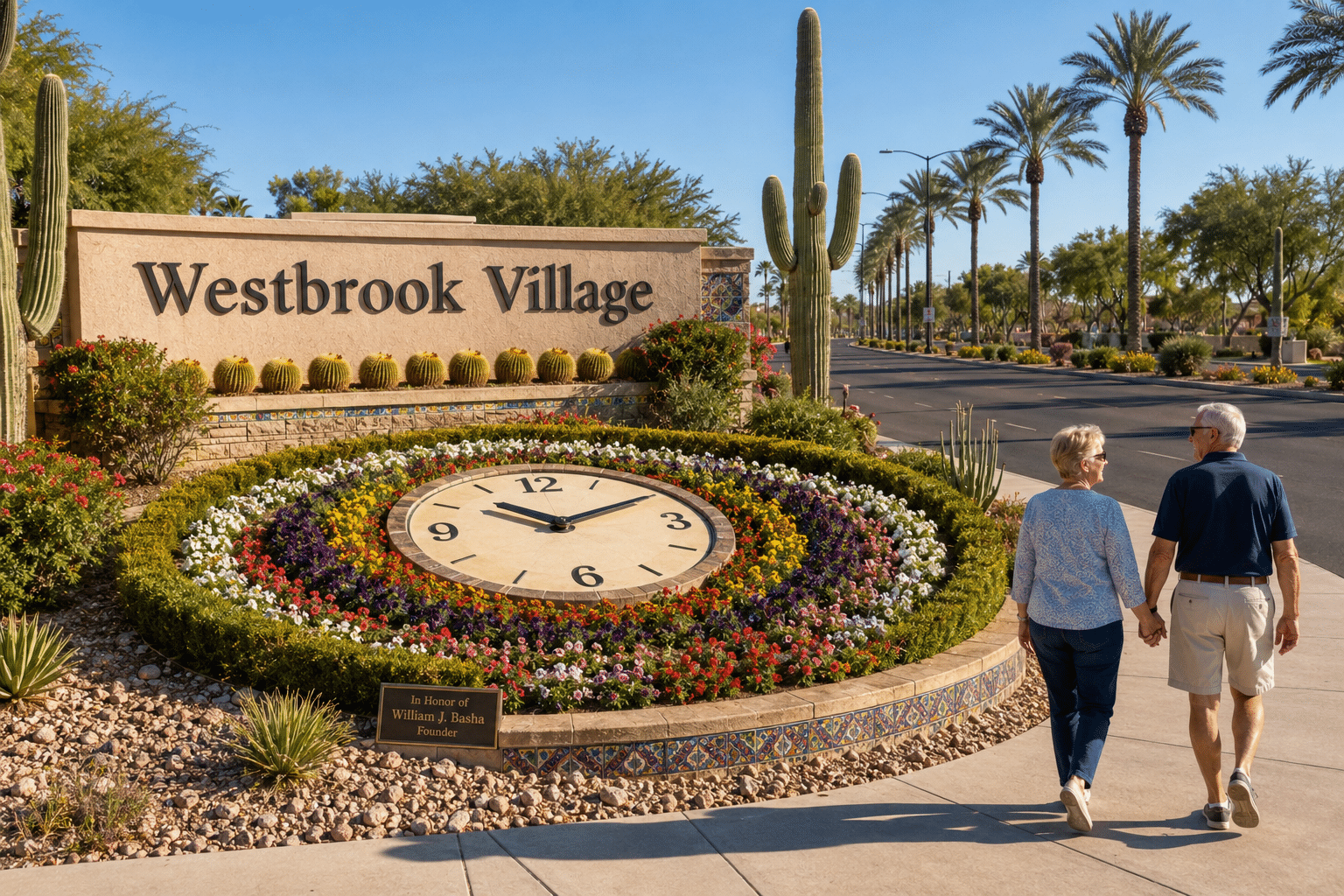
A first visit to Westbrook Village pays off best when it is split into two distinct days with different purposes. The first day is recon — self-guided, low-pressure, designed to test fit. The second day is structured, with a 55+ specialist agent walking the buyer through specific homes, the HOA disclosure packet, and the financial picture. Most buyers do not need three days. Most buyers who try to compress everything into a Saturday miss the daily-rhythm signals that decide the question.
Day one begins with a self-paced drive of both gates — entering near Westbrook Parkway, exiting near Country Club Parkway — to feel the community’s two halves. Lunch at the Sunset Bistro at the Lakes or the Vistas restaurant follows. The afternoon includes a walk around both pool decks, a swing past the Fine Arts Association gallery, and an unhurried tee box visit if the schedule allows. By the end of day one, most buyers know whether the community’s tempo matches the life they are imagining. Day two is the structured agent appointment. Two or three specific homes get walked. The HOA packet gets reviewed in detail. The financial picture lays out in a single conversation. By the end of day two, most buyers have a clear yes-or-no without the fatigue of a marathon weekend.
Buyers should bring the same package they would bring to any active adult tour: pre-approval letter, list of must-have home features, list of must-have community features, and a written set of questions. The five worth asking specifically at this 55+ golf-and-tennis community are: how the master association and any applicable sub-association split the maintenance load; how the golf-membership decision interacts with the resale price; what the most recent capital project at the recreation centers was and what is planned next; how the age-qualification deed restriction reads on the specific home being toured; and which Medicare Advantage plans the local primary-care providers accept in-network. With those answered, the Peoria 55+ communities directory becomes the natural next step. Comparing Westbrook Village against the original Sun City to the south, Sun City West’s mature golf footprint to the west, The Grand in Surprise just up Bell Road, PebbleCreek’s Robson resort model in Goodyear, and CantaMia at Estrella’s lakefront enclave further southwest gives buyers the working comparison set this resale market gets benchmarked against. The Westbrook Village Association office is the right point of contact for community-level questions. A 55+ specialist agent licensed in Arizona is the right point of contact for the home itself.
We use cookies to improve your experience on our site. By using our site, you consent to cookies.
Manage your cookie preferences below:
Essential cookies enable basic functions and are necessary for the proper function of the website.
CloudFlare provides web performance and security solutions, enhancing site speed and protecting against threats.
Service URL: developers.cloudflare.com (opens in a new window)
Google Tag Manager simplifies the management of marketing tags on your website without code changes.
These cookies are used for managing login functionality on this website.
Statistics cookies collect information anonymously. This information helps us understand how visitors use our website.
Google Analytics is a powerful tool that tracks and analyzes website traffic for informed marketing decisions.
Service URL: policies.google.com (opens in a new window)
You can find more information about our Cookie Policy and Privacy Policy.