
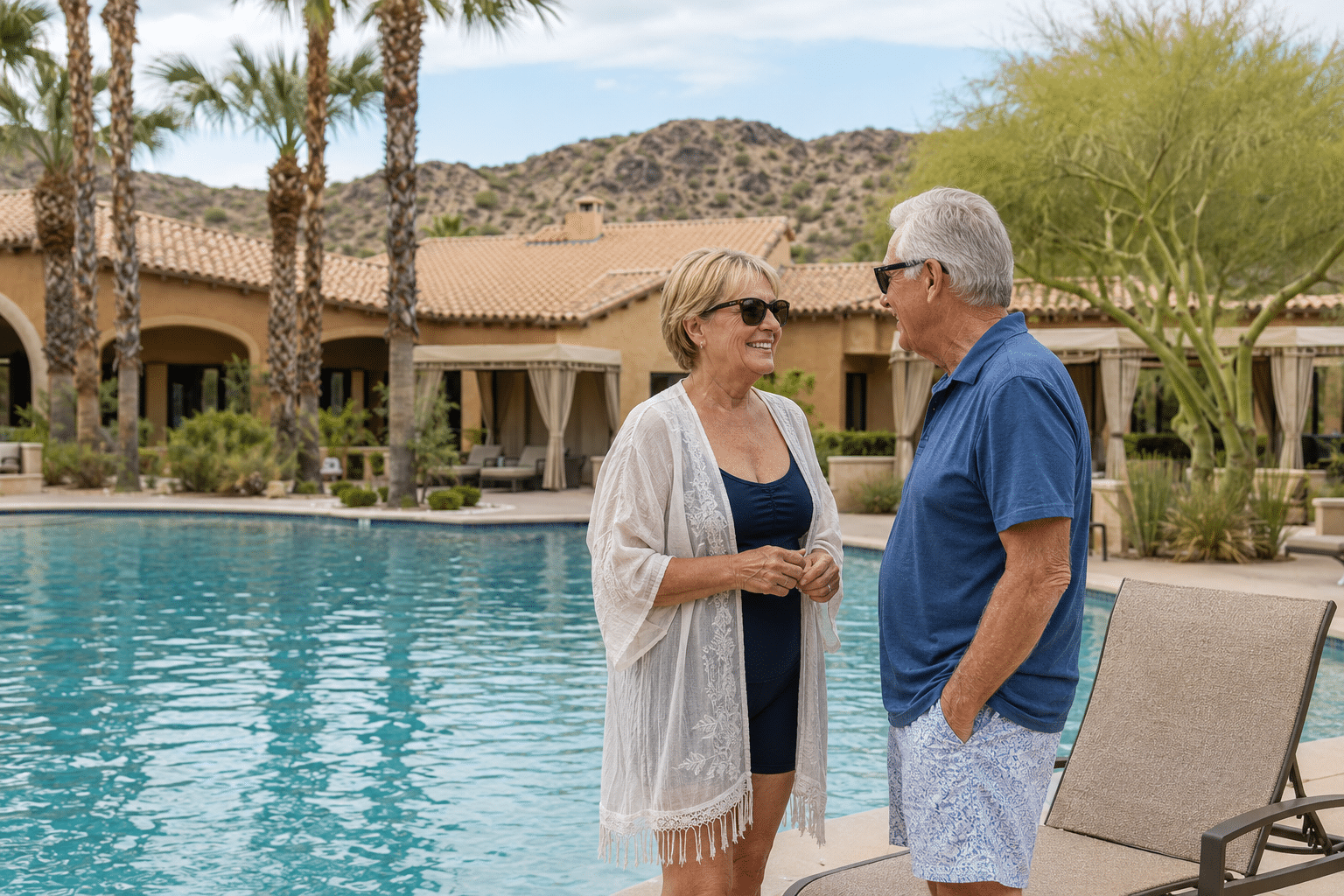
By five-thirty on a February afternoon, the light at the Mita Club Terrace turns copper, and the Bradshaw Mountains soften from gray ridges into something warmer above the resort pool. Inside, members drift back from late tee times at the Trilogy Golf Club, a pickleball clinic at the Kiva Club, and the day’s last yoga class at Alvea Spa. A culinary studio session is wrapping up. Two friends compare notes on a Center for Higher Learning lecture. The terrace fills slowly. None of it feels staged. That texture is what most buyers come away talking about after a first visit to Trilogy at Vistancia, the original Shea Homes Trilogy community and the 55+ country club section of the larger Vistancia master plan in north Peoria.
This page covers what daily life looks like at the property, how the Kiva-side and Mita-side homes differ, what the amenity package actually delivers, the way residents stitch together their weekly calendar, where the community sits inside the Sonoran Foothills geography of Peoria, the layered healthcare picture residents rely on, what a 2026 buyer pays in dues and carrying costs, and how to plan a tour without burning a weekend on guesswork.
Trilogy at Vistancia is fully built out. The original Kiva-side neighborhood opened in 2004 and the Trilogy West expansion on the Mita side, annexed in 2015, sold its last new home in 2022. Every transaction now is a resale. That changes the buyer pool. The community no longer attracts the first-wave new-build customer who wants to pick a lot and watch a frame go up. It attracts the buyer who has already done the master-plan tour circuit, sat with the trade-offs, and decided that two clubs, a Gary Panks course, and a Sonoran Foothills setting beat the alternatives.
That buyer arrives in 2026 from one of three rough cohorts. The first is the out-of-state equity mover, often relocating from California, the Pacific Northwest, or Colorado, trading a high-tax primary residence for a single-story home and a desert calendar. The second is the in-state right-sizer leaving a larger Phoenix-area family home now that the kids are settled. The third is the long-time Peoria or Sun City corridor resident moving laterally to access the Kiva-Mita amenity tier. The mix shifts a little year to year, but the community character holds. Residents who were active before they moved here stay active. Residents who came for the social calendar tend to fill it.
The community’s age requirement follows the federal Housing for Older Persons Act framework: at least one resident in each home must be 55 or older. Beyond that floor, the cultural mix tilts toward residents in their early sixties through mid-seventies. Snowbirds make up a noticeable share, but the year-round population is large enough that the December-through-March peak does not feel like a different community from the May-through-September quieter season. The clubs run programming year-round. Charter clubs meet straight through the summer. Real summer heat is the price of admission, which is why most resale tours cluster between October and April.
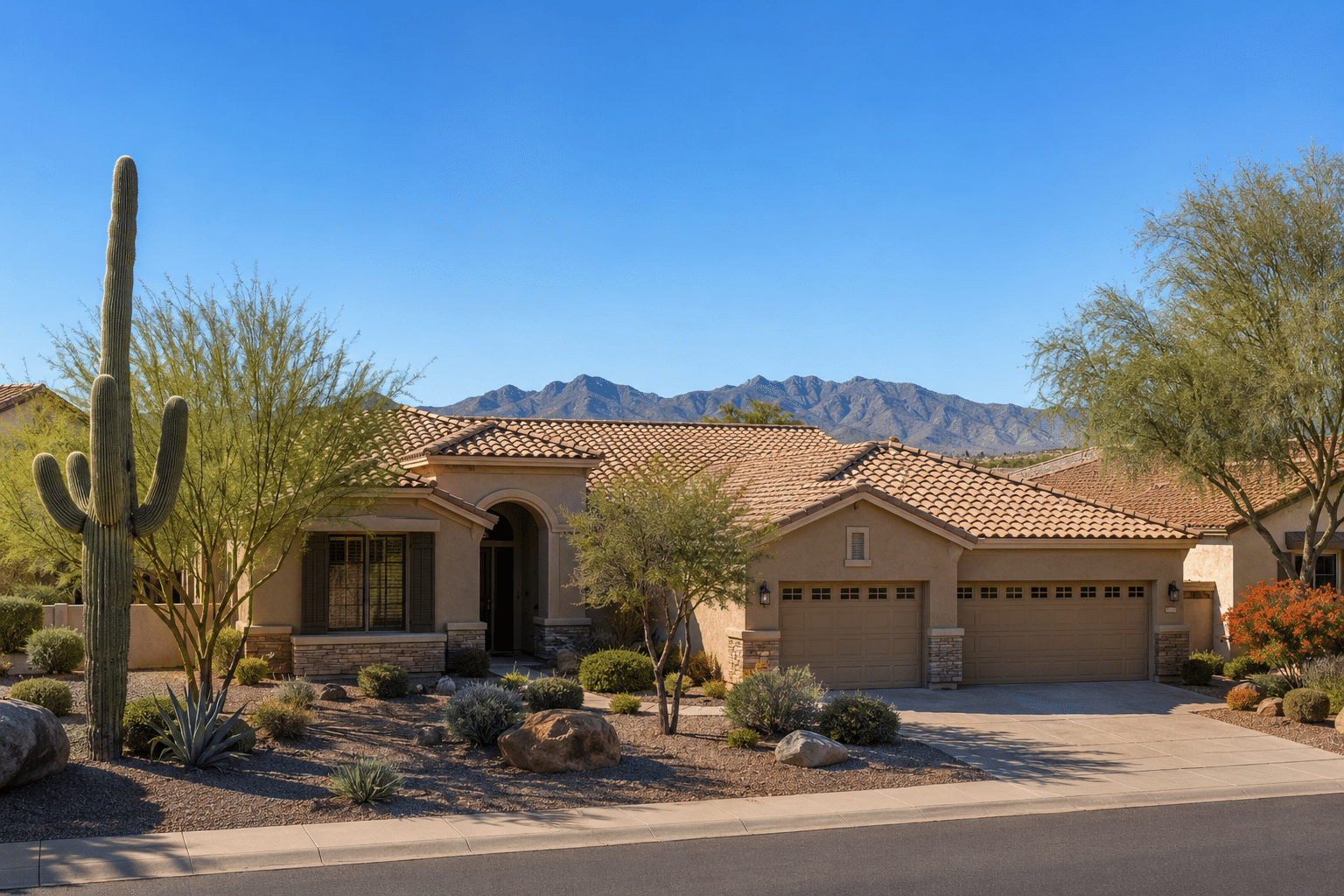
Every home at the property is single-story. Square footage ranges from roughly 1,218 square feet at the entry tier up to about 3,096 square feet at the top end, with a small handful of extended estate plans pushing higher. Two- and three-car garages are standard. Tan stucco with tile roof is the dominant exterior on the Kiva side. The Mita side leans contemporary, with cleaner rooflines, larger glass, and Shea’s newer Green Space layouts that buy side-yard breathing room between neighbors.
The original Kiva-side homes follow Shea’s first Trilogy series naming: Reflect, Focus, Contour, and Vignette. Most plans run two bedrooms plus a den, three baths, and an attached two- or three-car garage. Loft variants exist in a small number of plans but are uncommon. The Mita side draws from the newer Shea floor-plan library that also rolled out at Trilogy at Encanterra in San Tan Valley. Plan names buyers see in current listings include Cadiz, Lumina, Suscito, Serenitas, Affirm, and Chroma. The newer plans are flatter and brighter, with kitchens scaled for entertaining and primary suites pushed to the rear of the lot.
Resale buyers shopping the Kiva side in 2026 should expect updated kitchens, refreshed flooring, and varying degrees of bathroom renovation. The original Trilogy buyer cohort is now 20-plus years into the home, so a meaningful share of inventory has been touched once or twice. Solar is common. Owned solar arrays show up regularly on listing sheets and meaningfully change the carrying-cost picture. Casitas appear on a subset of plans and trade at a premium because guest-bedroom flexibility is a real factor for buyers who plan to host visiting family during the cool season.
The Mita side is younger by a decade and reflects a different design era. Lots are smaller in some sub-neighborhoods, but the Shea Green Space concept opens side yards between buildings rather than back yards. There are no golf-course lots on the Mita side because the Mita expansion was platted away from the Gary Panks layout, but several streets run along desert washes that give the homes a quasi-natural buffer rather than a fairway view. Pricing reflects newer construction. For current prices, inventory and days on market in Trilogy at Vistancia, see the market report linked on this page, which updates from ARMLS listing data.

The amenity package is the strongest case for the property. Every resident, regardless of which side they live on, gets full member access to both clubhouses, both pools, both fitness studios, the spa, the golf course — subject to a separate fee structure — and the Center for Higher Learning programming. That sets the Kiva-Mita model apart from later Trilogy properties, which built private country-club structures with expensive initiation fees. Here, the clubs are HOA-included.
The Kiva Club is the original 35,000-square-foot social hub, designed by Bing Hu, an architect known for his Frank Lloyd Wright-influenced work. Inside, residents find a state-of-the-art fitness floor, an aerobics and dance studio, a movement room used for tai chi and yoga, and an indoor lap pool used heavily during the cooler months. The building also houses a small movie theater, a computer lab, a library, hobby studios, multipurpose rooms, and Cafe Solaz for coffee and a quick bite. The outdoor resort pool sits behind the clubhouse with cabana seating and a long sun deck. Tennis courts, bocce, and pickleball are nearby.
The Mita Club opened in 2016 and was designed by H&S International, the firm behind several luxury Arizona club projects. It runs roughly 17,000 square feet and complements rather than duplicates the Kiva offering. Members find a larger movement studio, an artisan craft studio, a culinary studio, a market-style cafe called The Market Place, and the outdoor cantina-style Shallow Well for casual food and drinks. Two championship tennis courts sit on the northeast side of the club, available by reservation. The Terrace functions as the connective outdoor space, looking west toward the Bradshaws, the White Tank ridge, and a long horizon of unobstructed desert.
The Trilogy Golf Club at Vistancia is a 7,300-yard, par-72, 18-hole championship course designed by Gary Panks. The layout uses three native grass types to produce a high-chaparral look that plays differently in winter green than summer dormancy. Golf Digest awarded it five stars in its 2008-09 Best Places to Play, putting it among a small group of public courses to earn that rating. It runs as a daily-fee public course, which means residents do not face a country-club initiation. Resident annual passes and pay-per-round options exist alongside open public tee times. V’s Taproom and the Verde Grill at the clubhouse handle post-round food and an active happy-hour scene.

Two clubhouses and a sprawling member roster generate a deep charter-club roster. Residents organize their own clubs around interests they bring with them or pick up on site, and the activities team supplies a frame, scheduling, and rooms. Photography, ceramics, woodworking, hiking, ballroom, line dance, mahjong, bridge, wine, book club, and several travel-tour groups all meet on a regular cadence. Pickleball runs a multi-level league. A walking and running group uses the 3.5-mile Discovery Trail that threads through Vistancia.
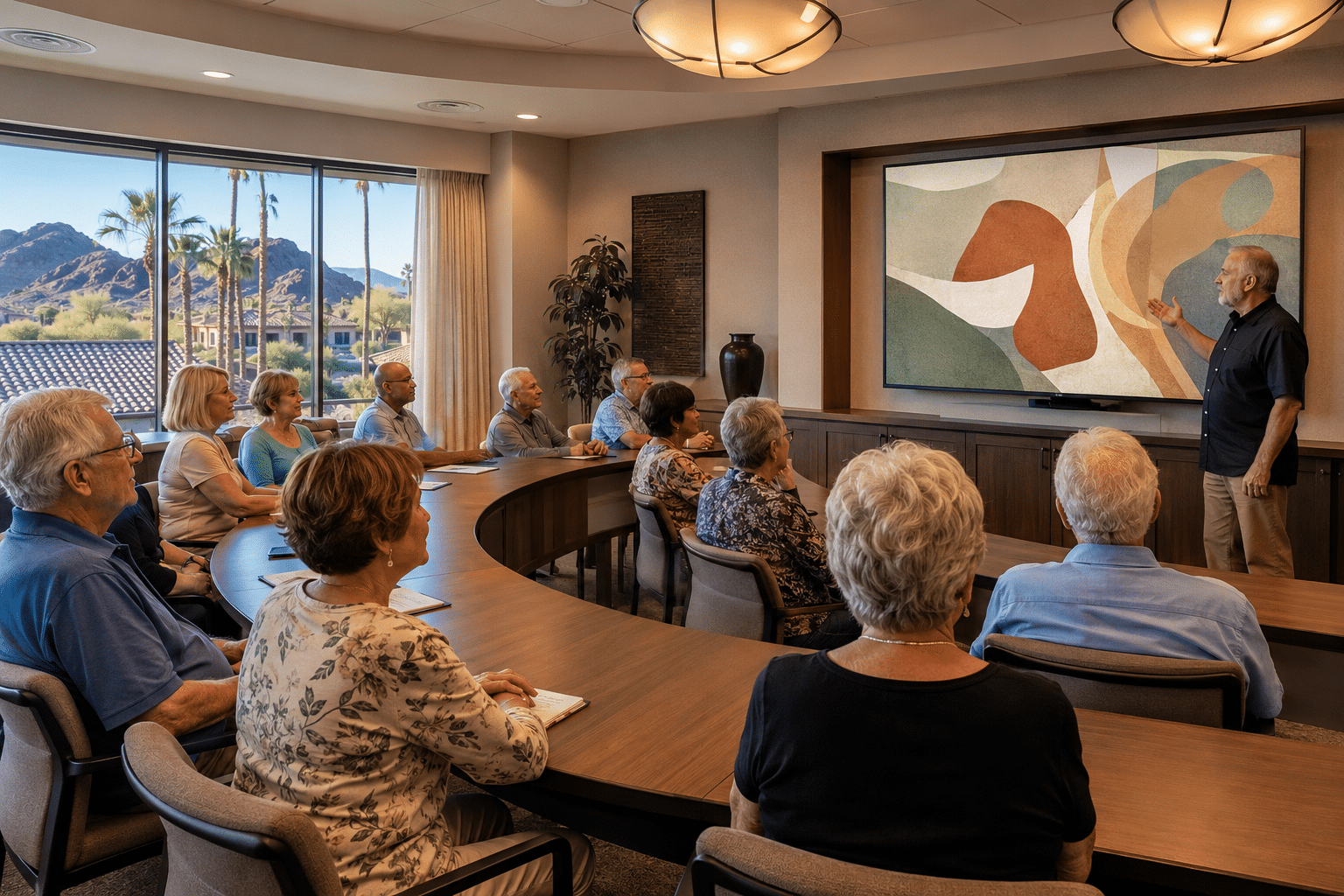
The Center for Higher Learning is the editorial difference between the community and a property where the social calendar lives or dies on bridge night. The center programs lectures, classes, and short courses across language, finance, art history, science, photography, and current events. Local instructors and visiting speakers fill the room. Residents who arrive expecting a quiet golf retirement and end up taking an introductory Spanish series are a recognizable archetype here. Continuing education is also a visible part of how snowbirds plug into the community quickly during their first season; a Tuesday class introduces ten new neighbors faster than any social mixer.
The community operates with a three-restaurant rhythm. V’s Taproom at the golf clubhouse is the casual indoor-outdoor spot for a beer, a burger, or a longer happy hour after a round. The Verde Grill, also at the golf clubhouse, runs a more elevated lunch-and-dinner menu. Cafe Solaz inside the Kiva Club covers gourmet coffee, smoothies, and quick bites. The Market Place and The Shallow Well at the Mita Club round out the picture with grab-and-go and poolside options. Residents who entertain visiting family describe the routine the same way: model home tour for the curious cousin, then dinner at V’s, then a walk on Discovery Trail at dusk.
Trilogy at Vistancia sits at the north edge of Peoria, where the developed valley grades into rolling Sonoran Foothills. Happy Valley Road and Vistancia Boulevard provide the primary entry. Loop 303 picks up traffic to the south and connects east to Loop 101 and west toward Sun City Festival in Buckeye. The Hieroglyphic Mountains rise to the northeast. The Bradshaws stand farther north on a clear day. The far western horizon shows the long ridgeline of the White Tanks. The terrain is elevated enough that desert hill views are common from interior streets, and the Sonoran Preserve presses up against parts of the parent Vistancia master plan.
The closest large outdoor draw is Lake Pleasant Regional Park, a roughly 15-minute drive from the front gate. The lake holds water year-round and offers two marinas, paddle-friendly coves, hiking trails, and a quick-fix change of scene that residents lean on hard during cooler months. Peoria Sports Complex hosts spring training for the San Diego Padres and Seattle Mariners and runs concerts and community events the rest of the year.
Day-to-day errands route to the Safeway at El Mirage Road and Vistancia Boulevard, with Park West and Arrowhead Towne Center handling broader retail and dining ten to fifteen minutes south. Phoenix Sky Harbor International Airport is roughly a 35-to-45-minute drive depending on time of day. Day trips to Prescott or Sedona run two and three hours respectively, both routes Peoria-area residents drive often during the spring shoulder season. The City of Peoria publishes regularly updated parks, library, and transit information for residents who want to dig deeper into the area.
Healthcare planning at Trilogy at Vistancia rewards a different mental model than the standard hospital-list approach. Residents in their sixties and seventies typically build a care-coordination structure: a primary-care physician they see regularly, a small panel of specialists they rotate to as conditions evolve, a same-day urgent-care option for the unexpected, and an emergency hospital they want to be routed to if something serious happens. The interesting question is not which hospital is closest but how the appointments connect. The geography of north Peoria makes that a solvable problem.
A growing share of Trilogy-area residents use concierge or direct-primary-care arrangements that combine a smaller patient panel with longer appointments and direct access to the physician for telehealth and same-day questions. Several Phoenix-area concierge practices accept new patients in north Peoria. Telehealth platforms layered on top of concierge or traditional Medicare relationships handle a larger share of routine follow-ups than they did pre-2020, which matters for residents who travel during summer and want to keep continuity with their primary physician without a 100-mile drive back. A care-coordination conversation with a knowledgeable insurance broker is often more useful in the first 60 days at the community than picking a hospital.
For tangible facilities, residents draw on a Banner Health Center within a short drive for outpatient and primary-care visits. The wider network of Banner hospitals along the Loop 303 corridor handles inpatient care and most surgical work.
Higher-acuity and tertiary specialty cases route to Mayo Clinic Hospital in north Phoenix, roughly 30 to 40 minutes east depending on traffic. HonorHealth facilities in the broader Phoenix metro pick up additional specialty options. None of this is unusual for a north Peoria 55+ buyer, but the structure matters: the community is well-positioned for a layered network rather than dependent on a single hospital. Residents who want to read the broader Banner system map can review information published directly by Banner Health.
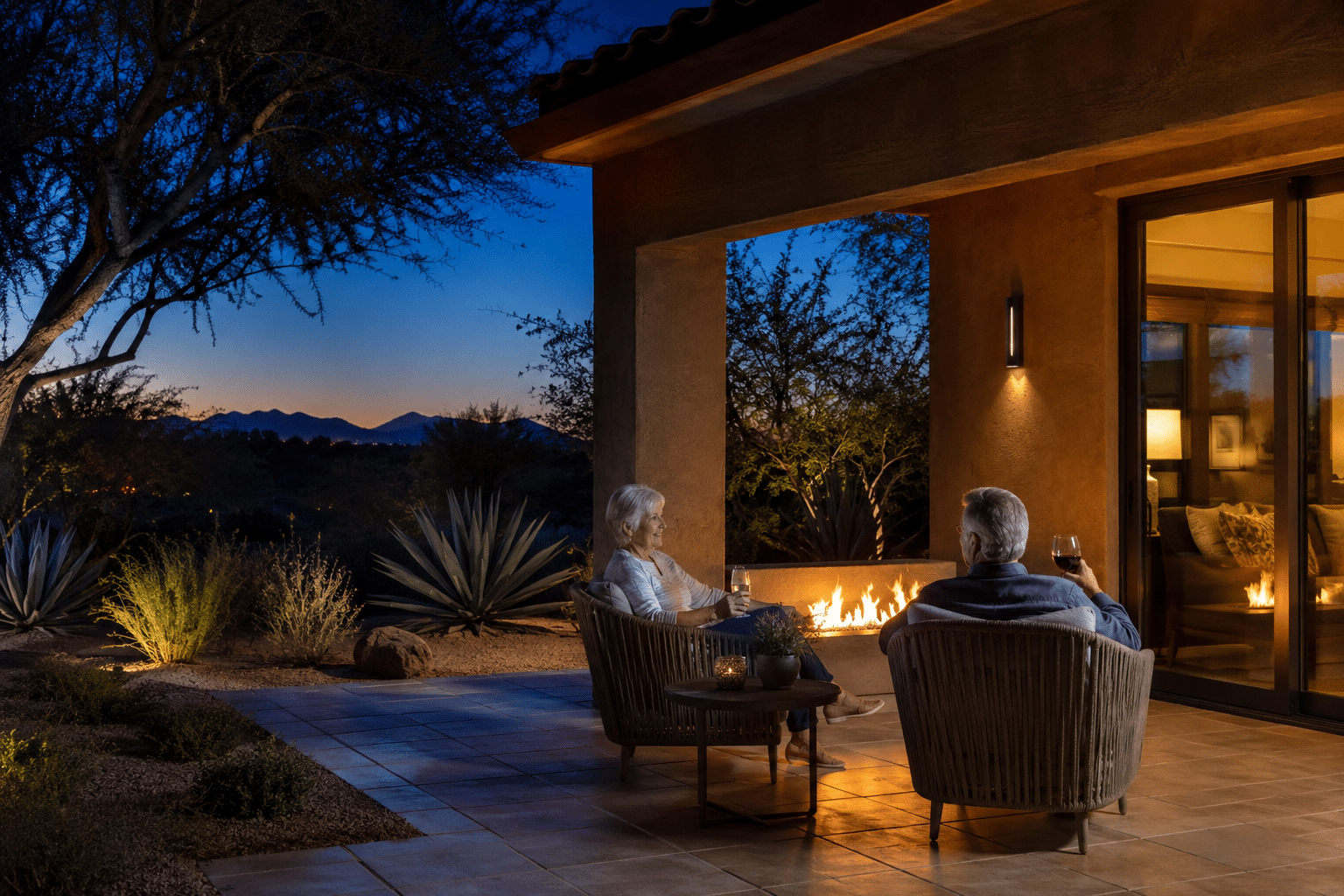
The 2026 financial picture at the property has three clear layers. The headline home price is the largest piece and the most variable. The HOA contribution is the most predictable. The optional layer, which covers the Alvea Spa membership tier and any golf annual-pass commitment, is where buyers tune the carrying cost to match how they actually intend to use the community.
Reported HOA dues at the community have been billed quarterly. HOA dues vary by sub-association; confirm current fees with the association or in the HOA disclosure during escrow. The dues cover Kiva and Mita Club access, common-area maintenance, and street upkeep, but specific buyers should always verify current dues, sub-association assessments where applicable, and reserve study status with the HOA before closing. Some sub-neighborhoods carry small additional sub-HOA assessments. The Alvea Spa is fee-for-service for personal treatments, and Trilogy Golf Club rounds are billed either by tee time or through resident annual-pass packages. A buyer who plans to play regularly should price an annual pass into year-one carrying cost rather than treat it as an after-the-fact decision.
For a specific home’s property tax, look up the parcel on the Maricopa County Treasurer’s website. Arizona offers a senior property valuation freeze for qualifying residents 65 and older with income below the program threshold; the program freezes the limited property value used in the tax calculation, which protects long-term residents from valuation creep. Buyers should review the program terms with the Maricopa County Assessor’s office before counting on it.
Pets are permitted under standard 55+ HOA rules with leashing on Discovery Trail and clubhouse grounds, waste pickup expected, and reasonable household limits. Assistance animals are considered as a reasonable accommodation and are not subject to pet restrictions. Snowbird ownership is common and the HOA’s reserve and operating budgets are written for a community where roughly a third of homes turn quieter for the summer months. Detailed tax-jurisdiction information is published by the Arizona Department of Revenue.
Trilogy at Vistancia is a 55-plus community subject to the federal Housing for Older Persons Act. At least one occupant of every home must be 55 or older, and no permanent resident may be under 19.
Reported HOA dues at Trilogy at Vistancia are billed quarterly for the standard package, which covers access to the Kiva Club and Mita Club, common-area maintenance, and street upkeep. Optional Alvea Spa services and Trilogy Golf Club rounds are billed separately. Always verify current fees with the HOA.
Pets are permitted at Trilogy at Vistancia. Standard CC&R rules around leashing in common areas, waste pickup on Discovery Trail and clubhouse grounds, and reasonable household limits apply. Owners should confirm any breed or count specifics directly with the HOA before purchase.
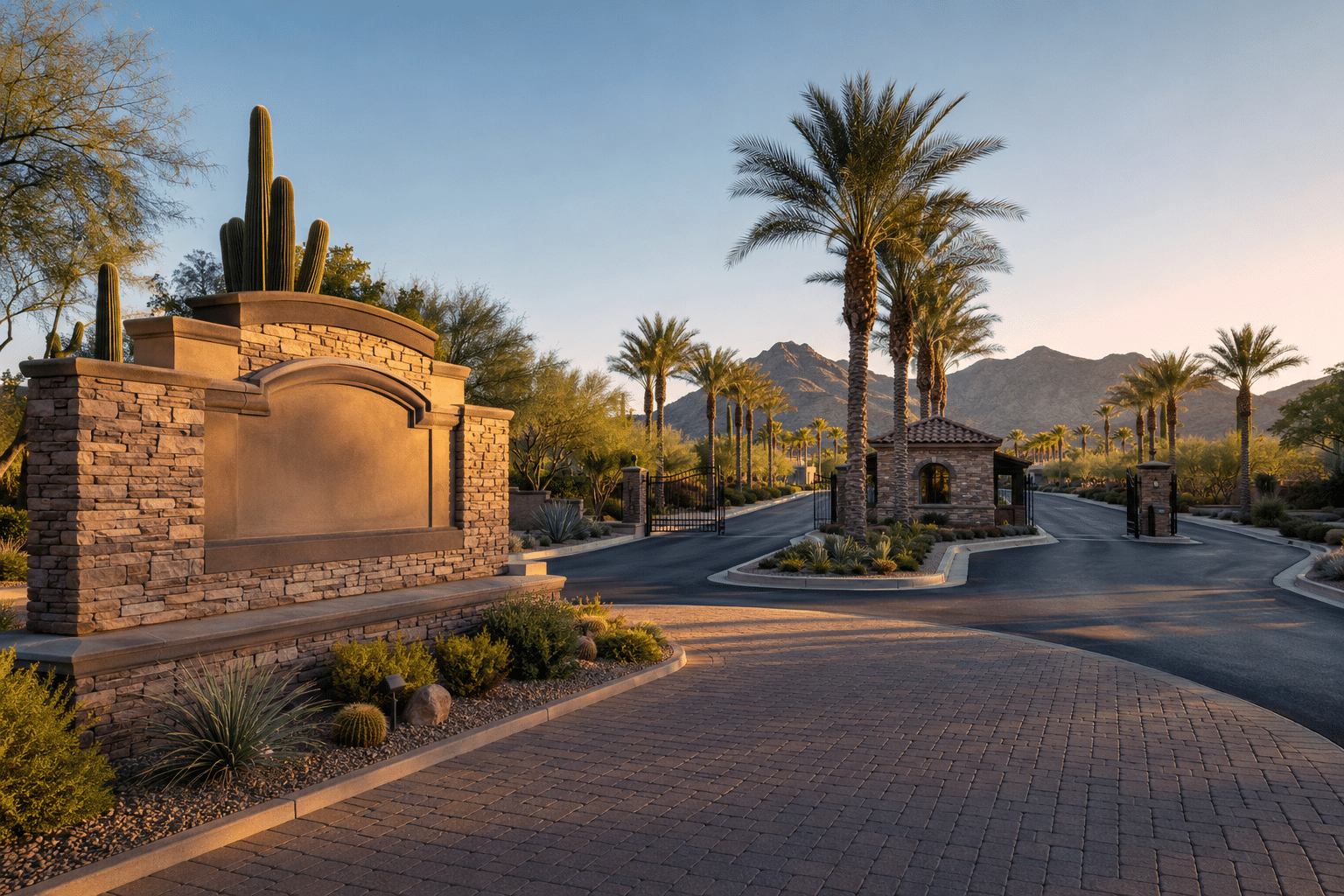
Yes. Both the original Kiva-side neighborhood and the newer Trilogy West (Mita) section operate guard-gated entrances with controlled vehicle access. The two sides share full amenity access for all residents.
Trilogy at Vistancia residents typically use a layered care model. A nearby Banner Health Center handles outpatient and primary care, while higher-acuity needs route to hospitals along the Loop 303 and Loop 101 corridors. Mayo Clinic Hospital in north Phoenix is reachable for tertiary specialty work.

A structured tour pays off here in a way a Saturday drive-through cannot. The property is large, the two sides feel distinct, and the amenity footprint is substantial enough that a half-day visit will miss what makes the place work. The most efficient sequence in 2026 starts before the buyer leaves home.
A virtual walkthrough is the right first step. Shea Homes and several specialty brokerages publish video walkthroughs of every standard floor plan and both clubhouses. Two hours of focused video review eliminates two-thirds of the available inventory for most buyers and clarifies the Kiva-versus-Mita question before a plane ticket gets booked.
The next step is a buyer-specialist phone or video call to map the virtual impressions onto current resale inventory and to clarify HOA dues, sub-HOA assessments, golf-pass options, and concierge-medicine setups specific to the household. Only then does the on-site visit become productive: a single day starting with the Kiva Club and golf course, lunch at V’s Taproom, an afternoon at the Mita Club and Alvea Spa, and a closing walk on the 3.5-mile Discovery Trail at dusk.
Buyers comparing Trilogy at Vistancia to other Shea Trilogy properties can review the Trilogy at Wickenburg Ranch profile for the high-desert ranch alternative, the PebbleCreek profile for a comparable Goodyear master plan, or the Sun City Festival profile for the far-west Del Webb option. A short conversation with a Peoria 55+ specialist before booking flights makes everything that follows sharper.
Also see Trilogy at Vistancia Homes for Sale.
We use cookies to improve your experience on our site. By using our site, you consent to cookies.
Manage your cookie preferences below:
Essential cookies enable basic functions and are necessary for the proper function of the website.
CloudFlare provides web performance and security solutions, enhancing site speed and protecting against threats.
Service URL: developers.cloudflare.com (opens in a new window)
Google Tag Manager simplifies the management of marketing tags on your website without code changes.
These cookies are used for managing login functionality on this website.
Statistics cookies collect information anonymously. This information helps us understand how visitors use our website.
Google Analytics is a powerful tool that tracks and analyzes website traffic for informed marketing decisions.
Service URL: policies.google.com (opens in a new window)
You can find more information about our Cookie Policy and Privacy Policy.