
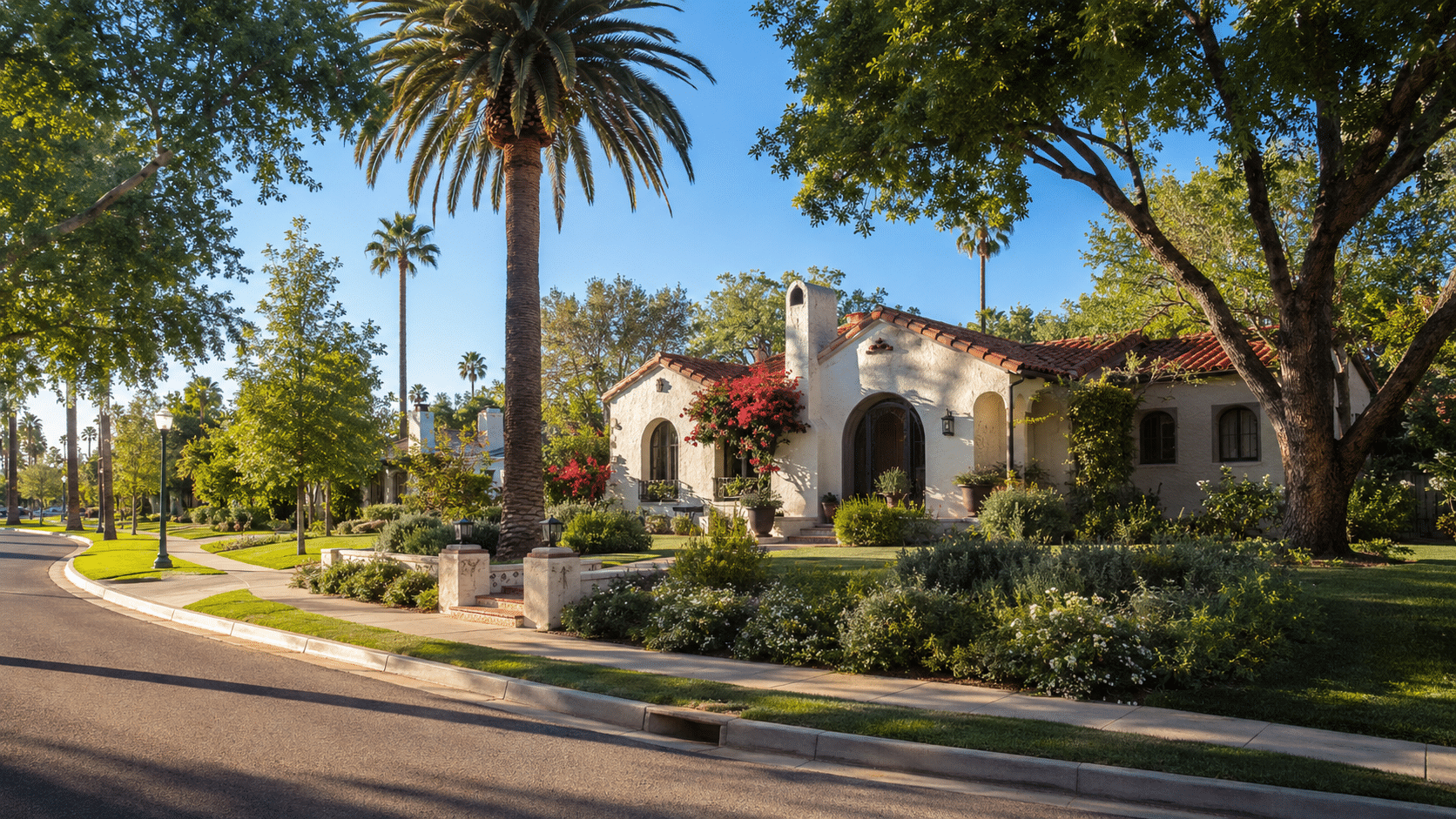
Encanto Village real estate anchors the most historic and walkable core of midtown Phoenix — an 8-square-mile Encanto Village that is the smallest of the City of Phoenix’s fifteen urban villages by area, and consequently one of its most densely built. Homes for sale in Encanto cluster within twenty-two historically designated neighborhoods — the greatest concentration of historic districts in all of Phoenix — including the prestige addresses of Encanto-Palmcroft and Willo, the tree-lined streets of Country Club Park and Brentwood, and the high-rise condominium inventory along the Central Avenue Corridor served by Valley Metro Light Rail.
The village runs from McDowell Road on the south to the Grand Canal on the north and east, and to Interstate 17 on the west. The urban village designation places Encanto inside the City of Phoenix planning framework alongside Central City and Alhambra as a member of the Central Phoenix cluster. Buyers comparing Encanto homes for sale against the broader Phoenix real estate market typically rank three things highest: walkability to Park Central, light rail access along Central Avenue, and proximity to landmarks like Encanto Park and the Heard Museum at the village’s southern edge.
The Encanto-Palmcroft Historic District is the most prestigious address inside Encanto Village and one of the most expensive historic neighborhoods in central Phoenix. Developed between 1928 and 1932 by the Encanto-Palmcroft Historic District under Dwight B. Heard Investment Company stewardship, the district was designed as a garden suburb in the City Beautiful tradition — winding, non-grid streets, ornamental landscaping, and an integrated 222-acre park on its western edge. The roughly 330 homes range from restored Spanish Colonial Revival and Monterey Revival estates to Tudor Revival and Pueblo Revival residences, with finished homes routinely trading above $1 million.
The Willo Historic District along 3rd Avenue between McDowell Road and Thomas Road is the most walkable of Encanto’s historic neighborhoods. The Willo Historic District features Tudor Revivals, Spanish Colonials, Pueblo styles, and Craftsman bungalows on tree-lined streets, with the annual Willo Home Tour drawing visitors from across the metro each February. Entry pricing for dated homes with good bones runs in the $450,000 to $650,000 range, while fully restored homes push past $800,000.
Country Club Park sits adjacent to the Phoenix Country Club along the village’s central core. The district carries authentic 1920s and 1930s bungalows at entry pricing below Willo and Encanto-Palmcroft — recent listings cluster between $350,000 and $500,000 for renovation candidates, making it one of the strongest renovation-to-value opportunities in Encanto Village real estate.
Brentwood, Yaple Park, Windsor Square, Del Norte Place, Medlock Place, and North Encanto round out a historic district inventory that no other Phoenix urban village can match in density. Every transaction in these districts triggers a preservation overlay review and zoning specifics that buyers and sellers should understand before drafting offers, and Encanto’s Village Planning Committee actively shapes infill development inside each district boundary.

Encanto Village real estate spans a narrower price range than most of Phoenix’s larger urban villages — but a deeper one in terms of architectural variety. Recent twelve-month closings in the Encanto-Palmcroft Historic District averaged near $697,557, with single-story luxury listings reaching the $1 million tier. Smaller homes and renovation candidates in Encanto-Palmcroft can be found in the high $500,000s to $650,000 range, while fully restored homes in Willo and Country Club Park push into the $800,000-$1.2 million tier depending on lot size and restoration scope. Country Club Park retains the village’s strongest entry pricing for renovation-minded buyers — original homes priced in the $350,000 to $500,000 range remain available, though inventory turns quickly. Homes for sale in Encanto Village average approximately 49 days on market in the Encanto-Palmcroft district per Homes.com data — close to the broader Phoenix metro figure but with substantial price-tier distribution.
The Central Avenue Corridor carries a parallel inventory of high-rise and mid-rise condominium units. Mid-rise condos near Park Central and Central Station start in the upper $200,000s for one-bedroom units and run into the $700,000s for larger floor plans in the newer Central Avenue mid-rises. The Valley Metro Light Rail stations between Encanto and Camelback Road give these properties a transit-adjacent profile that suburban Phoenix simply cannot offer.
Every transaction inside one of Encanto Village’s twenty-two historic districts triggers a preservation overlay review with specific exterior and lot-line rules that buyers and sellers should understand before drafting an offer. ARMLS-sourced comparative market analysis is the only reliable basis for accurate pricing in this submarket — automated estimates routinely miss the price-per-square-foot gaps between restored, partially restored, and original-condition homes within the same district. The Phoenix listing strategy resource at West USA Realty covers pre-list preparation specific to Phoenix historic homes.
Most homes in Encanto Village fall within the Osborn Elementary School District for kindergarten through eighth grade. Osborn operates several K-8 campuses inside or immediately adjacent to the village, including schools that families consistently identify as strong choice options for the central Phoenix neighborhoods. The district’s footprint is among the smallest in Maricopa County by area, but the density of historic-district residential blocks means most Osborn campuses sit within walking distance of multiple Encanto neighborhoods.
For grades nine through twelve, Encanto Village homes feed into the Phoenix Union High School District, with Central High School at Thomas Road and Central Avenue serving as the dominant comprehensive high school assignment for village addresses. Phoenix Union High School District operates magnet programs, Advanced Placement tracks, and International Baccalaureate pathways across its campuses; families touring homes in Encanto should pull current address assignment from PUHSD before making an offer, since boundary lines do shift.
The village also contains Phoenix College at 10th Avenue and Thomas Road — a Maricopa Community Colleges campus that has operated continuously since 1920 and now serves more than 12,000 students annually. Phoenix College’s presence inside the village contributes to a buyer-and-renter mix uncommon outside larger metros, and the campus hosts the Encanto Village Planning Committee in its Willo Conference Room each month. Charter and private school options across central Phoenix round out the picture, with several nationally respected private campuses sitting within commuting distance of Encanto neighborhoods
Encanto Park sits at the geographic and cultural heart of Encanto Village — 222 acres of mature canopy trees, lagoons, and recreation infrastructure that the Works Progress Administration built between 1934 and 1938. The park was modeled on the English Garden park tradition, inspired by Golden Gate Park in San Francisco and Balboa Park in San Diego, and integrated directly into the surrounding Encanto-Palmcroft subdivision plan. The Encanto Park masterplan was an unusually ambitious example of the City Beautiful Movement applied to a desert city, and the park has been recognized by Forbes as one of America’s Best City Parks.
Inside the park, Encanto Golf Course opened in 1935 and remains Arizona’s third-oldest golf course, with an 18-hole municipal layout that draws regular play from across the metro and serves as an affordable counterweight to north Phoenix’s resort-tier courses. Enchanted Island Amusement Park, the children’s amusement section in the park’s northwest corner, retains a carousel originally moved from California in 1934 — believed to be the oldest carousel in Arizona. Fishing lagoons, paddle boats, picnic ramadas, and the urban fishing program round out a recreation profile most major American cities cannot match inside a historic urban core.
At the village’s western edge, the Arizona State Fairgrounds and the Arizona Veterans Memorial Coliseum host the annual Arizona State Fair and a steady calendar of concerts and events. The Coliseum was the original home of the Phoenix Suns NBA franchise — the Arizona Veterans Memorial Coliseum opened in 1965 and remains one of the city’s most historically significant arena buildings.
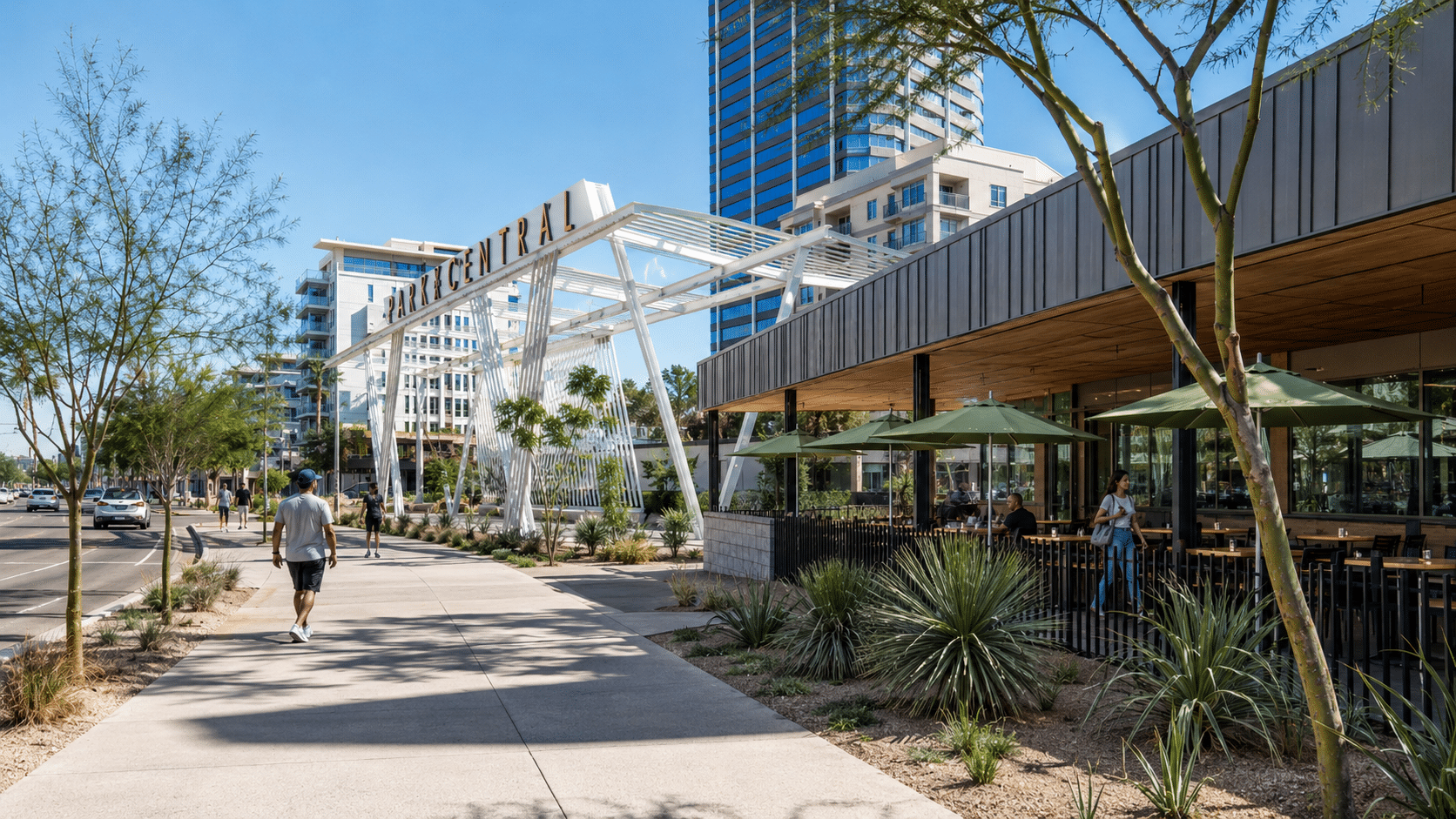
Park Central, the historic 1957 shopping center at Central Avenue and Earll Drive, is the formal core of Encanto Village in the City of Phoenix planning documents. The complex completed a major adaptive-reuse redevelopment that converted the original mid-century retail structure into a mixed-use destination with creative office, restaurants, and ground-floor retail — preserving the recognizable architecture while adding the kind of density and walkability the surrounding Midtown neighborhoods had lacked for two decades. The result is a working village core that anchors daily life across the surrounding historic districts.
To the north along Seventh Avenue between Indian School Road and Camelback Road, the Melrose District forms one of Phoenix’s most walkable independent retail corridors. The Melrose District carries antique shops, boutiques, cafes, and neighborhood restaurants in a low-rise streetscape that contrasts sharply with the Central Avenue high-rises one mile east. The annual Melrose on 7th Avenue Street Fair draws tens of thousands of visitors and consistently ranks among central Phoenix’s best independent events.
At the village’s southern edge along the Central Avenue Corridor, the Heard Museum at 2301 N. Central Avenue houses one of the world’s deepest collections of American Indian art and cultural history, attracting more than 250,000 visitors annually. The Phoenix Country Club — Arizona’s first golf club, founded in 1899 — anchors the village’s eastern flank with a private 18-hole layout that gives the surrounding Country Club Park historic district its name. The mix is hard to overstate: a working village core, an independent retail corridor, a major art museum, and a historic country club all sit inside Encanto’s 8-square-mile boundary.
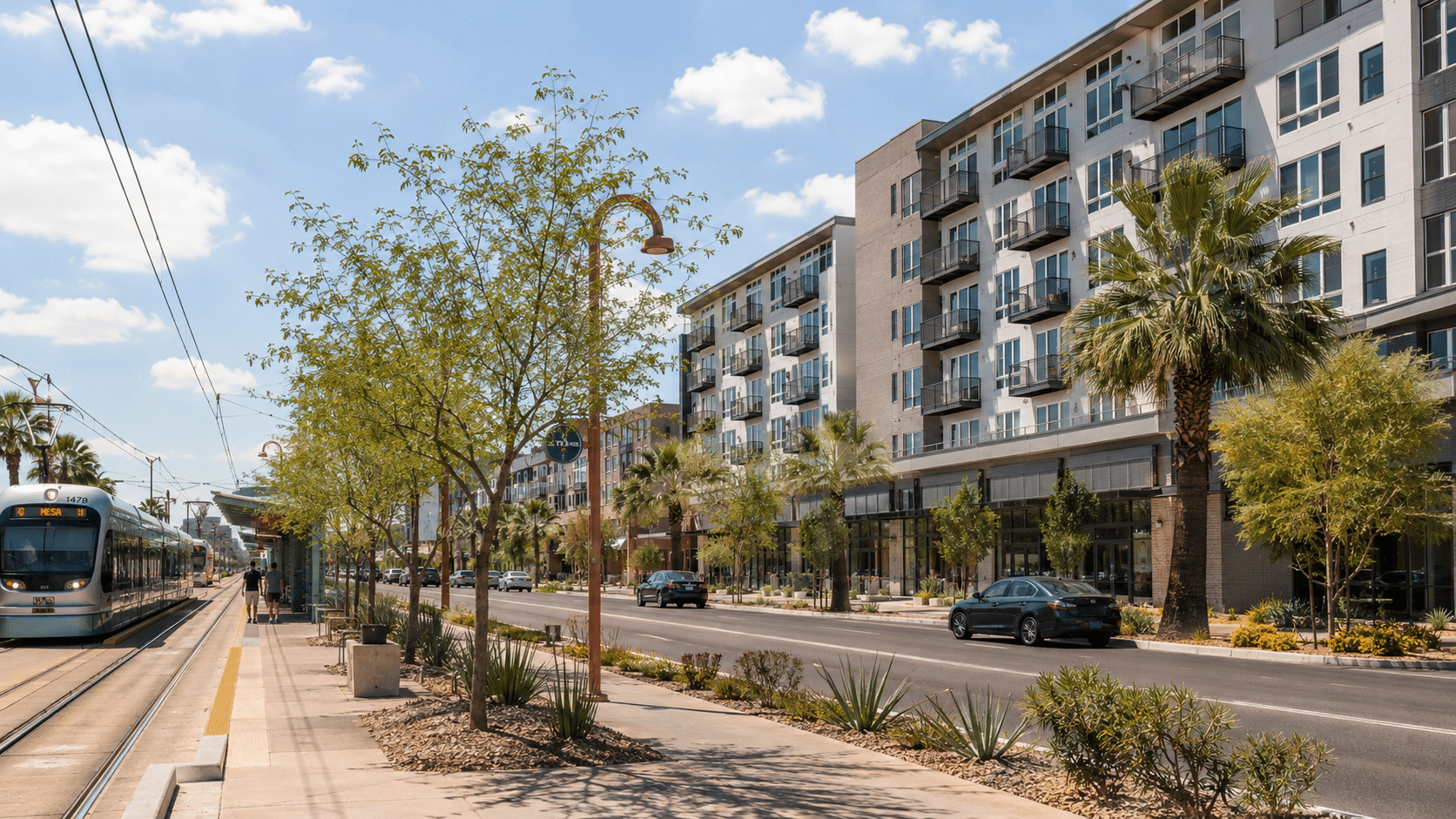
Valley Metro Light Rail runs the full length of Encanto Village along the Central Avenue Corridor, with multiple stations between McDowell Road and the Grand Canal serving the village’s residential blocks directly. The Encanto/Central, Thomas/Central, Osborn/Central, Indian School/Central, and Campbell/Central stations between them put most Encanto addresses within a five-to-ten-minute walk of light rail, which runs south to downtown Phoenix and Phoenix Sky Harbor International Airport via the PHX Sky Train connector, and continues north toward Camelback Road and Christown Spectrum. The Valley Metro Light Rail network makes Encanto one of only a handful of Phoenix urban villages where genuinely car-light daily life is practical — a fact that materially shapes the buyer base and the long-term value of Central Avenue Corridor inventory.
For freeway commuters, Interstate 17 (the Black Canyon Freeway) runs along the village’s western boundary, connecting south to I-10 and the Loop 202 interchange and north to Loop 101 and Deer Valley. The Grand Canal multi-use path along the village’s northern and eastern boundary adds a separated bike-and-walking corridor that connects east into Central City Village and continues north toward North Mountain Village. Sky Harbor sits roughly five miles southeast of most Encanto addresses — a 12 to 15 minute drive under normal traffic conditions, or roughly 20 minutes via light rail with the PHX Sky Train transfer.

Encanto Village real estate is one of the most district-driven submarkets in Phoenix. Within the same 8-square-mile village, Country Club Park trades from the $350,000s, Willo Tudor Revivals push past $800,000, and finished Encanto-Palmcroft estates routinely clear $1 million — which means averaging the village into a single median is more misleading than informative. Recent Encanto-Palmcroft Historic District twelve-month closings averaged near $697,557 per Homes.com data, with homes spending approximately 49 days on market — close to the broader Phoenix metro figure but with substantial price-tier distribution between original-condition and fully restored homes.
For sellers in Encanto Village, the most expensive mistake is pricing against the wrong district. The correct list price for a Willo Tudor is determined by Willo comparables, not Encanto-Palmcroft estates a half-mile away. Pre-list inspection reports, transferable warranties, and a clear historic-preservation review history all matter more in this submarket than in newer Phoenix neighborhoods — buyers conduct closer diligence on roof age, foundation work, and any prior unpermitted modifications inside designated historic districts. ARMLS-sourced comparative market analysis tailored to the specific district is the only reliable basis for accurate pricing.
For buyers, the preservation overlay that protects every Encanto historic district also constrains what can be modified — exterior materials, window replacements, and significant additions all require review before construction. The buyer’s guide at West USA Realty covers loan types, inspection priorities, and how historic-district purchases differ from standard resale transactions; the seller’s guide covers comparative market analysis and listing strategy for the current Phoenix market. Buyers comparing Encanto homes for sale against the midtown-adjacent established corridors also routinely shortlist Camelback East Village to the east before committing.
Encanto Village real estate rewards buyers and sellers who treat the village as the district-driven submarket it is, rather than averaging into Phoenix-wide medians. The combination of twenty-two historically designated neighborhoods, the 222-acre Encanto Park anchor, Valley Metro Light Rail along the Central Avenue Corridor, Park Central as a working village core, and the deepest concentration of preservation-overlay inventory in any Phoenix urban village gives Encanto a residential profile no other part of the city can replicate. Whether you are restoring a Tudor in Willo, evaluating an Encanto-Palmcroft estate, or weighing a renovation candidate in Country Club Park or Brentwood, the right next step is a direct conversation about district comparables, preservation-review timing, and pre-list preparation specific to historic homes in Encanto.
Whether you are exploring buying a home in Encanto, selling your Encanto home, or simply comparing Encanto homes for sale against other Phoenix urban villages under current market conditions, the next step is a direct conversation. Reach Carl at (602) 518-4440 or chapman@westusa.com to begin.
Encanto Village sits in central Phoenix, immediately north of Central City Village and the downtown core. The village is bounded by McDowell Road on the south, Interstate 17 (the Black Canyon Freeway) on the west, and the Grand Canal on the north and east. At approximately 8 square miles, Encanto is the smallest of the City of Phoenix’s fifteen urban villages by area — and consequently one of the most densely built. The core of the village is Park Central along the Central Avenue Corridor, with the village extending west to the Arizona State Fairgrounds and east to the Phoenix Country Club. Encanto Village is one of three urban villages that make up the Central Phoenix cluster, alongside Central City Village to the south and Alhambra Village to the west.
Encanto Village real estate prices vary significantly by historic district. The Encanto-Palmcroft Historic District averaged near $697,557 across the most recent twelve months of closings per Homes.com data, with finished Spanish Colonial Revival and Tudor Revival estates frequently clearing $1 million. Smaller homes and renovation candidates in Encanto-Palmcroft start in the high $500,000s. The Willo Historic District runs from the $450,000s for dated homes with good bones into the $800,000s for fully restored properties. Country Club Park, adjacent to Phoenix Country Club, retains the village’s strongest entry pricing — original homes priced from the $350,000s to the $500,000s remain available for renovation-minded buyers. Mid-rise condominium inventory along Central Avenue runs from the upper $200,000s to the $700,000s. Encanto Village homes for sale average approximately 49 days on market in the prestige districts.
Encanto Village contains twenty-two historically designated neighborhoods — the greatest concentration of historic districts in any Phoenix urban village. The most-searched among them are Encanto-Palmcroft, developed 1928-1932 by Dwight B. Heard Investment Company and the village’s most prestigious address; Willo, Phoenix’s most walkable historic district between McDowell Road and Thomas Road; and Country Club Park, adjacent to Phoenix Country Club. Other named districts inside Encanto include Brentwood, Yaple Park, Windsor Square, Medlock Place, Del Norte Place, North Encanto, and Pierson Place. Every district carries its own preservation overlay rules, distinct architectural style mix, and price tier. Buyers and sellers transacting inside any of these districts should work with a Phoenix realtor familiar with the specific district’s review process, since exterior modifications, window replacements, and additions require historic preservation review before construction.
For the full architectural and developmental history of the village’s most prestigious district, see the Encanto-Palmcroft Historic District Wikipedia entry.
Encanto-Palmcroft and Willo are both inside Encanto Village but differ on lot size, price tier, and street layout. Encanto-Palmcroft sits at the western edge of the village adjacent to Encanto Park, with approximately 330 homes on winding, non-grid streets and lots that often exceed a quarter acre. The district was developed as a garden suburb in the City Beautiful tradition and is widely cited as the wealthiest historic neighborhood in Phoenix — finished homes routinely trade above $1 million. Willo sits roughly a mile southeast, between 3rd and 7th Avenues from McDowell Road to Thomas Road, on a tighter grid of walkable blocks and smaller lots. Willo is more architecturally diverse (Tudor Revival, Spanish Colonial, Pueblo, and Craftsman) and carries broader price-tier accessibility, with restored homes pushing past $800,000 and renovation candidates starting in the $450,000s. The choice between the two usually comes down to lot size, street layout preference, and budget.
Most homes in Encanto Village fall within the Osborn Elementary School District for kindergarten through eighth grade, with high school addresses assigned to the Phoenix Union High School District and Central High School at Thomas Road and Central Avenue. Phoenix College, a Maricopa Community Colleges campus at 10th Avenue and Thomas Road, has operated inside the village since 1920 and now serves more than 12,000 students annually. Charter and private school options across central Phoenix round out the picture. Family buyers should pull current address assignment from each district before making an offer, since boundary lines do shift.
For the City of Phoenix’s official Encanto Village page and Village Planning Committee meeting schedule, see the official Encanto Village page.
Yes — Valley Metro Light Rail runs the full length of Encanto Village along the Central Avenue Corridor, with stations at Encanto/Central, Thomas/Central, Osborn/Central, Indian School/Central, and Campbell/Central serving the village’s residential blocks directly. Most Encanto addresses sit within a five-to-ten-minute walk of a station. The light rail connects south to downtown Phoenix and Phoenix Sky Harbor International Airport via the PHX Sky Train connector, and continues north toward Camelback Road and Christown Spectrum. Encanto Village is one of the only Phoenix urban villages where car-light daily life is practical year round, and that connectivity is consistently one of the village’s most-cited buyer advantages over comparable established neighborhoods elsewhere in Maricopa County.
We use cookies to improve your experience on our site. By using our site, you consent to cookies.
Manage your cookie preferences below:
Essential cookies enable basic functions and are necessary for the proper function of the website.
You can find more information about our Cookie Policy and Privacy Policy.