

Eighteen years after the original Sun City defined the American 55+ masterplan, Del Webb opened the second one and refined almost everything that mattered. Sun City West launched in 1978 as Del Webb’s second unincorporated age-restricted community, eight miles west of the original. Lot sizes grew. Recreation centers consolidated rather than scattered. Golf courses integrated more naturally into the street grid. The amenity mix shifted from card rooms toward fitness centers two decades before the broader retirement industry caught up. What buyers find today on the western side of Bell Road is the version of the Del Webb formula that had time to learn from itself.
The community sits roughly twenty-five miles northwest of downtown Phoenix on about twelve square miles of West Valley desert and functions as a retirement town rather than a development. Sun City West holds its own ZIP code at 85375, its own fire district, its own chamber of commerce, an in-borders acute care hospital named after the developer himself, and roughly 25,000 to 28,000 residents who chose the Northwest Valley because it does not require a city hall to feel complete.
The texture of daily life shows up in small specifics. Golf carts share the inside lanes of R.H. Johnson Boulevard with cars on the way to morning fitness class at Palm Ridge. The Stardust Theatre at Kuentz Recreation Center runs first-run films at matinee prices most weekday afternoons. The library at R.H. Johnson lends both books and adaptive equipment for short-term medical needs.
None of this is unusual for an established age-restricted community. What is unusual is how integrated it feels. Recreation centers, golf courses, the medical campus, and volunteer infrastructure knit together without the visual clutter of newer master-planned developments. Architecture follows a consistent low-slung Sonoran palette of stucco walls, tile roofs, and desert-adapted yards. Streets curve in long quiet arcs. Trees are mature, irrigation is settled, and the housing stock has cycled through enough resale generations that wholesale neighborhood transformation no longer happens on any visible timeline.
Most age-restricted communities in metro Phoenix sit inside a municipality. Sun City West sits inside itself. The community has remained unincorporated by deliberate resident vote since 1978. It supports its own recreation funding entity in the Recreation Centers of Sun City West and runs a service ecosystem that includes the Sun City West Foundation, the Sun City West Sheriff’s Posse, and a Maricopa County Library District branch. For most of daily life, residents rarely drive outside community boundaries except for grocery shopping, specialty retail, and certain medical appointments. The functional result is a town that votes against ever becoming one.
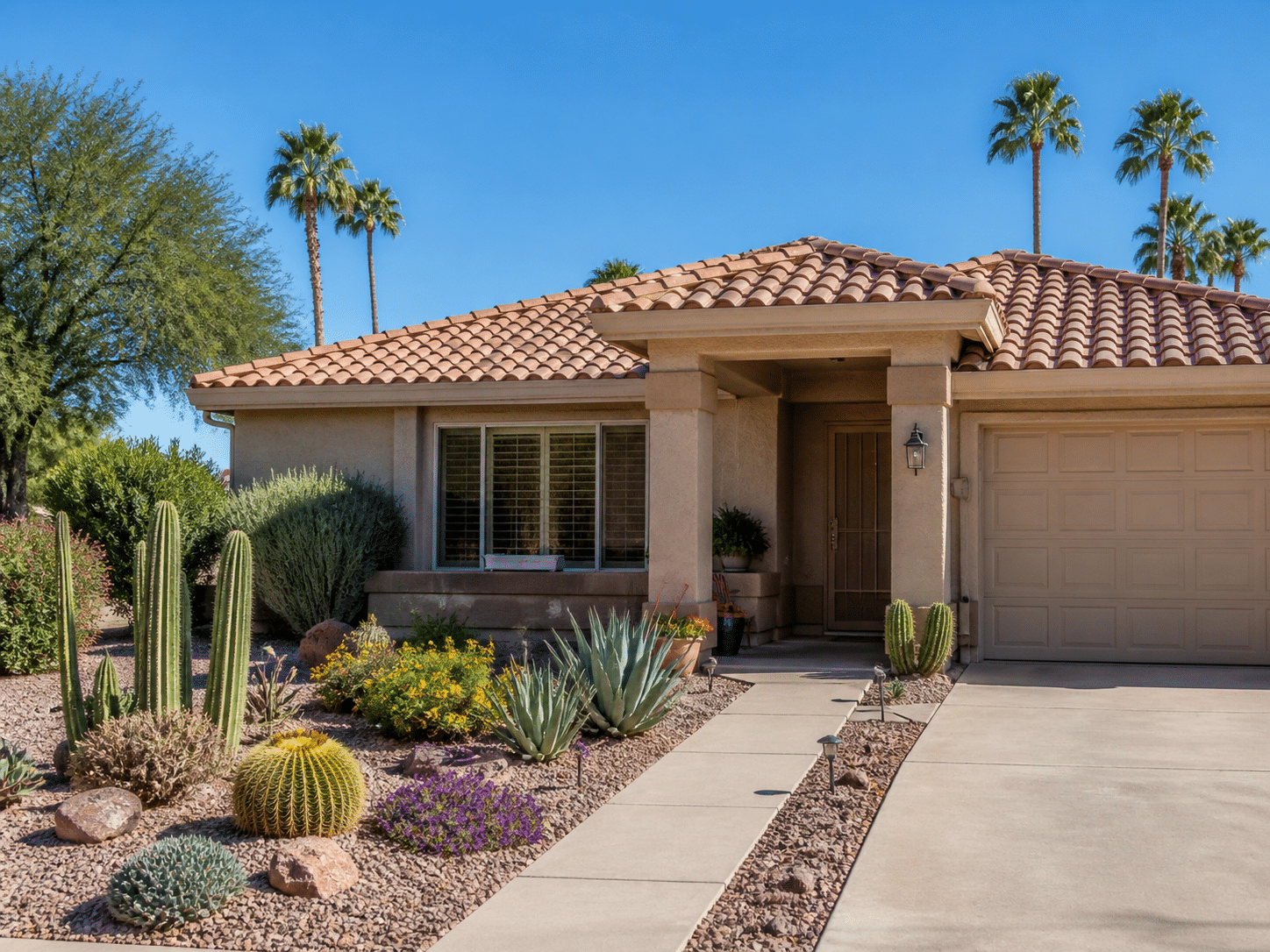
The community’s housing stock came online over a roughly twenty-year window starting in 1978 and tapering off in the late 1990s. That timing matters less than the cohorts inside it. Del Webb — the original company, before the PulteGroup acquisition in 2001 — built almost all of Sun City West. He built it in distinct waves, and the construction era of any given home tells a buyer most of what they need to know about how it lives today.
The earliest homes, built between 1978 and roughly 1985, occupy the eastern portion of the community closer to Bell Road and the original Sun City corridor. These are typically smaller — patio homes from about 800 to 1,400 square feet — with simpler floor plans, attached single-car or single-and-a-half-car garages, and lots that prioritize low maintenance over outdoor living space. The second wave, built from the mid-1980s through the early 1990s, added square footage and amenity counts: master baths grew, kitchens opened, two-car garages became standard, and golf-frontage lots multiplied. The final wave, completed by 1998, leaned toward larger custom and semi-custom homes on the western edges, with three-car garages, separate primary suites, and room counts that sometimes pushed past 2,500 square feet.
A buyer who looks only at the year of construction will misjudge the home. A 1982 patio home that has been gutted and updated in 2022 lives like a current-decade build inside the bones of an early-cohort lot. A 1996 custom that has not been touched in twenty years can feel dated despite generous square footage. The resale market in Sun City West rewards walking the home, not reading the deed.
Across the eras, Sun City West homes share a recognizable architectural DNA — single-story construction, low pitched roofs, stuccoed walls, attached covered entries, and front-yard desert landscaping that the recreation centers’ landscaping committee actively monitors against unauthorized planting. Floor plans range from compact one-bedroom patio designs through three- and four-bedroom layouts on golf-course lots. Many original models have been sufficiently renovated that interior walls do not match the original blueprint. A handful of the larger custom homes, particularly along the Pebblebrook and Grandview corridors, were never built to a published plan at all.

The amenity footprint is the headline that draws buyers and the reality that keeps them. The Recreation Centers of Sun City West, known as RCSCW, owns and operates four large activity centers and seven golf courses inside the community. Two independently managed regulation courses — Briarwood Country Club and Hillcrest Golf Club — bring the total to nine. The combined recreation footprint runs to several hundred acres and supports a programming calendar that genuinely fills a week.
The four centers split the community geographically and functionally. R.H. Johnson Recreation Center is the original and largest at 48 acres along R.H. Johnson Boulevard. It holds the Sports Pavilion, the corporate offices of RCSCW, the central library, both dog parks, the renovated outdoor resort pool, miniature golf, and a dense cluster of arts-and-crafts buildings. The Sports Pavilion alone houses a 30-lane bowling center and a 27-table billiards hall. Most chartered hobby clubs run out of the surrounding R.H. Johnson buildings.
Palm Ridge Recreation Center anchors the western section. It offers three pools — two indoor, one outdoor — an indoor walking track suspended above the pool deck, a modern fitness center, pickleball courts, and a ballroom that handles larger evening events. Beardsley Recreation Center at 12755 West Beardsley Road runs an Olympic-size indoor pool, a fitness center, the model railroad clubhouse, a greenhouse, a playground for visiting grandchildren, and ramada-shaded picnic spaces. Kuentz Recreation Center at 14401 R.H. Johnson Boulevard houses the Stardust Theatre, the woodworking shop with cabinet-grade tools, an outdoor pool and spa, and the softball field.
The seven RCSCW golf courses include four regulation eighteen-hole layouts — Pebblebrook, Echo Mesa, Trail Ridge, and Grandview — and three executive-length Par 60 courses — Stardust, Deer Valley, and Desert Trails. Per-round rates remain among the lowest in the Phoenix metro for golf of this quality. An annual cardholder pass covers unlimited play across all seven. Grandview hosted the LPGA Legends Tour from 2012 to 2014. Briarwood Country Club, managed by Troon, offers private membership with social and proprietary equity options. Hillcrest Golf Club is the public-access regulation course on the eastern edge and has hosted Senior PGA and LPGA Tour events.
Beyond golf, the community supports a deep portfolio of secondary sports. Across the four centers, residents have access to twenty-seven tennis courts, twenty-seven pickleball courts, fourteen bocce courts, thirty-two lawn bowling rinks, six swimming pools, indoor and outdoor walking tracks, racquetball, table tennis, miniature golf, and the softball field at Kuentz. Lawn bowling has a competitive history here. The rinks are tournament-grade, and several residents arrived specifically because the sport’s footprint is one of the largest in the country. The 30-lane bowling center keeps league play running through most of the year, with morning and afternoon flights that fill quickly during the high season.

Recreation centers are facilities. Clubs are what make a 55+ community feel like a place rather than a hotel. Sun City West has more chartered clubs than most American small towns. The published count runs well over three hundred member-organized groups. Categories range from the predictable — book club, bridge group, garden club — through the specialized — lapidary, silvercraft, model railroad, ham radio — to the unusual — writing circles, auto restoration, computer repair guilds, drone photography. The arts-and-crafts village at R.H. Johnson alone houses over a hundred chartered clubs in dedicated buildings.
The club system runs on volunteer leadership and modest dues. Most clubs charge a nominal annual membership fee — often $10 to $40 — that covers materials, equipment maintenance, and instructor honoraria. The system rewards depth of interest. A new resident who shows up for the first ceramics meeting in October will, by April, have access to communal kilns, mentoring from members with decades of practice, and a place in the spring exhibition rotation. The same pattern repeats across woodworking, silversmithing, painting, sewing, dance, and the various performing groups attached to the Stardust Theatre.
Sun City West has several volunteer backbones. The Sun City West Foundation funds local nonprofits. The library auxiliary supports programming. The Pride Trust maintains landscaping along the major boulevards. The volunteer hour count across these organizations runs into the hundreds of thousands annually.
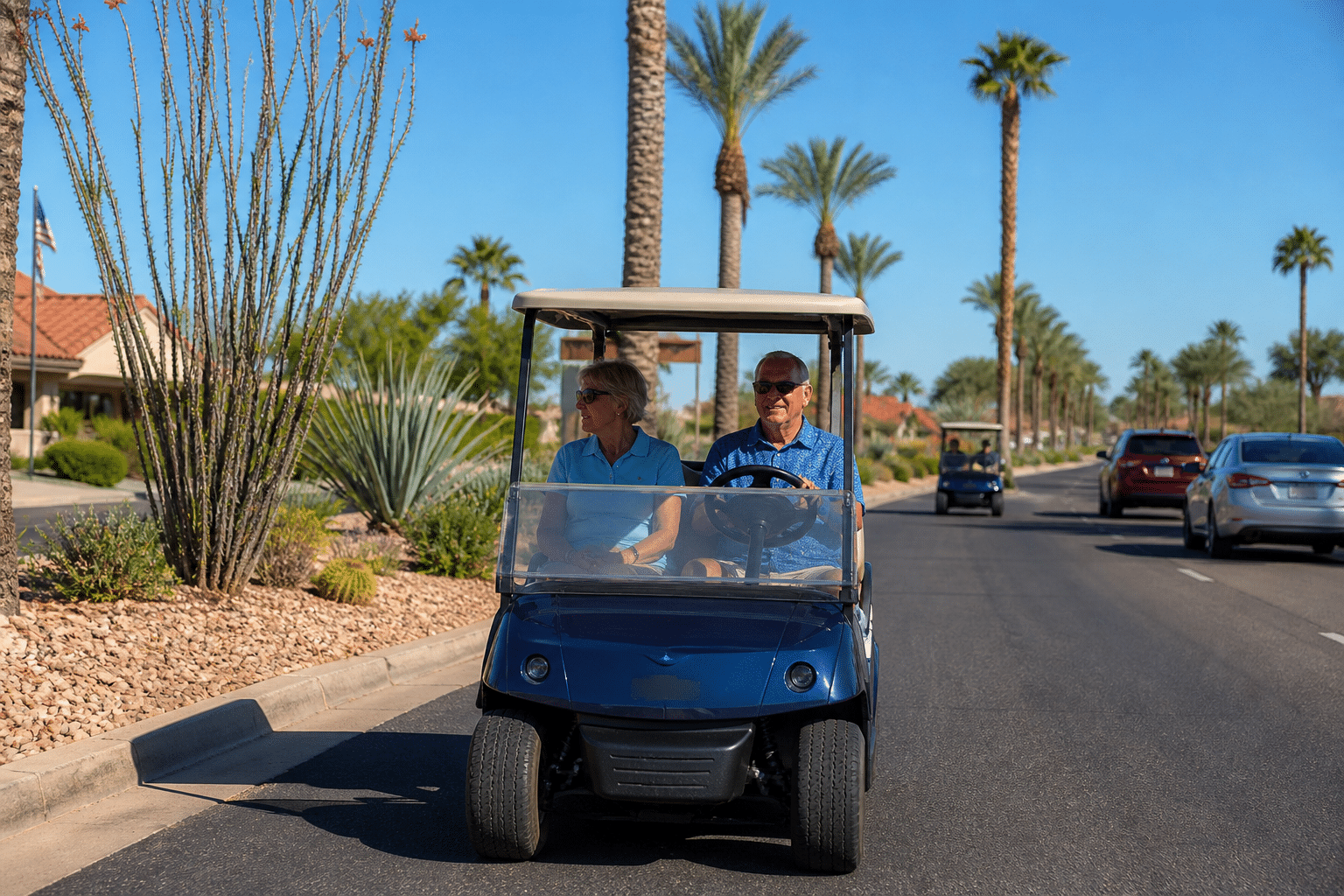
The community’s geography is straightforward and worth understanding before any tour. Sun City West occupies the wedge of West Valley desert bounded by Bell Road on the north and Grand Avenue on the south. R.H. Johnson Boulevard runs east-west through the interior as the primary artery, and 99th Avenue and Camino del Sol form the secondary internal grid. Loop 303 lies a few miles west; Loop 101 lies several miles east. Both reach Phoenix Sky Harbor International Airport in roughly forty-five minutes outside rush hour. The original Sun City sits immediately east, separated only by 99th Avenue, and Sun City Grand sits immediately northwest along Bell Road. Together the three communities form what longtime real estate agents call Retirement Row — the densest concentration of age-restricted households anywhere in Arizona.
The terrain itself reads as flat West Valley desert with the White Tank Mountains visible to the southwest, low alluvial plain in every direction, and a desert sky that residents describe as the unobstructed kind. Mature palm boulevards line several of the major internal streets. Desert-adapted landscaping fills front yards. The community’s elevation runs around 1,200 feet above sea level, low enough to keep winter temperatures consistently warm and high enough to avoid the lowest urban heat-island effects of central Phoenix.
A twenty-minute drive from community boundaries reaches a usable inventory of services. A full Banner Health hospital campus sits inside the borders. The Surprise commercial corridor along Bell Road and Litchfield Road carries Costco, Trader Joe’s, and Safeway anchors. Surprise Stadium hosts spring training during Cactus League play each February and March. The Wildlife World Zoo and Aquarium sits just south on Northern Avenue, and the entrance to the White Tank Mountain Regional Park system reaches in about fifteen minutes southwest, with hiking, picnic, and waterfall trails. Lake Pleasant Regional Park lies thirty minutes north for a boating or extended hiking outlet. The Westgate Entertainment District in Glendale, with its restaurants, the State Farm Stadium home of the Arizona Cardinals, and substantial retail, sits about thirty-five minutes east on Loop 101.
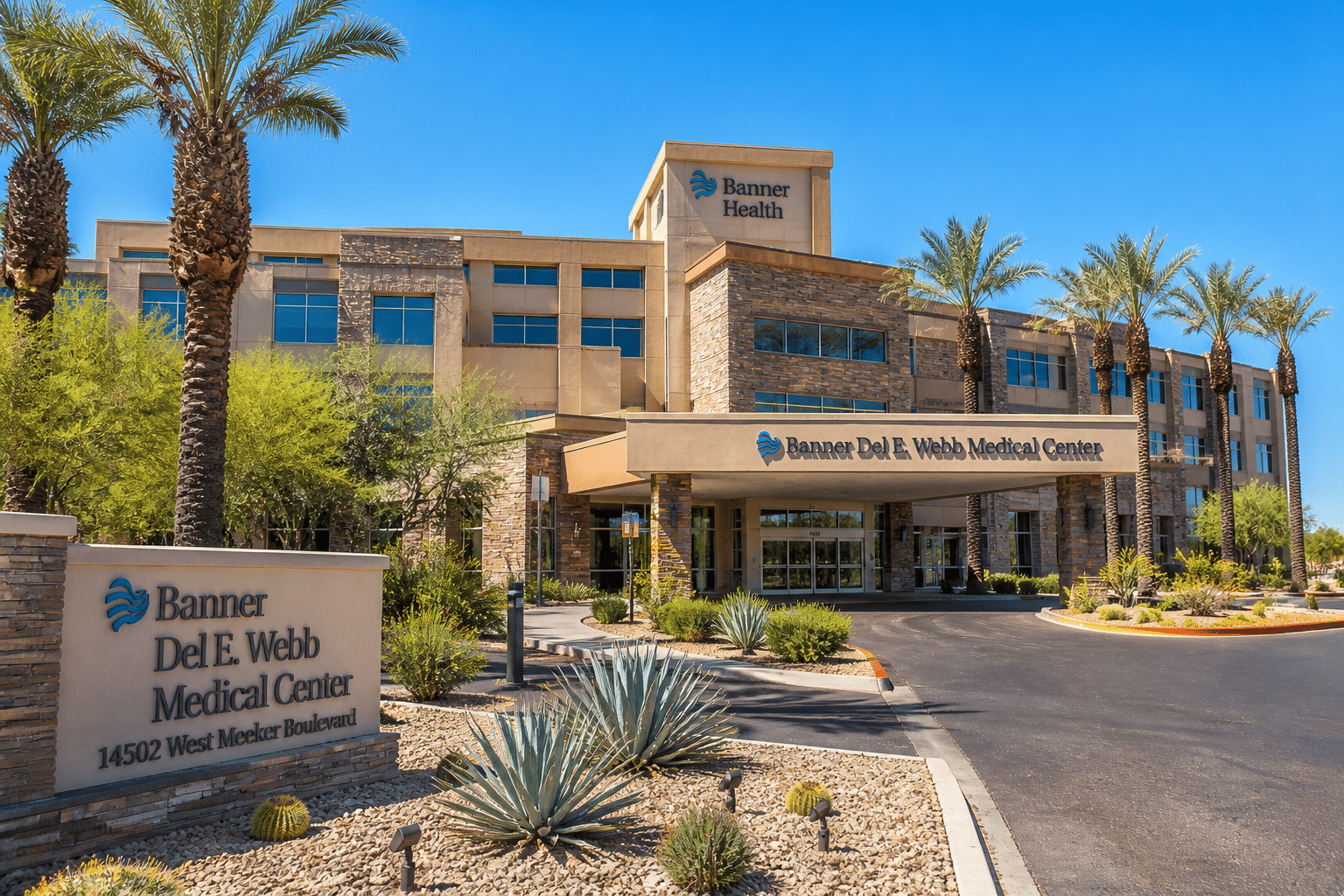
Healthcare access at Sun City West is unusual in two ways. First, it begins inside the community boundaries rather than outside them. Second, it is anchored by a service-line specialty profile — cardiac, stroke, orthopedic, and oncology — that reflects what an age-restricted population actually uses rather than the general acute-care mix of a regional hospital. Most age-restricted communities in metro Phoenix have to drive ten to fifteen minutes for emergency care. Sun City West has its emergency department on West Meeker Boulevard at the southern end of community.
Banner Del E. Webb Medical Center opened in 1988 at 14502 West Meeker Boulevard. The hospital’s specialty profile reflects its patient mix: stroke care, robust cardiac catheterization and surgery programs, women’s health and maternity services, robotic surgery suites, and orthopedic programs anchored around joint replacement. A BannerAir helicopter flies from the campus for trauma transfers. The medical staff includes more than 230 physicians across roughly fifty specialty areas, and an attached medical-office building houses the bulk of the local outpatient specialist network. For residents whose care concentrates on cardiac, orthopedic, or oncologic conditions, the campus often supports the entire treatment plan without a drive into central Phoenix.
Beyond the hospital itself, Sun City West residents have access to the Sun Health continuum of services. Sun Health is a long-running senior-focused nonprofit with research, wellness, and continuing-care arms operating in the area. Banner and other providers run urgent care locations within a few miles in Surprise and Peoria. Specialty centers reach in twenty to thirty minutes for everything from neurology to dermatology. Mayo Clinic Hospital in north Phoenix sits roughly forty minutes east for residents whose conditions warrant tertiary care. The practical pattern most seasoned residents settle into is straightforward. Primary care and routine specialists run at or near Banner Del E. Webb. Condition-specific tertiary care sits eastward at the academic medical centers in central and north Phoenix as needed. Medicare Advantage plan selection covers the full network for most retirees.
The financial profile of Sun City West breaks differently from most metro-area master plans because the community does not run on a traditional HOA structure. Most homes are not subject to the kind of monthly HOA dues common in Surprise, Goodyear, or Peoria active adult communities. Instead, residents pay an annual mandatory recreation assessment to RCSCW that funds the four recreation centers and seven golf courses. The trade-off is real and worth understanding before signing.
HOA dues vary by sub-association; confirm current fees with the association or in the HOA disclosure during escrow. The catch is that a one-time Preservation and Improvement Fee applies at every property transfer, paid by the buyer, and certain subdivisions inside Sun City West — notably some condominium and patio-home enclaves — charge an additional sub-association fee for shared exterior maintenance, gated parking, or building reserves. Most stand-alone single-family homes do not carry that secondary fee.
Sun City West’s unincorporated status places it in unincorporated Maricopa County for property tax purposes, with no municipal property tax layer. For a specific home’s property tax, look up the parcel on the Maricopa County Treasurer’s website. Arizona’s senior valuation programs offer additional relief for qualifying long-term residents on fixed income. Resale values have followed a long-term upward trajectory tracking the broader metro Phoenix market, with the resale-only nature of the community producing slower turnover than newer communities and a buyer profile that tends to plan multi-decade ownership horizons. The honest framing for total cost of ownership is straightforward. Headline home prices in Sun City West typically run lower than equivalent square footage in newer Surprise or Goodyear communities. The trade-off is age of construction and the resulting maintenance and renovation timeline.
Sun City West is an age-restricted community where at least one resident in each home must be 55 or older, and no resident may be under 19. The community operates under the federal Housing for Older Persons Act exemption and enforces the age rule through the Recreation Centers of Sun City West.
Sun City West does not have traditional HOA fees on most homes. Instead, residents pay an annual mandatory dues assessment to the Recreation Centers of Sun City West for amenity access. Some condominium and patio-home subdivisions inside the community may charge a separate sub-association fee.
Pets are permitted at Sun City West. The community maintains two dedicated dog parks at the R.H. Johnson Recreation Center, one for large dogs and one for small dogs, and most subdivisions allow dogs and cats subject to standard nuisance and leash rules. Assistance animals are considered as a reasonable accommodation and are not subject to pet restrictions.
Sun City West is not gated. It is an open age-restricted community with public streets, although recreation center access is controlled and limited to RCSCW cardholders and their guests. Most internal residential streets read as quiet, low-traffic suburban roads.
Banner Del E. Webb Medical Center sits inside the community on West Meeker Boulevard and operates a 404-bed acute care hospital with cardiac, stroke, orthopedic, and emergency services. Sun Health and several outpatient clinics serve residents within community boundaries, with additional specialists at Banner facilities throughout the Northwest Valley.

A first-time visit reveals more if a buyer arrives prepared. The community is large, the housing stock varies by construction era, and the recreation footprint is too distributed for a casual drive-through to capture. The most productive first visits combine a structured rec-center tour, a deliberate driving loop through three different home cohorts, and a conversation with at least one specialist agent who handles Sun City West resale exclusively.
First, obtain the official RCSCW rec-center tour schedule and align a visit to one of the monthly walk-throughs. These tours are free, take ninety minutes, and reveal the specific clubs and amenities a brochure cannot describe. Second, drive at least three different residential streets across the early — pre-1985 — middle — 1985-1992 — and late — 1993-1998 — construction cohorts. The housing-stock variation will be visible rather than hypothetical. Third, plan the visit during the October-through-April high season when the community is at full population. A July visit will under-represent the social texture by an order of magnitude.
[IMAGE 10: A residents’ welcome event at a Sun City West clubhouse social hall with five or six residents in casual conversation around a beverage table in warm interior light]
Once those preparations are complete, the on-site tour does what a brochure cannot. It answers whether Sun City West fits the way you want to live. From there, a West USA Realty agent who knows Sun City West can set up a tour appointment and compare the community directly to the original Del Webb masterplan next door. To get started, contact Carl Chapman with the Zona Team at West USA Realty: call or text (602) 617-4440 or email chapman@westusa.com. To consider a newer alternative in the West Valley or a golf-focused community in Goodyear, browse the full Northwest Valley 55+ inventory. For broader context, see the Recreation Centers of Sun City West official site, the Banner Del E. Webb Medical Center service profile, the Maricopa County Parks page on White Tank Mountain Regional Park, the Arizona Department of Health Services profile, and the City of Surprise events portal for high-season programming.
We use cookies to improve your experience on our site. By using our site, you consent to cookies.
Manage your cookie preferences below:
Essential cookies enable basic functions and are necessary for the proper function of the website.
CloudFlare provides web performance and security solutions, enhancing site speed and protecting against threats.
Service URL: developers.cloudflare.com (opens in a new window)
Google Tag Manager simplifies the management of marketing tags on your website without code changes.
These cookies are used for managing login functionality on this website.
Statistics cookies collect information anonymously. This information helps us understand how visitors use our website.
Google Analytics is a powerful tool that tracks and analyzes website traffic for informed marketing decisions.
Service URL: policies.google.com (opens in a new window)
You can find more information about our Cookie Policy and Privacy Policy.