
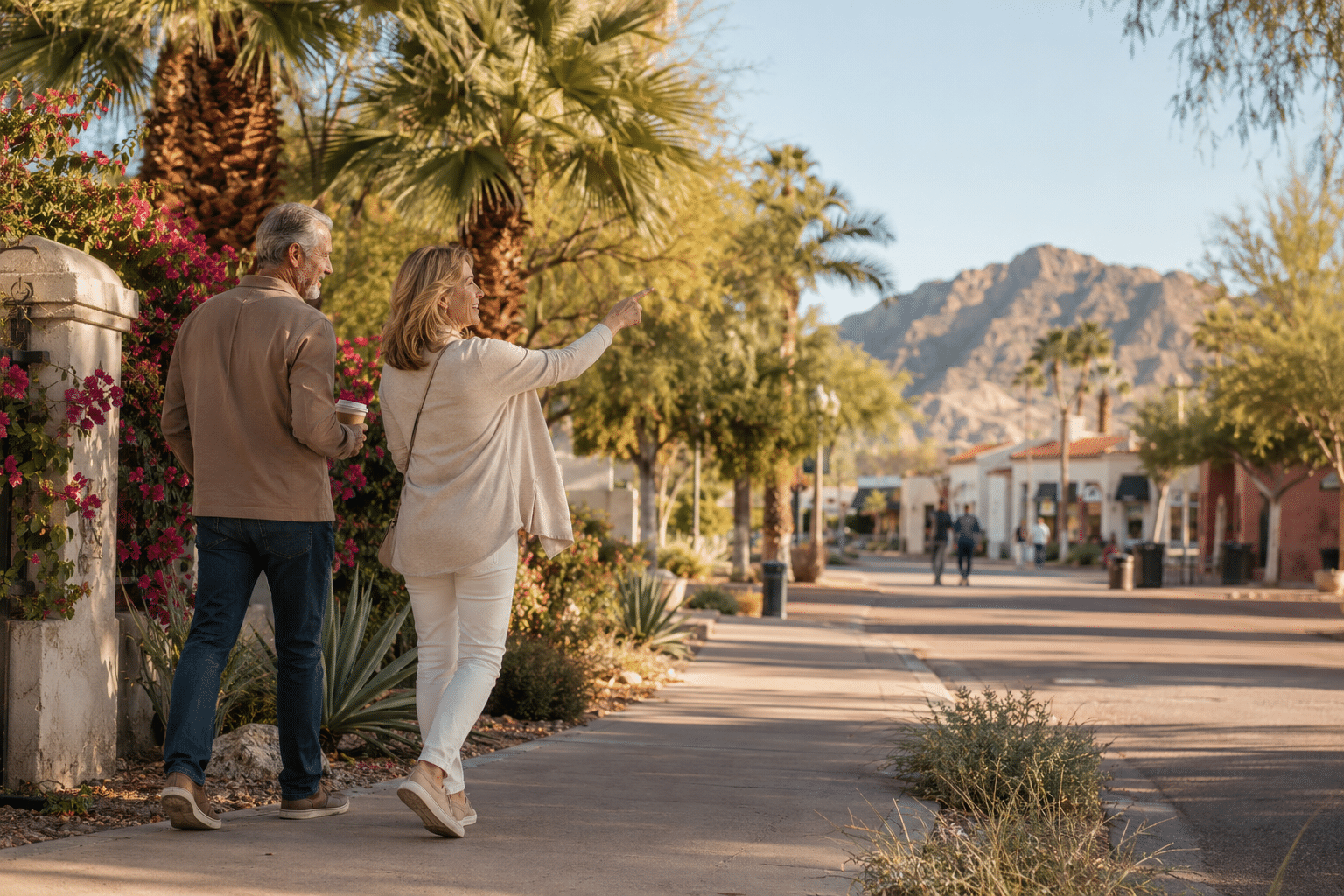
If your idea of the next chapter looks less like a master plan on the metro fringe and more like a six-block walk to a farmers market, Villa Monterey has been quietly delivering that exact life for over six decades. Tucked along the Chaparral Road corridor between Hayden Road and Miller Road, this historic 55+ retirement village sits inside one of the most amenity-rich square miles in metro Phoenix. The townhomes are small, the streets are lantern-lit and curving, and the architectural detail is unlike any new construction you will find in the Valley today. For a particular kind of buyer, that combination is the entire reason to consider this address.
Villa Monterey opened its first homes in 1961, when developer David Friedman of Butler Homes returned from a trip to California’s Monterey Peninsula with a new idea for desert retirement living. Friedman wanted a community of single-story attached homes with shared walls, courtyard pools, and a degree of architectural variety that the Phoenix market had not yet seen. He hired Ralph Haver, then one of the region’s most prolific architects, to draw the early units. The result, built in seven phases through 1969, became the first successful 55+ townhome subdivision in Scottsdale.
Sixty-plus years later, the community still reads as distinctive. The seven historic sub-units cluster around small interior pools and ramadas, the streets curve rather than grid, and each unit’s facade carries its own character treatment. Some homes lean Spanish Castillo, with arched entries and decorative tile. Others borrow Moorish detail, New Mexican adobe lines, or even a faintly Texan ranch flavor. The City of Scottsdale designated the entire community as the Villa Monterey Units 1-7 Historic District, which preserves the architectural variety as a permanent feature rather than a footnote.
For a 55+ buyer comparing this address against a suburban master plan, the trade-off is concrete. Villa Monterey offers no golf course, no resort pool deck, and no fitness campus. What it offers instead is location, scale, and architectural specificity — a walkable urban village inside one of the most desirable ZIP codes in Arizona, at price points that remain genuinely accessible relative to the surrounding Old Town real estate.
Most active adult communities are designed around the car. Villa Monterey is designed around the curving sidewalk. A typical resident’s morning starts on the patio with coffee, moves to a stroll along the AZ Canal path or down to Chaparral Park, and continues with errands at Sprouts or Trader Joe’s a short drive west. By late afternoon, residents are often back home for happy hour with neighbors, with a six-block walk to dinner on Marshall Way or Old Town as the evening option. The pace is intentional, slower than Scottsdale Quarter and quieter than Old Town proper, but never far from either.
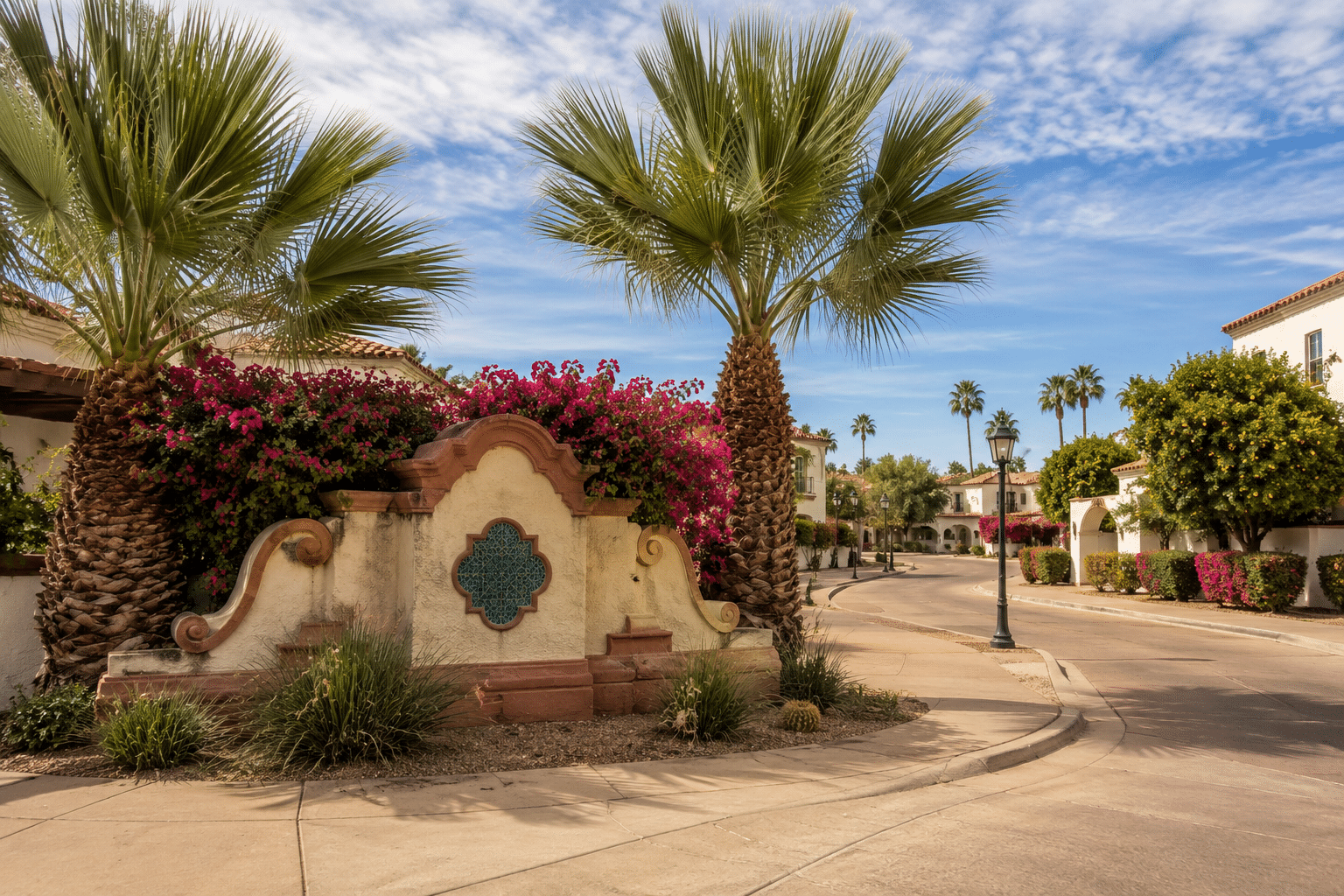
Real estate at Villa Monterey is a resale market built around roughly 800 attached homes spread across the seven historic units. Floor plans run from compact two-bedroom layouts at around 900 to 1,200 square feet, up through three-bedroom designs that occasionally exceed 2,000 square feet. Most homes are single-story, though a handful of two-story plans exist, particularly in the units along the south side of Chaparral Road. Garages are typically single-car, often with carports rather than enclosed structures, reflecting a 1960s design priority that buyers should plan around.
The architectural style at Villa Monterey defies easy labels. Architectural historians who have studied the neighborhood call it Postmodern Pastiche — a deliberate mix of regional motifs assembled with theatrical confidence rather than scholarly accuracy. One block delivers a Castillo entrance with cast stone detail. The next block shifts to a New Mexican adobe profile with vigas and rounded parapets. A third block reads as faintly Moorish, with a Moroccan tile detail at the recreation building entry. The variety is part of the point. Friedman believed that homebuyers wanted the freedom to choose a facade that matched their personal sense of place, and Villa Monterey was built to give them options.
Each of the seven Villa Monterey units carries its own floor-plan inventory, its own pool and ramada complex, and its own HOA. Unit 5, for example, comprises 99 homes organized around a single shared pool and a recently remodeled ramada. Unit 3 spans more homes and offers a different mix of two- and three-bedroom layouts. Some units feature private patios that open to common-area greenbelts; others place patios at the rear of the home for additional privacy. Buyers tend to settle on a preferred unit before they settle on a specific home, because the differences between subdivisions are real and matter for daily life.
Because every home at Villa Monterey is at least fifty-five years old, the resale conversation centers on update history. Roof recoats, dual-pane window upgrades, HVAC replacement, plumbing line updates, kitchen and bath remodels, and electrical-panel upgrades are the items that separate a turn-key purchase from a project. Listings that document recent capital work — a 2024 roof recoat, a 2023 HVAC unit, an inside-laundry conversion — typically command a premium. The compact footprint of most homes makes renovation budgets manageable, but historic-district guidelines apply to facade-visible work, so buyers planning exterior changes should review the City of Scottsdale design guidelines before closing.

The amenity philosophy at Villa Monterey is shared-but-modest. Each of the seven historic units operates its own pool and ramada, with the pool serving as the social center of that subdivision. There is no grand clubhouse, no fitness campus, no full-service spa. What residents have instead is a pool five minutes’ walk from their front door, a ramada with games and seating, and the assurance that the people in the water are their neighbors.
Several units have invested heavily in their pool and ramada complexes over the past five years. Unit 5’s HOA recently completed a beautifully remodeled climate-controlled ramada that hosts year-round social gatherings. Unit 3 maintains an active social calendar around its pool deck. Other units run quieter, with the pool functioning more as a private amenity than a programmed gathering point. Buyers tour the pool of any unit they consider before they consider an offer, because the pool’s condition, hours, and culture vary noticeably from one HOA to the next.
The standard amenity package across the seven units includes an outdoor pool, a spa or hot tub, a covered ramada, restrooms, and a multi-purpose space for cards, games, and small social events. A few units have added tennis courts; most have not. None of the units has installed pickleball courts, though residents who want pickleball play at nearby Scottsdale public courts a few minutes away. Walking and biking trails wind through the community grounds, with the curving interior streets functioning as the main walking loop for many residents.
The most consequential amenity at Villa Monterey is not on the property at all. It is the surrounding neighborhood. From most homes, residents are within a fifteen-minute walk of Scottsdale Fashion Square, the Scottsdale Waterfront, the Old Town entertainment district, and the AZ Canal multi-use path. A short drive west places residents at Sprouts, Trader Joe’s, and the Civic Center cultural campus. For an active 55+ buyer who wants a daily life shaped by walking and small errands rather than long suburban drives, the on-foot amenity stack here is unmatched in the Valley’s age-restricted inventory.
Two blocks east of Villa Monterey, Chaparral Park provides a 100-acre civic park with a lake, walking paths, off-leash dog area, tennis courts, and an aquatic center. Residents use it as an extension of the community grounds. The park hosts seasonal programming including outdoor concerts, holiday events, and farmers-market-style vendor days. It is the kind of public amenity that an isolated suburban 55+ community would have to build internally, and at Villa Monterey it sits a five-minute walk away.
The social fabric at Villa Monterey is woven differently than at a master-planned 55+ community. There is no community-wide events calendar coordinated by an activities director. There is no central clubhouse pulling residents together for two hundred clubs. What exists instead is a quieter, more organic pattern of gathering, organized at the unit level around the pool and ramada and at the personal level around the streets and front patios.
Residents form ongoing groups around interests rather than scheduled programming. Cards, cycling groups, walking groups, swimming, tennis, and small game-night gatherings recur week after week, often at someone’s patio or in a unit’s ramada. The mix of full-time residents and seasonal snowbirds keeps the social rhythm year-round, with the cooler months bringing the highest density of gatherings and the summer months running quieter as part-time residents head north.
A typical week at Villa Monterey includes an informal coffee hour at one of the unit ramadas, a small evening card game, a midweek group walk along the canal, and a Saturday morning cyclist meet-up that loops out toward Indian Bend Wash Greenbelt. Larger gatherings tend to cluster around holidays and seasonal milestones rather than a published events calendar. The social texture rewards residents who are willing to introduce themselves at the pool and follow a recurring conversation thread, rather than buyers who expect a curated activity menu delivered to their inbox.
Villa Monterey has long been a popular second-home market for residents from the Upper Midwest, the Pacific Northwest, and Western Canada. Affordability relative to surrounding Scottsdale housing, combined with the lock-and-leave simplicity of an attached home, has made the community a steady seasonal-ownership market for decades. Full-time residents form the social backbone of each unit, and seasonal residents contribute the cross-pollination that keeps the community connected to a wider network of friends and former neighbors. The mix produces a community that fills up between October and April and runs at a quieter, more intimate pace from May through September.

Villa Monterey sits at one of the most central addresses in metro Phoenix. The community lies along Chaparral Road between Hayden Road on the east and Miller Road on the west, with most units sitting just south of Chaparral. Old Town Scottsdale begins about half a mile to the south. Scottsdale Fashion Square is a two-mile drive or a comfortable bike ride west. Camelback Mountain rises directly south, providing the visual anchor that defines the eastern Phoenix skyline from many of the community’s patios.
The road network out of Villa Monterey gives residents efficient access to the entire metro area. Loop 101 sits a short drive east, providing direct routing to north Scottsdale, the Salt River Pima-Maricopa Indian Community shopping districts, and the airport and East Valley via Loop 202 to the south. SR-51 (the Piestewa Freeway) and Interstate 17 connect to north Phoenix and beyond. Sky Harbor International Airport is roughly fifteen miles to the south, a twenty- to twenty-five-minute drive that makes regular travel practical for snowbirds and full-time residents alike. Day trips to Sedona, Prescott, and the high country pull residents north on Interstate 17 in well under two hours.
The walkable amenity inventory begins with Scottsdale Fashion Square, which combines luxury retail with restaurant options ranging from quick service to fine dining. The Scottsdale Waterfront District extends the dining and lifestyle scene along the canal, and the Old Town entertainment district adds galleries, the Scottsdale Center for the Performing Arts, the Scottsdale Museum of Contemporary Art, Western Spirit: Scottsdale’s Museum of the West, and the Scottsdale Stadium home of the San Francisco Giants spring training operation. Marshall Way’s gallery row hosts the celebrated Scottsdale ArtWalk every Thursday evening. For residents who enjoy a daily errand-and-coffee walk, this density of destinations is the practical reason to choose this community over a suburban alternative thirty minutes away.

Healthcare planning starts with HonorHealth Scottsdale Osborn Medical Center, the full-service hospital located roughly two miles southwest of Villa Monterey. Osborn provides emergency services, surgery, cardiology, orthopedics, and a broad range of specialty service lines. For residents who need a hospital connection close to home, this is the routine anchor. HonorHealth Scottsdale Shea Medical Center to the north and HonorHealth Scottsdale Thompson Peak farther north extend the same network into north Scottsdale.
Mayo Clinic Arizona, on Shea Boulevard about twelve miles north, serves as the specialty-care destination for many Villa Monterey residents. The campus draws patients from across the country for complex cases, but it is also a routine option for north-Valley residents who want Mayo-system care for cardiology, oncology, neurology, or other specialty needs. Banner Health and Dignity Health both operate facilities in the broader Scottsdale and Phoenix area, and most residents end up with a primary-care provider within a five- to ten-minute drive of home.
For routine care, urgent care, and most specialist appointments, the HonorHealth network within ten miles of Villa Monterey covers the bulk of resident needs. Outpatient imaging centers, physical-therapy clinics, and primary-care offices populate the corridor between the community and the hospital campus. Pharmacy options include CVS, Walgreens, and several independent pharmacies along Scottsdale Road and Camelback Road. The combination of full-service hospital access close to home and specialty depth available a short drive north is one of the practical reasons that Scottsdale’s central neighborhoods remain attractive to retirees who prioritize healthcare convenience.
The community itself supports wellness through walkability rather than through a formal fitness facility. Residents who want a structured workout often join a private gym a short drive away, or they build daily movement into the routine through canal walks, Chaparral Park visits, and casual cycling. The flat terrain, mild winter weather, and walkable neighborhood streets make consistent daily movement easier here than in many master-planned communities, where the only safe walking surface is a private community trail loop.

The financial picture at Villa Monterey is shaped by three realities that differ from a typical master-planned 55+ community. Each of the seven units operates its own HOA with its own dues structure. The community is resale-only, with no new-construction inventory and no builder pricing. And the historic-district designation creates a renovation framework that buyers should understand before they make an offer.
HOA dues at Villa Monterey are typically modest compared to high-rise condominium communities. Each unit’s HOA covers common-area maintenance, pool and ramada upkeep, exterior insurance, and reserves for the shared structures. The exact dollar amount varies by unit and is best confirmed during a specific home’s purchase process. What buyers should plan for in addition to dues is the cost of interior renovations on a sixty-year-old home — electrical, plumbing, HVAC, and finish work — and the cost-time premium that historic-district guidelines may add to facade-visible exterior work.
A buyer comparing two listings in different Villa Monterey units should compare the HOA disclosure documents side by side. Some units cover roof maintenance under the HOA; others place roof responsibility with the homeowner. Some include exterior painting on a rotating schedule; others do not. Some maintain landscaping up to the front patio; others draw the line at the property edge. These per-unit differences materially affect the long-run cost of ownership and the amount of personal time a homeowner will spend on maintenance.
The Villa Monterey Units 1-7 Historic District designation places the community on the Scottsdale Historic Register and creates design guidelines for facade-visible exterior work. Roof material changes, window replacements visible from the street, exterior color changes, and additions all fall within the guidelines. Interior renovations — kitchen, baths, flooring, lighting — are largely unaffected. For most buyers, the practical effect is positive. The historic designation protects the architectural character that drew them to the community in the first place. Buyers planning a substantial exterior project should consult the City of Scottsdale Historic Preservation office during the offer-and-inspection period.
Villa Monterey is generally an age-restricted 55+ retirement village. Some sub-units within the seven historic subdivisions have varying age policies, and a few have been documented as 40+ rather than 55+. Buyers should confirm the exact age requirement with the specific unit HOA before making an offer.
HOA fees at Villa Monterey vary by individual subdivision unit, since each of the seven historic units operates its own HOA with its own assessment structure. Fees are typically modest compared to high-rise condominium communities, and they generally cover pool, spa, ramada, and common-area maintenance.
Pet policies at Villa Monterey vary by individual unit HOA, but most subdivisions allow dogs and cats with breed and size considerations. Confirm the specific pet rules with the HOA of the unit where you are considering buying.
Villa Monterey is not a gated community in the conventional sense. It is a historic-district townhome neighborhood with low walls, entry monuments, and shared interior streets. Residents value the open, walkable character that distinguishes the community from gated suburban 55+ properties.
HonorHealth Scottsdale Osborn Medical Center is the closest full-service hospital, roughly two miles southwest of Villa Monterey. The community is also within easy reach of HonorHealth Scottsdale Shea Medical Center to the north, and Mayo Clinic Arizona for specialty care in north Scottsdale.

The most efficient way to evaluate Villa Monterey is on foot, on a winter or early-spring weekday morning. Begin at the corner of Chaparral Road and Miller Road, walk one of the curving interior streets through Unit 3 or Unit 5, stop at the pool and ramada complex of whichever unit catches your eye, and continue across to Chaparral Park for the canal-path connection. From there, a short walk south on Hayden Road brings you to the edge of Old Town and Marshall Way’s gallery district. Two hours on foot will tell you more about the community’s daily texture than any brochure.
Once you have walked the community, the next step is to engage a real estate professional who specializes in Villa Monterey’s resale market. The historic district adds variables that a generalist agent may not handle well: per-unit HOA differences, historic-district renovation guidelines, age-of-systems disclosures, and the resale value impact of recent updates. A specialist who has closed transactions in multiple units across the seven subdivisions can save a buyer weeks of confusion.
A specialist will help you compare units against your priorities, walk you through each HOA’s disclosure package, identify homes with documented capital updates, and flag listings where the historic-district guidelines may complicate a planned renovation. The specialist can also connect you with inspectors familiar with 1960s townhome construction, which is essential for an honest read on a sixty-year-old structure. A serious tour day, paired with a specialist’s local knowledge, gives you the information you need to decide whether Villa Monterey fits the next chapter you have in mind.
When you are ready to schedule a visit, reach out for a custom tour itinerary tailored to your priorities. Whether the appeal is the architecture, the walkability, the price relative to surrounding Old Town, or the combination of all three, an in-person walk-through of two or three units with the right local guide is the right next step toward deciding if Villa Monterey is your home.
We use cookies to improve your experience on our site. By using our site, you consent to cookies.
Manage your cookie preferences below:
Essential cookies enable basic functions and are necessary for the proper function of the website.
CloudFlare provides web performance and security solutions, enhancing site speed and protecting against threats.
Service URL: developers.cloudflare.com (opens in a new window)
Google Tag Manager simplifies the management of marketing tags on your website without code changes.
These cookies are used for managing login functionality on this website.
Statistics cookies collect information anonymously. This information helps us understand how visitors use our website.
Google Analytics is a powerful tool that tracks and analyzes website traffic for informed marketing decisions.
Service URL: policies.google.com (opens in a new window)
You can find more information about our Cookie Policy and Privacy Policy.