
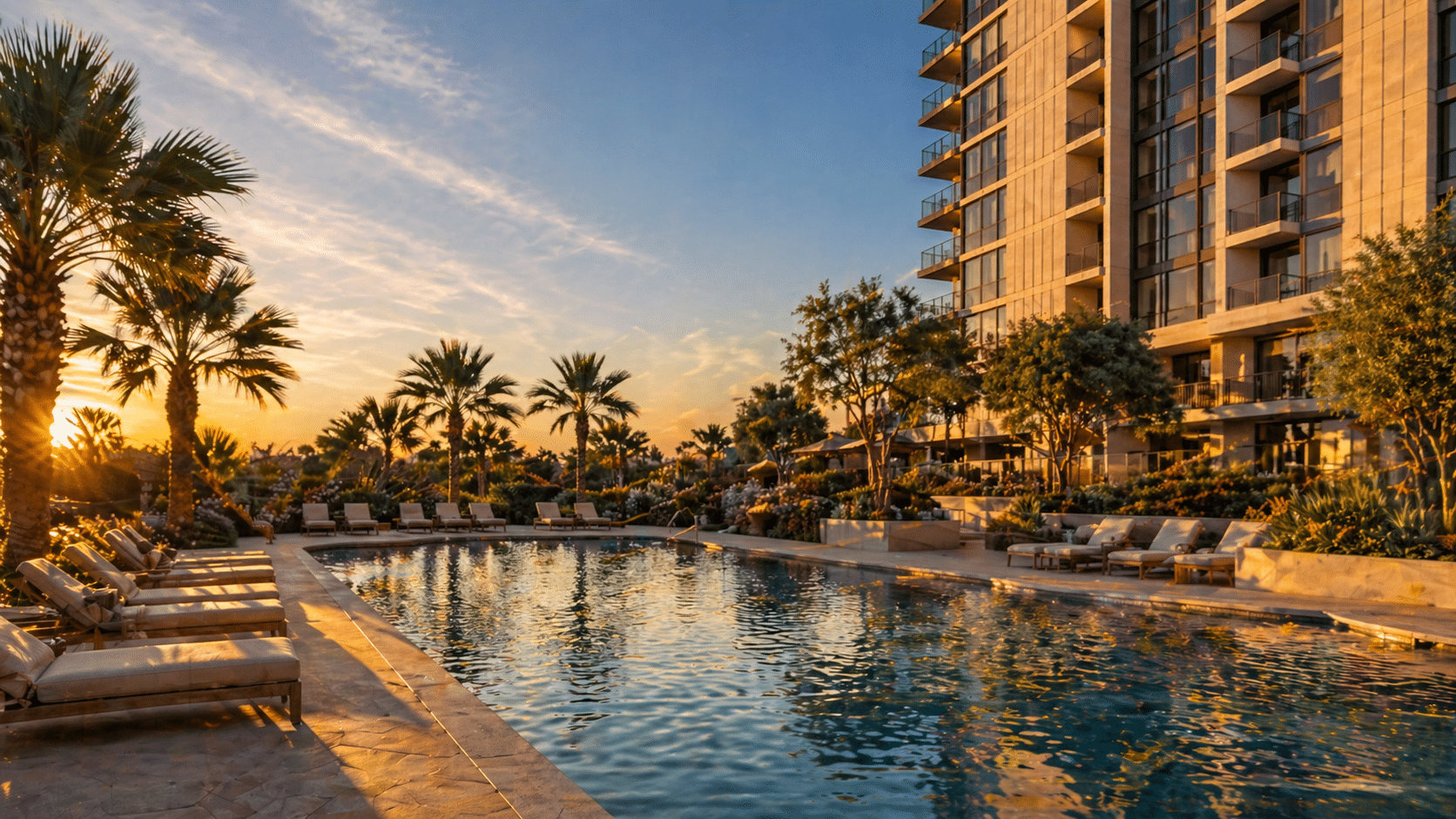
There is a particular kind of resident drawn to Scottsdale Shadows. They want the city, not the suburb. They want to step out of an elevator into a lobby instead of out of a garage onto a driveway. They want the produce stand at the Old Town Farmers Market, the gallery walk on Marshall Way, the morning coffee place where the barista already knows the order. Scottsdale Shadows gives them that life inside a 55+ age-restricted community structure — a combination almost no other property in the metro area offers.
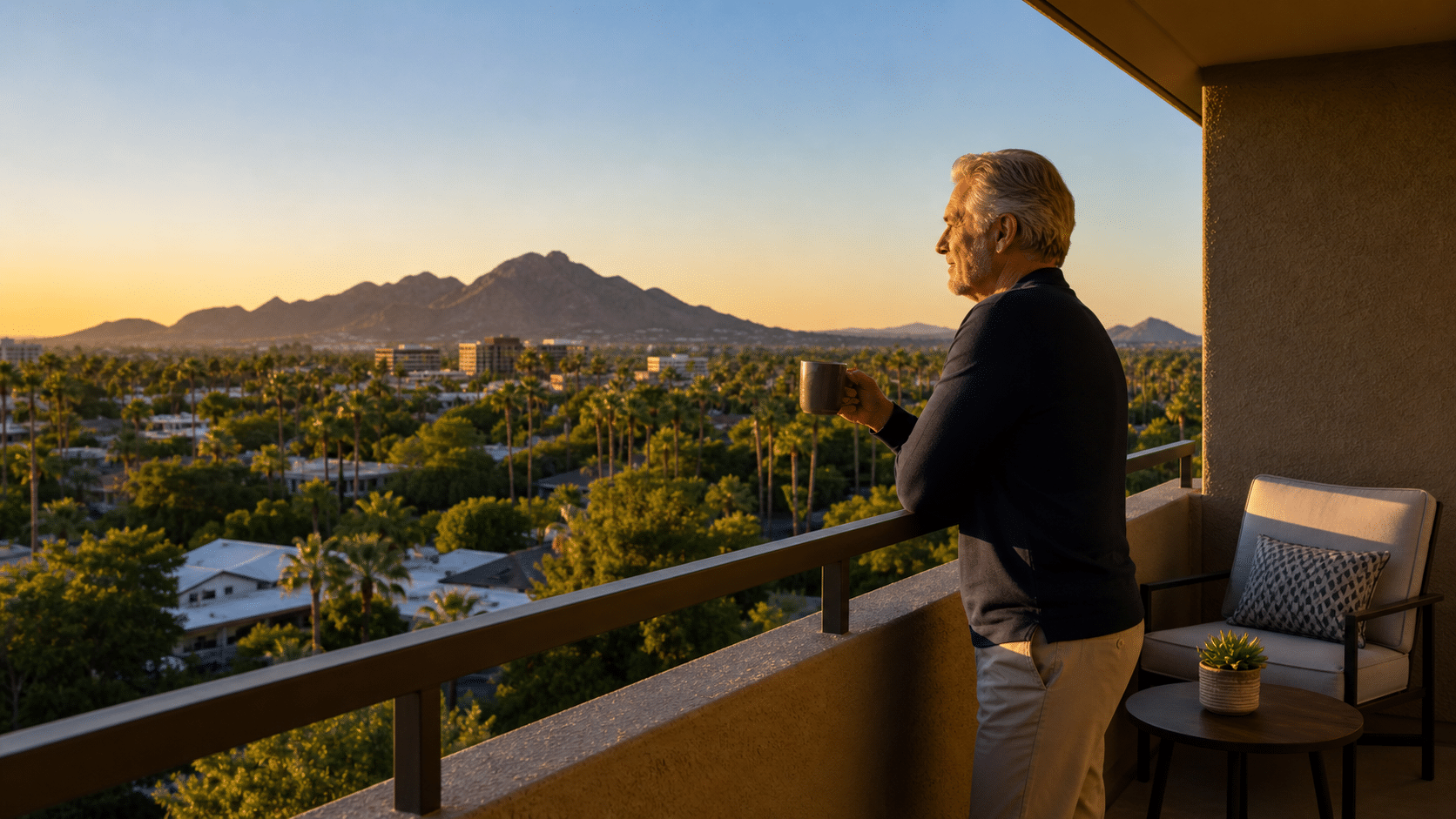
The community sits on the south side of Camelback Road between Scottsdale Road and Hayden Road, on a parcel that has been a 55+ condominium enclave since the towers first rose in the 1970s. From the upper floors, residents look out over Camelback Mountain to the west, the McDowell Mountains to the east, and the green ribbon of the Indian Bend Wash Greenbelt cutting south through the city. The Scottsdale Shadows Scottsdale AZ 55+ condominium community is, in short, the urban high-rise alternative to the master-planned suburban active adult life.

Most over-55 buyers in the Phoenix metro narrow their search to a handful of golf-course master plans on the city’s outer rings. Scottsdale Shadows is what they consider when none of those feel right. The pull here is not the fairway or the club calendar — it is the address, the architecture, and the access to everything central Scottsdale has built up around the property over the last fifty years.
Owners describe the community in practical terms. The grocery store is six minutes away. The art museum is ten. Phoenix Sky Harbor International Airport is fifteen on a good traffic day. The cardiologist, the dermatologist, and the orthopedist are all within a single zip code. Daily errands and major appointments fold into a small geographic footprint, which is precisely the point of urban age-restricted living.
The cultural mix reflects that footprint. Full-time residents share corridors with part-time owners who arrive in October and depart in May, professionals in their late fifties still working remotely, retired physicians and attorneys, former snowbirds who finally sold the house up north and committed to one address. The building meetings are well-attended. The pool deck conversations skew worldly. The age-restriction documentation is taken seriously by the association, which keeps the community’s defining identity intact across decades of ownership turnover.
The honest framing: a high-rise condominium does not offer the private yard, the casita-and-courtyard footprint, or the three-car garage that a Sun City-style detached home delivers. What it offers in exchange is location, lock-and-walk simplicity, and a building staff that handles roof, plumbing risers, elevators, and exterior paint. New owners who arrive from a single-family suburban background often describe the first six months as a recalibration — and then, almost universally, describe never wanting to go back.
The community is composed of multiple condominium towers ranging from low-rise to high-rise heights, with floor plans that span efficient one-bedroom layouts up through larger two- and three-bedroom corner units. Square footages, balcony sizes, and view orientations differ meaningfully from tower to tower and from low floors to penthouse levels. Buyers should expect to evaluate not just the unit but the floor, the orientation, and the proximity to elevator and trash chute access on each tower.
Scottsdale Shadows reflects the residential tower aesthetic of its construction era vertical balconies, generous window walls, broad communal pool decks, and lobby-level mailrooms. Many original units have been substantially updated by successive owners, with kitchens, bathrooms, flooring, and balcony enclosures modernized in cycles of buyer-driven renovation. A unit purchased in 2024 may have been remodeled in 2015 by an owner who in turn bought it from someone who renovated it in 2002. The current state of any specific unit is therefore a function of its individual ownership history rather than a community-wide construction year.
Because the community is fully built out and has been since the 1970s, every transaction is a resale. There is no model home, no standing inventory, and no builder pricing power. Listings appear when owners decide to sell. Pricing reflects view, floor, orientation, square footage, and condition rather than a builder spec sheet. Buyers working with an experienced Scottsdale 55+ specialist routinely tour several units across multiple towers before identifying the one that fits their priorities.
The amenity base supports the lock-and-walk lifestyle without trying to replicate a destination resort. Common spaces are designed to be used daily by residents who already have most of central Scottsdale at their disposal as an extended amenity district.
Multiple pools serve the towers, with deck space, shaded lounging areas, and adjacent spas typical of mid-century Scottsdale condominium design. The pool decks are heavily used in the cooler months and serve as a primary social anchor for residents who do not golf. Tennis courts are part of the amenity package, with overlapping pickleball use depending on resident demand.
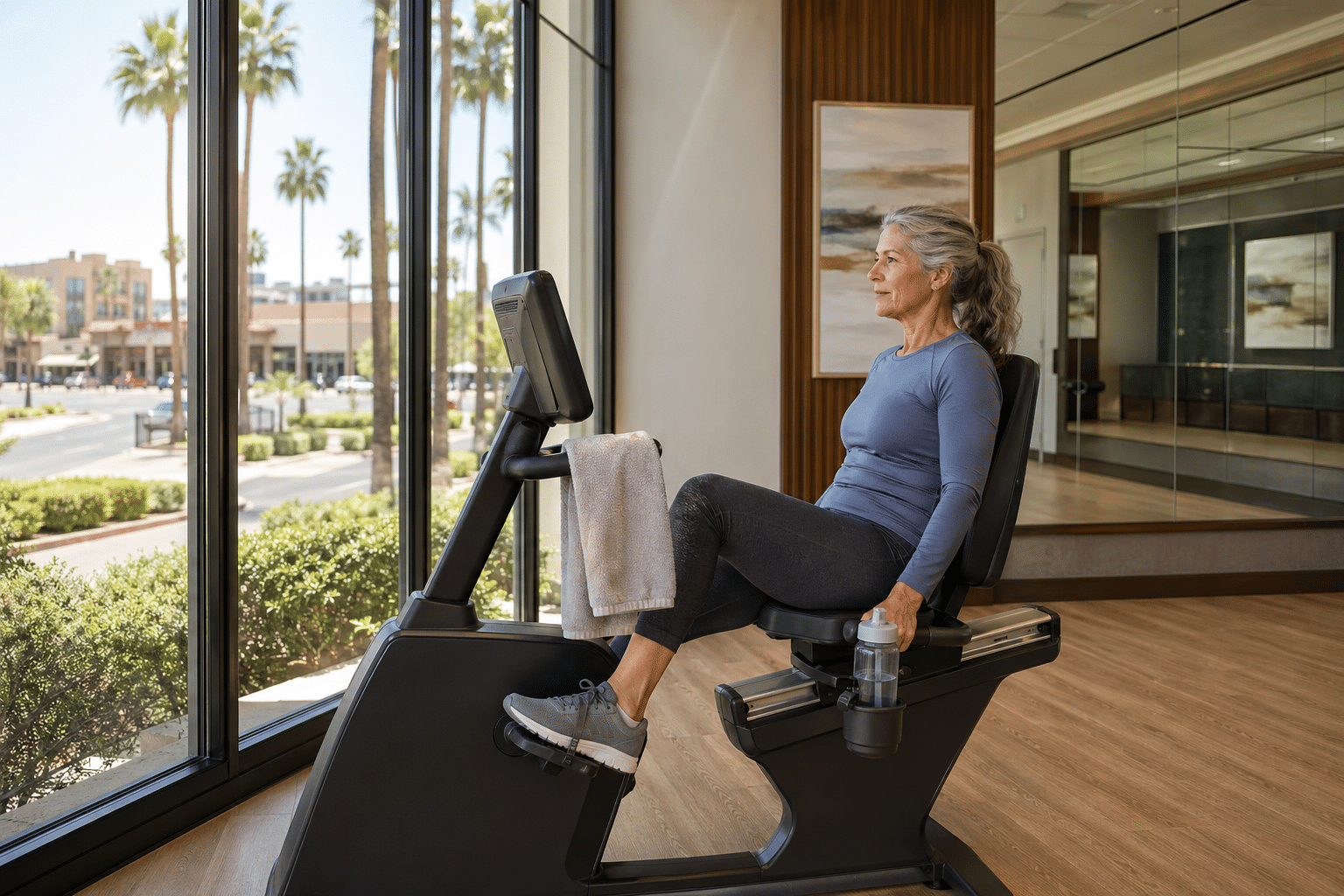
The fitness facilities provide a serviceable cardio-and-strength setup for residents who prefer to exercise inside the building. Beyond the equipment, common rooms host card games, book groups, and small-format community events. Saunas and additional wellness amenities round out the base.
Worth stating plainly: there is no on-site golf course at Scottsdale Shadows. There is no large multi-thousand-square-foot clubhouse with arts wing, woodshop, and dance studio. Residents who want those amenities access them off-site at private clubs, city facilities, or private studios within walking or short driving distance. The community trades amenity sprawl for location and architecture.

Social life at Scottsdale Shadows operates on two levels. Inside the community, the social graph is built tower by tower. Floor neighbors get to know each other through the elevator routine. Pool-deck regulars accumulate over seasons. Residents organize informally around poker nights, walking groups, and shared interests in art, theater, or the city’s restaurant scene. Outside the community, residents tap into the larger civic and cultural life of Scottsdale itself gallery openings, performing arts subscriptions, university lecture series at Arizona State University, and volunteer rosters at city institutions.
The seasonal pattern at Scottsdale Shadows differs from suburban 55+ communities in an important way. A meaningful share of owners are full-time year-round residents who use the building as their primary home. Another share are seasonal owners who treat their unit as a winter base. The two populations co-exist inside the same towers and pool decks, which produces a social rhythm distinct from communities that empty out in May. Year-round residents maintain a continuous social calendar, while seasonal owners arrive into an active community rather than a dormant one. The cross-generational continuity — some owners in their late fifties, others in their eighties gives the community a multi-decade depth.
Resident-led clubs cover the predictable categories: card games, book discussions, walking groups, art appreciation, and travel planning. The community calendar is published through the association and posted in lobby and common-room locations. Because the building footprint is compact, resident communication tends to move fast a flyer in the elevator on Tuesday produces a turnout by Thursday.

Location is the single strongest argument for Scottsdale Shadows, and it deserves a careful look. The community sits at one of central Scottsdale’s most efficient freeway and surface-street junctions. Drivers reach the SR-51 Piestewa Freeway in roughly fifteen minutes via Indian School or Camelback Roads, providing a direct shot into central and north Phoenix. Loop 101 runs along the city’s eastern edge for north-south travel toward Cave Creek, Carefree, and the McDowell Mountain area. Loop 202 anchors the south and connects southeast to Tempe, Mesa, and Phoenix Sky Harbor International Airport. Sky Harbor itself is reachable in fifteen to twenty minutes outside peak periods.
Old Town Scottsdale is the immediate cultural and retail backyard. Scottsdale Fashion Square is a few blocks south. Scottsdale Civic Center, the Scottsdale Center for the Performing Arts, and Western Spirit: Scottsdale’s Museum of the West are all within a short drive or longer walk. The Indian Bend Wash Greenbelt a multi-mile linear park with paved walking and biking paths runs through the city north and south, providing daily-use outdoor recreation that few comparable urban communities can match.
For day trips, the location supports a wide menu. Sedona is two hours north on I-17. Prescott is roughly two hours northwest. The Salt River and the Tonto National Forest open up east of the metro for fishing, kayaking, and hiking. Spring training brings the San Francisco Giants to Scottsdale Stadium downtown each February and March, with several other Cactus League venues a short drive away.
The compact urban core means many residents organize the day around walking and short drives rather than freeway trips. Grocery stores, pharmacies, banks, and dry cleaners cluster within a half-mile radius. The community’s address is one of the few in the metro 55+ market where a resident could legitimately consider keeping only one car or no car at all, depending on their travel and medical needs.
The cultural calendar adds another dimension. Scottsdale Arts operates a year-round programming schedule across the Center for the Performing Arts, Scottsdale Museum of Contemporary Art, and the Public Art collection. The ArtWalk on Main Street runs every Thursday evening through the cooler months. Scottsdale Public Library branches are within easy reach for residents who use library systems regularly. For sports fans, Scottsdale Stadium downtown hosts the San Francisco Giants for spring training each year, with several other Cactus League ballparks within thirty minutes. Few 55+ communities in the metro put this much cultural and civic programming inside a fifteen-minute radius of the front door.

The healthcare picture for Scottsdale Shadows residents starts not at the hospital but at the urgent-care and primary-care layer. Several urgent-care clinics operate within a few miles of the community, and a dense network of independent and group primary-care practices serves central Scottsdale. For residents managing chronic conditions, the routine appointment infrastructure is unusually well-developed — a function of the city’s affluent demographic and the resulting concentration of specialists.
When a higher level of care is needed, three major hospital systems are within easy reach. HonorHealth Scottsdale Osborn Medical Center sits less than two miles south and serves as the closest emergency department for many residents. HonorHealth Scottsdale Shea Medical Center anchors the northeast portion of the city and is a common destination for orthopedic and cardiac care. Mayo Clinic Hospital in north Scottsdale is roughly fifteen miles northeast and brings nationally ranked programs in oncology, cardiology, neurology, and transplant medicine to the metro. Dignity Health and Banner Health also operate facilities within the broader Scottsdale and Phoenix corridor, expanding the network of options for specialty referrals.
For day-to-day wellness, residents leverage the same urban density that makes the location attractive. Yoga studios, pilates reformers, physical therapy practices, and integrative-medicine clinics operate within walking distance. The Indian Bend Wash Greenbelt provides a no-cost daily walking circuit. Several private fitness clubs in Old Town offer 55+ programming and pickleball court time as alternatives to the on-site amenity base.
Pricing at Scottsdale Shadows operates on different rules than suburban single-family 55+ communities, and prospective buyers should understand the differences before they tour. Acquisition cost varies widely by tower, floor, square footage, view orientation, and condition. A small one-bedroom on a low floor of a less-renovated tower may list at a fraction of the price of a renovated three-bedroom corner unit on a high floor with mountain views. Buyers should plan to evaluate at least four to six listings across multiple towers to develop a working sense of value.
Monthly HOA assessments are typically larger than what owners pay in a detached single-family 55+ community because the assessments include items that detached homeowners cover separately. Building insurance, exterior maintenance, water and sewer, trash, common-area utilities, elevator maintenance, lobby and corridor cleaning, and pool deck operation are all rolled into the monthly fee. Owners pay no separate roofing or exterior paint reserve. Confirmed current fees should be requested in writing from the association before any offer is finalized.
Pet policies are set by the association and generally allow dogs and cats with limits on number and weight. Service animals are exempt from breed and weight restrictions under federal law. Age-restriction enforcement under the federal Housing for Older Persons Act is administered at the condominium-board level, which means age verification documentation is collected and reviewed for every closing. Buyers should expect to provide identification and complete association forms as part of the standard purchase process. Property tax treatment for owner-occupied condominium units in Maricopa County follows the same primary-residence assessment rules that apply to detached homes; consult the Maricopa County Assessor for current rates and the Arizona senior property valuation freeze program eligibility rules.
Scottsdale Shadows is a 55+ age-restricted condominium community operating under the federal Housing for Older Persons Act. At least one occupant per unit must be 55 or older, and the condominium association verifies age documentation at closing.
HOA fees at Scottsdale Shadows vary by tower, square footage, and unit type. Because the community is composed of mid-rise and high-rise condominium buildings, monthly assessments typically include exterior maintenance, building insurance, water, trash, common-area utilities, elevator service, and amenity access. Buyers should request the current fee schedule for the specific tower they are considering.
Pet policies at Scottsdale Shadows are set by the condominium association and may include limits on the number of pets, weight, and breed. Verify the current pet rules with the association before purchase.
Scottsdale Shadows is a controlled-access tower community. Residents and guests enter buildings through secured lobbies, and parking is generally restricted to residents and registered visitors. The community does not function as a perimeter-gated subdivision because it is built around mid-rise and high-rise towers rather than detached homes.
Residents have rapid access to HonorHealth Scottsdale Osborn Medical Center, Mayo Clinic Hospital in north Scottsdale, and HonorHealth Scottsdale Shea Medical Center. Several urgent-care clinics, primary-care offices, and specialty practices operate within a few miles of the community.
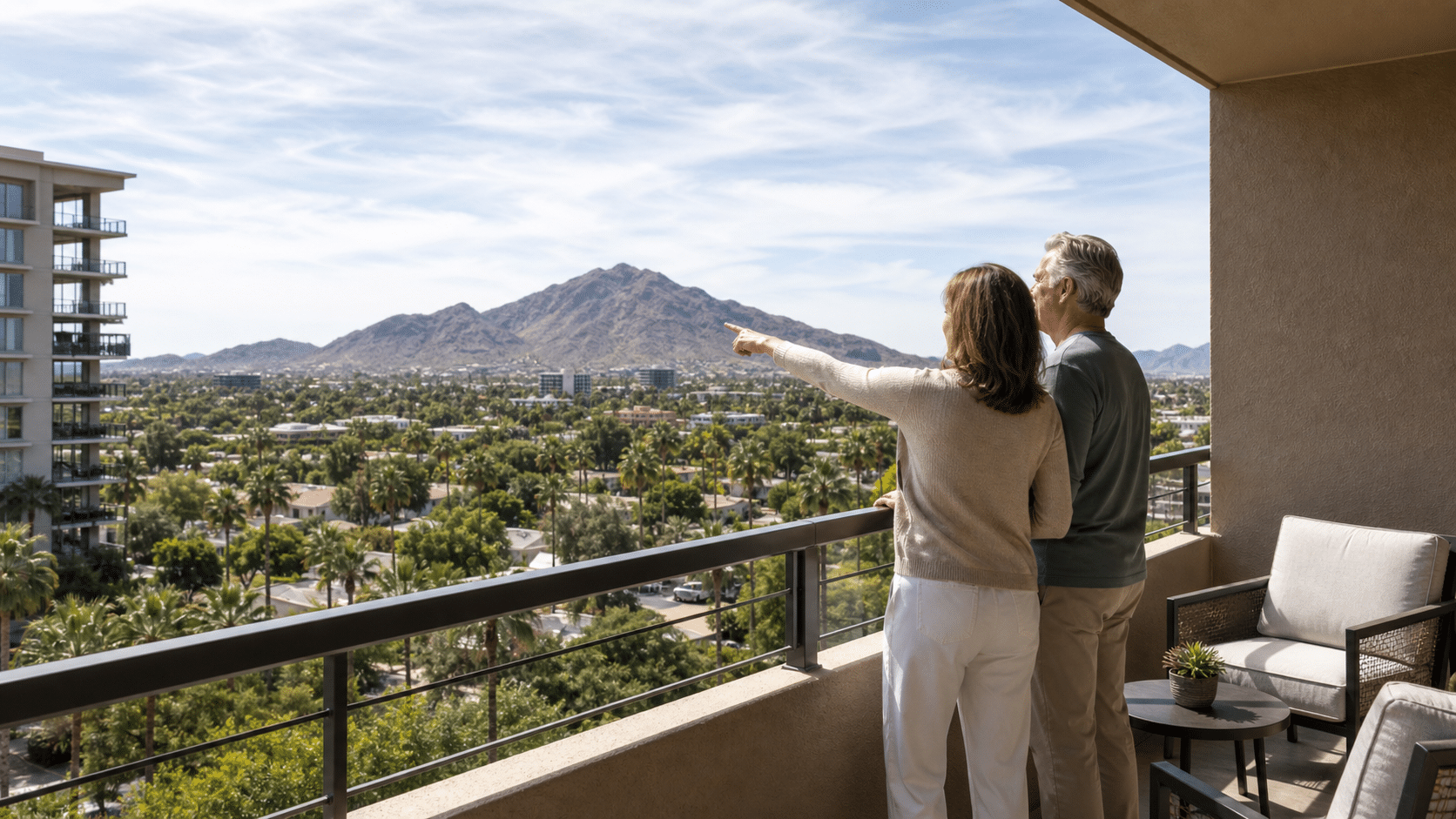
[IMAGE 10: Active 55+ couple standing on a private Scottsdale Shadows condo balcony overlooking palm-lined streets and distant mountains in soft midday light]
A buyer’s first step before scheduling individual tours should be a broader orientation to the urban-condo 55+ category itself. Tower living involves considerations that single-family buyers often have not weighed — the impact of the floor and orientation on views, light, and afternoon heat load; the practical realities of elevator-only access; the storage and parking allocations attached to each unit; and the way condominium reserve studies and special assessments interact with monthly HOA budgets. Reading a published 55+ buyer’s guide before touring saves time on the front end and produces sharper questions during the visit.
Once the orientation work is done, the most efficient path forward is to engage a real estate professional who specifically works the central Scottsdale condominium market. They know which towers have the strongest reserve studies, which floors carry view premiums, which units have been recently renovated, and which listings have priced ahead of or behind the current market. Tours can typically be scheduled within a few days during the cooler months and same-day during summer when listing activity slows. Bring identification, a notepad, and a list of priorities ranked in order. The right unit at Scottsdale Shadows is rarely the prettiest one in the listing photos — it is the one whose floor, orientation, and tower align with how you actually intend to live.
We use cookies to improve your experience on our site. By using our site, you consent to cookies.
Manage your cookie preferences below:
Essential cookies enable basic functions and are necessary for the proper function of the website.
CloudFlare provides web performance and security solutions, enhancing site speed and protecting against threats.
Service URL: developers.cloudflare.com (opens in a new window)
Google Tag Manager simplifies the management of marketing tags on your website without code changes.
These cookies are used for managing login functionality on this website.
Statistics cookies collect information anonymously. This information helps us understand how visitors use our website.
Google Analytics is a powerful tool that tracks and analyzes website traffic for informed marketing decisions.
Service URL: policies.google.com (opens in a new window)
You can find more information about our Cookie Policy and Privacy Policy.