

Tuesday afternoon, the temperature finally eases below ninety. A doubles match wraps up on the pickleball courts. Two neighbors lean across a back fence to compare notes on an early winter tomato bed. Inside the ballroom, a community choir runs through the second half of an April program for the third time this week. The slow shift of late-spring light across the Superstition Mountains to the northeast feels less like scenery than a daily metronome — the thing the community calendar quietly sets itself by.
This is how a week reads at Sunland Springs Village. The neighborhood is not the largest 55+ enclave in east Mesa, and it does not run on a country club’s professional staffing model.
What it offers instead is a lived-in rhythm that residents have been refining since the late 1990s. The Springs is a mid-sized lifestyle community where the activity calendar is dense and the daily map of where to be at four o’clock is something most homeowners can recite from memory by their second winter. HOA dues vary by sub-association; confirm current fees with the association or in the HOA disclosure during escrow. This page is the 2026 read on what that rhythm actually looks like, who buys into it, and how the community fits inside Mesa’s eastern grid at Higley Road and Baseline Road. For buyers also weighing the larger Farnsworth-built sister community at Dolphin and Higley, the comparison points appear throughout this page.
Sunland Springs Village is the third Farnsworth-built active adult subdivision in the east Valley, following Dreamland Villa and the larger Sunland Village. The chronological order matters for buyers shopping the full Mesa cluster of 55+ neighborhoods. Dreamland Villa is the smallest and oldest, Sunland Village is the largest and the most architecturally varied across single-family, attached villa, and tower-condo product, and the Springs arrived later with a tighter, single-family-only footprint and a more contemporary build vocabulary. Buyers comparing the three usually move on price per square foot, lot size, and how new the kitchens read on resale tour day.
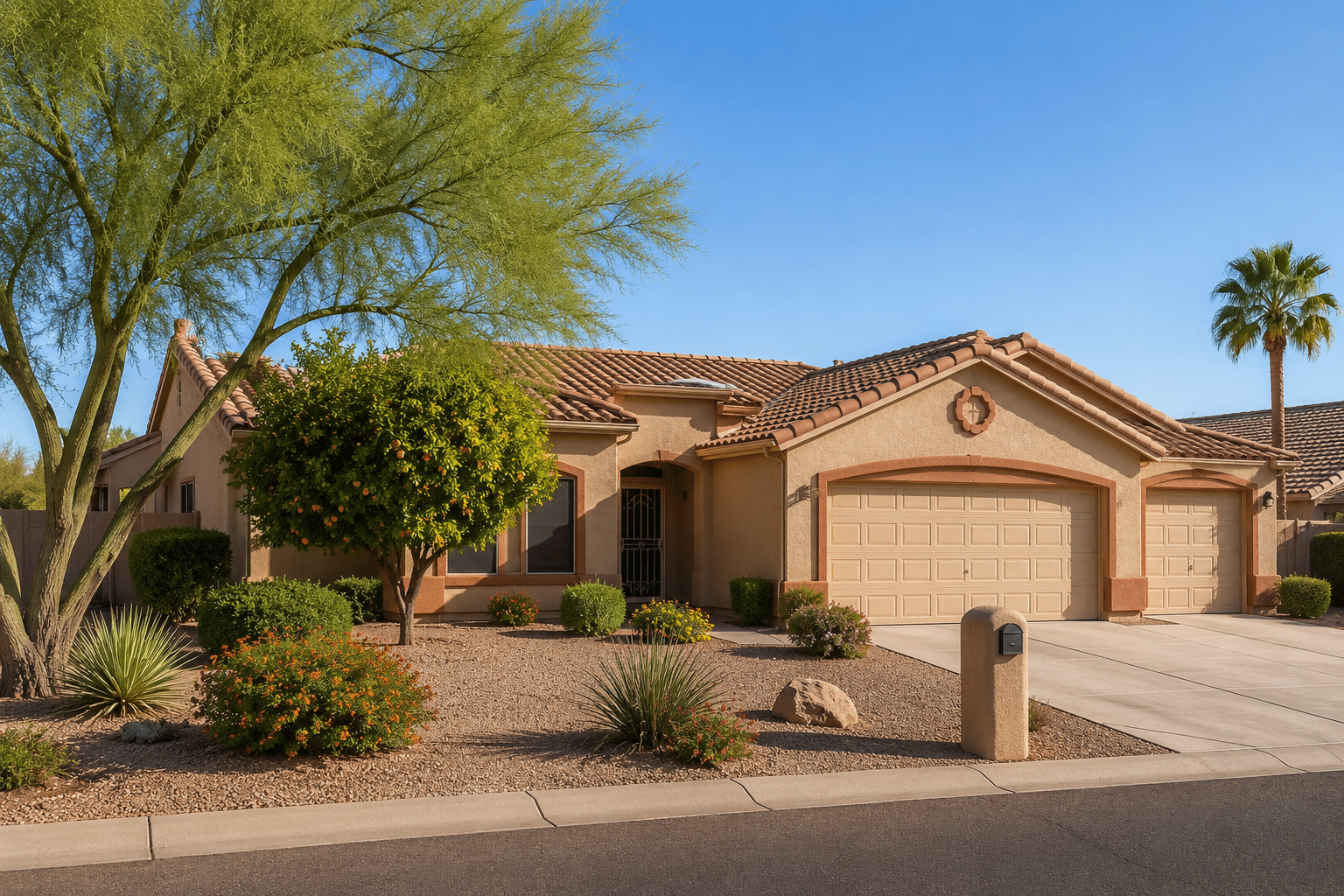
Every home at Sunland Springs Village is a resale — no builder is currently constructing new product inside the perimeter wall. That single fact reshapes the buying experience compared to communities where a sales office is still open.
Floor plans across the neighborhood reflect the design preferences of the late 1990s and early-to-mid 2000s, updated by individual owners over time. Approximately 2,400 single-family detached homes sit on the residential streets, ranging from compact two-bedroom plans of roughly 1,200 square feet up through three-bedroom-plus-den layouts above 2,200 square feet. Lots are predominantly modest desert-landscaped parcels, with a smaller share of premium lots backing the perimeter or interior open space.
Buyers touring the community in 2026 should expect to see the single-family detached product exclusively. There are no condominium towers here, no attached townhome rows, and no manufactured-home sections. The architectural vocabulary is consistent: stucco exteriors in warm desert palettes, tile roofs, two-car or two-and-a-half-car garages with golf-cart bays in many homes, and standard southwestern-suburban setbacks from the street. Interior updates vary widely. A home that traded hands within the last five years is likely to show updated kitchens, refreshed bathrooms, and modern flooring. A home held by a long-tenure original owner may still carry early-2000s fixtures, which usually translates to a lower asking price and a renovation budget on the buyer’s side.
The build window matters for two reasons. First, energy-efficiency standards moved meaningfully between 1998 and 2008, and a buyer touring on a hot day can feel the difference between an older single-pane window and a newer double-pane retrofit. Second, the kitchen-and-living-room layouts trend more open in homes built later in the run. A practical resale-tour habit at Sunland Springs Village is to ask the listing agent the year of original certificate of occupancy and the date of the most recent HVAC replacement. Both numbers calibrate the offer.
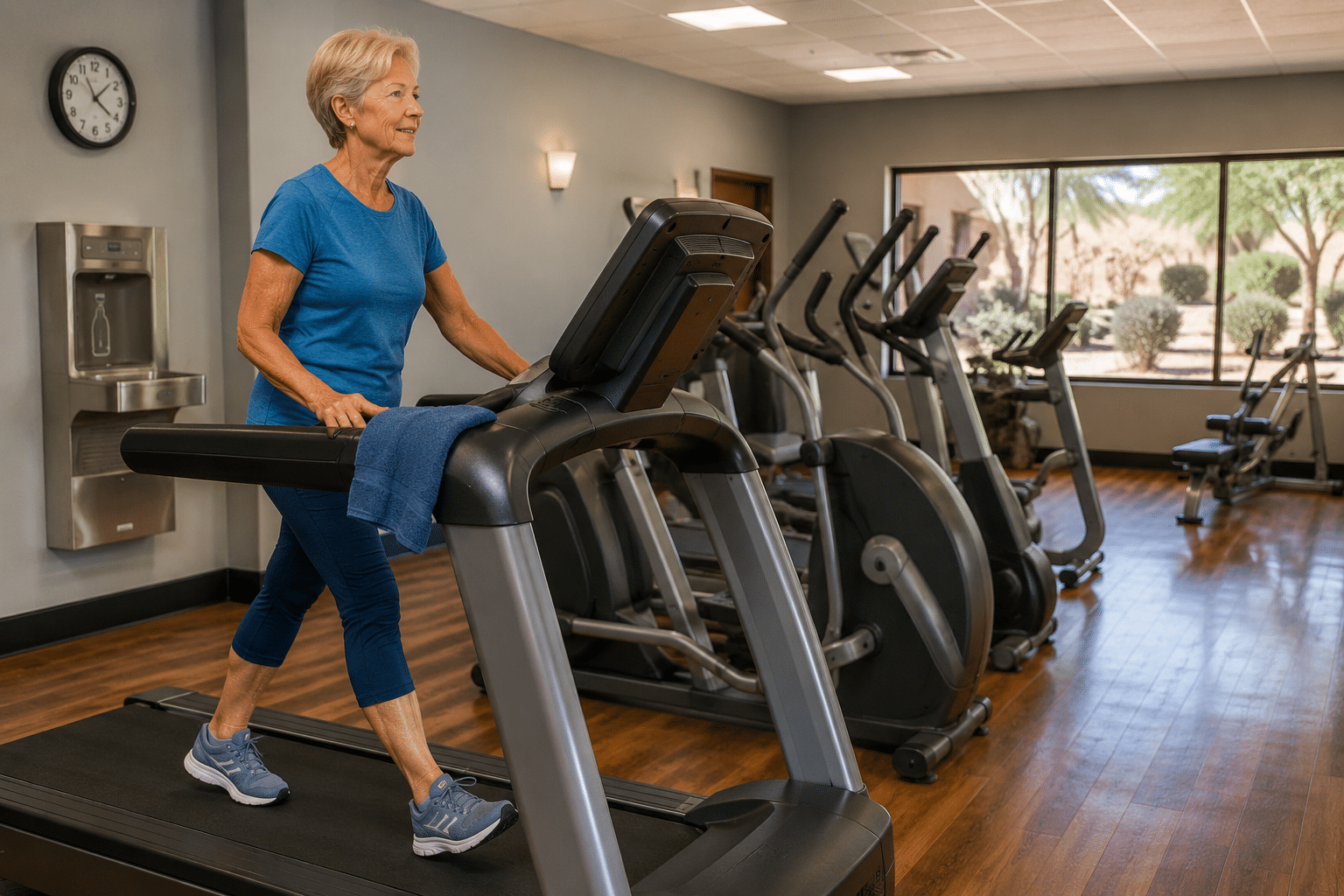
Daily amenity use at the community concentrates on a primary clubhouse footprint that anchors the social, recreational, and aquatic life of the neighborhood. The clubhouse complex includes a ballroom large enough for community-wide events, smaller meeting and craft rooms, a fitness room, and direct outdoor access to the pool deck.
The aquatic facilities typically include both a heated lap pool and a separate resort-style leisure pool, plus an attached spa. Outdoor sport courts in regular weekly use include pickleball, tennis, bocce, and shuffleboard.
Exact court counts and configurations are best confirmed during an on-site visit. The practical headline is that a resident who picks up a paddle on day one will find a regular doubles partner inside a week.
Two pools serve different daily uses. The lap pool runs lanes during morning and late-afternoon windows for residents who swim for fitness. The leisure pool functions as the social pool: water-aerobics classes through the cooler months, casual afternoon use during winter and spring, and the occasional evening event. Pool hours and access protocols are posted at the clubhouse. The combination of two water features lets residents who want a quiet swim and residents who want a chair-and-paperback afternoon coexist without colliding.
Pickleball has reshaped court life at every Mesa-area 55+ community over the last decade, and Sunland Springs Village reflects that shift. Dedicated pickleball courts run scheduled morning and afternoon sessions, with open-play windows during the cooler months. Tennis courts continue to host competitive league play and casual doubles. Bocce and shuffleboard fill out the outdoor footprint, drawing both regular leagues and pickup play. Most matches finish before noon during summer and stretch later into the day from October through April.
Indoor fitness anchors the daily wellness routine for many residents, particularly during the summer months when outdoor activity shifts to dawn and dusk. The fitness room at Sunland Springs Village offers cardio equipment and resistance machines suitable for an age-graded workout. Beyond the formal facilities, the residential streets themselves form a usable walking and golf-cart network — flat, low-traffic, and shaded by mature trees in established sections of the neighborhood. Many residents log a daily walking loop without ever entering a clubhouse.
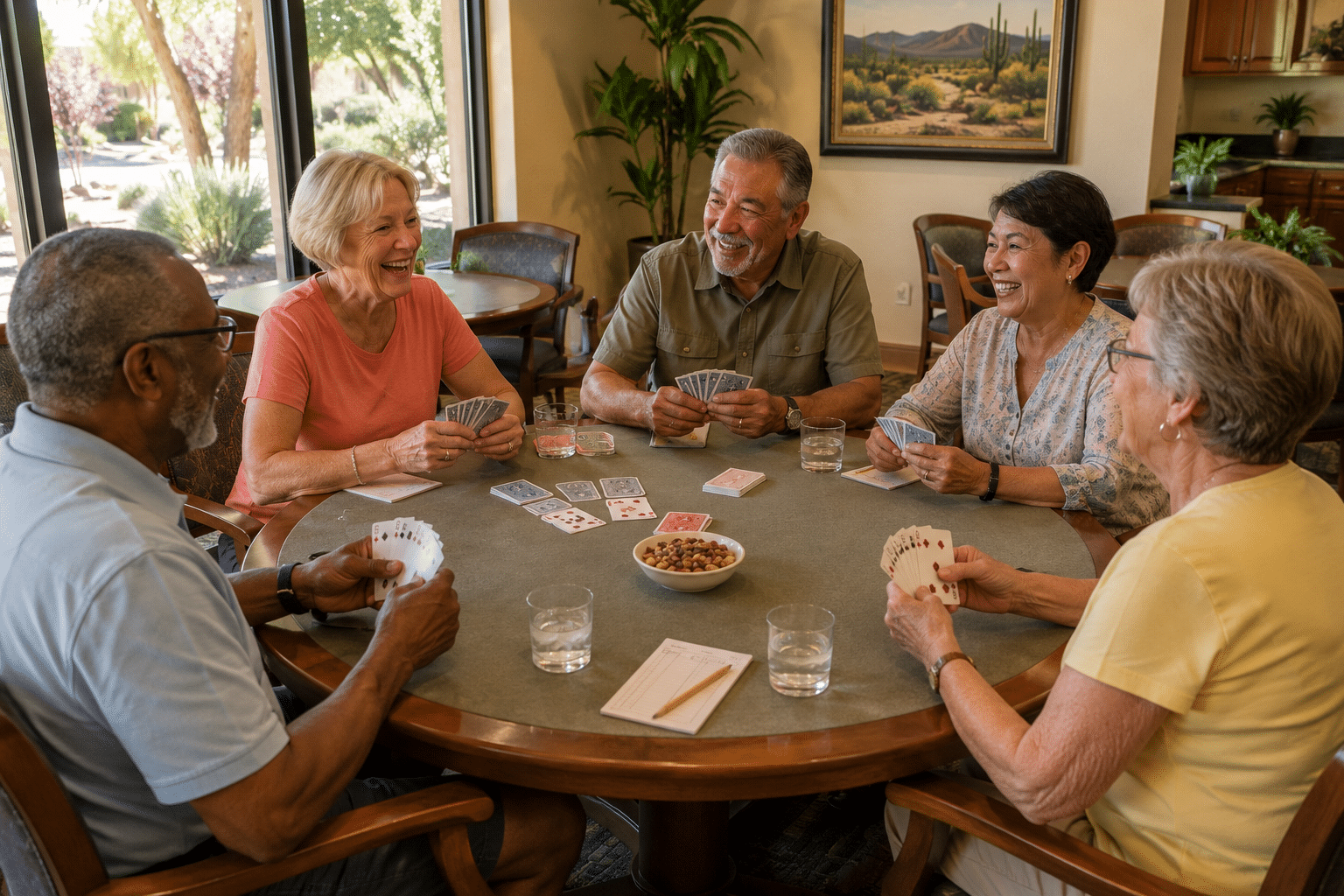
The activity calendar at Sunland Springs Village fills itself in a particular way. Residents who arrive with a hobby or a program idea propose it, find three or four neighbors who will commit, and a weekly or monthly slot opens up. The clubhouse craft and meeting rooms cycle through quilting, painting, woodworking, lapidary, dancing, card play, book discussions, and seasonal interest groups across a week. There is no central activities director writing a corporate-style program from a master template. The character of the calendar instead reflects who currently lives in the neighborhood and what they want to do with their afternoons.
Music and performance occupy a meaningful share of the social calendar from October through April. A community choir typically rehearses through the cool months and performs seasonally. Resident-led music groups — ukulele circles, line-dance classes, and informal jam sessions — rotate through the ballroom and meeting rooms on a weekly cadence. Holiday programs, themed dances, and visiting performers fill the larger events on the schedule. Tickets, when required, are typically modest and benefit either the activity group running the event or a community charitable initiative.
Card play is the quiet engine of weekday afternoons. Bridge, pinochle, Mahjong, and canasta groups maintain regular weekly sessions, and most run a beginner-friendly table for new residents. Craft and hobby rooms host quilting, sewing, ceramics, and art classes. The lapidary and woodworking spaces, where they exist, are typically among the most well-equipped community-run shops in any East Valley 55+ neighborhood, supported by member dues and volunteer maintenance. Newcomers usually find the cards-and-crafts side of the schedule the easiest entry point into the community’s social fabric.

Sunland Springs Village sits at one of the more useful intersections in the southeast Valley. Higley Road runs north-south through east Mesa and into Gilbert; Baseline Road runs east-west across the entire metropolitan area, from Apache Junction on the east to South Mountain on the west.
From the gates, the US-60 Superstition Freeway is roughly a five-minute drive north, providing the primary west-bound commute toward central Phoenix and the connection south on Loop 202 to the airport corridor. Phoenix-Mesa Gateway Airport sits roughly fifteen minutes east, and Phoenix Sky Harbor International is approximately a thirty-five-minute drive west under typical traffic.
Day-to-day errand geography is denser than the freeway map suggests. Major grocery, pharmacy, hardware, and dining are clustered along Power Road, Recker Road, and Baseline Road within a five-minute radius. A weekly Costco run, a routine Trader Joe’s stop, and a midweek lunch out at any of the community’s regular cafe haunts each fall inside a fifteen-minute round trip. Cultural and recreational anchors — Mesa Arts Center to the west, the Riparian Preserve at Water Ranch in nearby Gilbert to the south, and the open-space footprint of Usery Mountain Regional Park to the northeast — sit within twenty to thirty minutes of the gates.
The intersection itself is a useful daily reference point for buyers evaluating the location. Standing at Higley and Baseline, a resident can be at the City of Mesa civic district in about twenty-five minutes, in downtown Gilbert in fifteen, in Tempe in twenty-five, and on a hiking trailhead in the Superstition foothills in twenty-five. The breadth of those twenty-five-minute destinations is what makes this corner of east Mesa work for buyers who want both quiet residential daily life and reasonable metro access for medical, cultural, and family obligations.
Healthcare access from the community runs through two distinct hospital networks rather than a single system, and that geographic happenstance is a quiet advantage for buyers who care about provider choice. Sunland Springs Village sits roughly equidistant between Mercy Gilbert Medical Center on the Dignity Health side and Banner Gateway Medical Center on the Banner Health side.
Both hospitals operate full emergency departments, surgical programs, and outpatient specialty clinics. Banner MD Anderson Cancer Center is co-located on the Banner Gateway campus and offers cancer care for East Valley residents.
Beyond the hospital anchors, the surrounding southeast Mesa and Gilbert grid carries a dense rolodex of primary-care offices, specialist practices, urgent care locations, and outpatient imaging centers. Banner Baywood Medical Center sits to the north on Power Road as a longer-tenured Banner facility serving the broader east Mesa population. A network of urgent-care locations along Higley Road, Power Road, and Greenfield Road handles after-hours and weekend triage without requiring a hospital trip. Most residents establish primary care within a five-mile radius of the gates and rely on the named hospitals only for surgical, cardiac, oncology, or emergency-level care. Buyers comparing healthcare access at nearby Sun Lakes and the Chandler corridor will find a similar two-network pattern.
Banner Gateway Medical Center is the practical anchor for residents who already have a Banner Health primary care provider or insurance preference. The campus is approximately a fifteen-minute drive from the community gates and includes the cancer center, full surgical suites, and a comprehensive outpatient infrastructure. Banner Heart Hospital and Banner Baywood Medical Center round out the network for cardiac and broader inpatient needs.
Mercy Gilbert Medical Center is the Dignity Health anchor on the Gilbert side, also approximately fifteen minutes from the gates. Residents already enrolled with a Dignity Health provider, or those seeking the Catholic-affiliated hospital network’s specific care model, will find Mercy Gilbert the natural destination. The hospital’s emergency department, surgical programs, and outpatient clinics run on the Gilbert side of the corridor, with a shorter drive than the further-west Banner Desert facility for many east-Mesa residents.

The financial profile of buying at Sunland Springs Village rests on three layers. The first is the home purchase price, which moves with the broader east Mesa resale market and varies materially by floor plan, lot, and the depth of recent updates.
The second is the HOA dues structure. The third is the carrying-cost layer of property tax, utilities, insurance, and the small-but-real cost of running a single-family home in a desert climate with summer cooling demand. A full breakdown of HOA fee structures across Arizona 55+ communities is a useful reference for cross-community comparison.
There is no on-site golf course, no equestrian center, no resort-grade spa, and no full-time concierge desk. There is a clubhouse, two pools, a working set of sport courts, an active calendar, and a perimeter-walled neighborhood with controlled vehicle entry.
The dues fund clubhouse operations, pool maintenance, gate operations, street upkeep within the community, common-area landscaping, and the activity-room infrastructure. They do not fund individual home exterior maintenance, individual landscaping, or individual utility costs. Buyers should confirm the published dues figure, the assessment cycle, and any pending capital-improvement special assessment with the HOA office before any binding offer.
Resale pricing at Sunland Springs Village reflects the broader Mesa market and varies by floor plan, lot, build year, and the depth of recent updates. A practical 2026 buyer worksheet adds the asking price, the monthly HOA dues, the estimated property tax (with the Arizona senior valuation freeze applied where eligible), the estimated annual cooling and water cost for a single-family Mesa home, and the cost of homeowners insurance, then divides the total by twelve to get a true monthly carrying cost. That number, not the listing price alone, is what most buyers should compare against alternative 55+ communities elsewhere in the Valley.
Sunland Springs Village is an age-restricted 55+ active adult lifestyle community. At least one resident in each household must be 55 or older, consistent with federal Housing for Older Persons standards.
Confirm the current published figure with the HOA office before any purchase decision.
Pets are permitted at Sunland Springs Village under the community’s CC&Rs, which typically allow domestic dogs and cats with leash and waste-disposal rules. Consult the HOA office for any breed or weight restrictions. Assistance animals are considered as a reasonable accommodation and are not subject to pet restrictions.
Sunland Springs Village is a perimeter-walled active adult neighborhood with controlled vehicle entry at primary gate points. Confirm current entry-control protocols during any on-site visit.
Mercy Gilbert Medical Center and Banner Gateway Medical Center are both within roughly fifteen minutes of Sunland Springs Village. Banner Baywood Medical Center, Banner Heart Hospital, and a network of urgent care locations also serve the southeast Mesa and Gilbert area
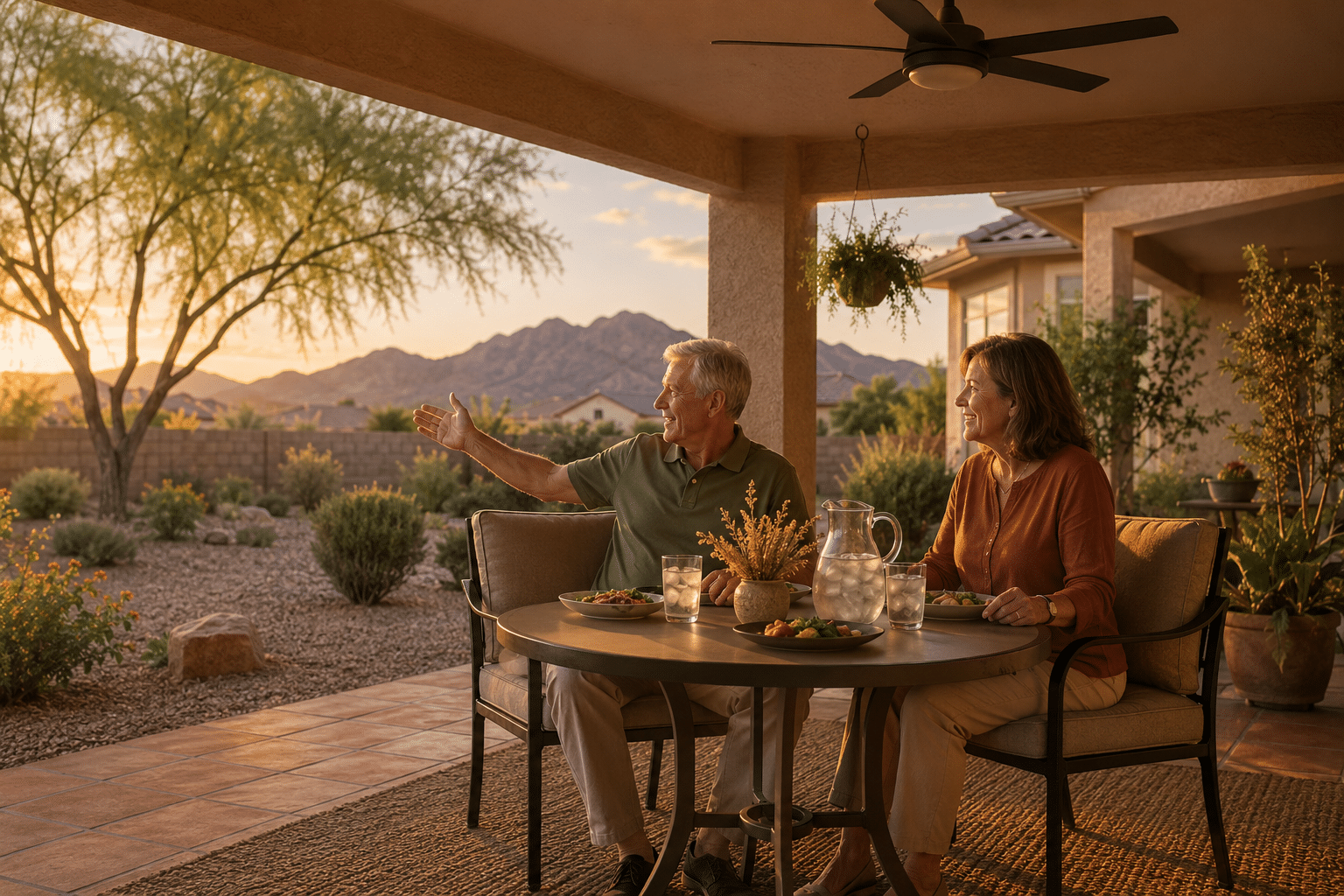
The right way to evaluate this neighborhood is to drive in, park at the clubhouse, and walk three specific stops in order. Stop one is the clubhouse itself: tour the ballroom, the craft and card rooms, the fitness room, and the pool deck on a weekday around mid-morning when the social calendar is in motion.
Stop two is a representative residential street — ideally on foot rather than from the car — to read how mature the landscaping is, how quiet the daily street life sounds, and whether the home density and lot character match what the buyer pictures for themselves. Stop three is a paired drive of the surrounding errand grid: a loop down Power Road, east on Baseline, and back up Higley to confirm the practical feel of the daily geography.
Two hours is enough time for the on-site portion of that walk. The decision a buyer makes by the end of it is rarely a yes-or-no on the community in the abstract; it is usually a yes-or-no on whether the specific resale homes currently on the market match both the budget and the floor-plan preference. A serious purchase pairs this on-site walk with a written list of must-haves on the home itself — single-level layout, garage configuration, kitchen footprint, lot orientation — and a current resale inventory pulled by a local 55+ specialist familiar with the Mesa cluster. Buyers who are still narrowing between communities can also consult the broader Arizona 55+ section index for side-by-side comparisons.
Schedule the on-site visit for a weekday morning between October and April, when the activity calendar is at its densest and the desert weather makes the outdoor amenity tour comfortable. Allow two hours on-site for the clubhouse, residential, and errand-grid walk, and a third hour for one or two specific resale-home showings if listings of interest are active. A productive visit ends not with a brochure in hand but with a clear written read on whether the lifestyle community math, the resale floor-plan inventory, and the southeast Mesa daily geography match what the buyer wants the next chapter to look like.
We use cookies to improve your experience on our site. By using our site, you consent to cookies.
Manage your cookie preferences below:
Essential cookies enable basic functions and are necessary for the proper function of the website.
CloudFlare provides web performance and security solutions, enhancing site speed and protecting against threats.
Service URL: developers.cloudflare.com (opens in a new window)
Google Tag Manager simplifies the management of marketing tags on your website without code changes.
These cookies are used for managing login functionality on this website.
Statistics cookies collect information anonymously. This information helps us understand how visitors use our website.
Google Analytics is a powerful tool that tracks and analyzes website traffic for informed marketing decisions.
Service URL: policies.google.com (opens in a new window)
You can find more information about our Cookie Policy and Privacy Policy.