

Seven hundred twenty-six homes. Built and sold across roughly five years. Closed to new construction since 2008. The numbers tell a different story at Solera at Johnson Ranch than at the larger Del Webb properties most prospective buyers picture first. This is not the original 27,000-home Sun City masterplan. This is not one of the 6,000-plus-home West Valley resort communities. This is Del Webb at sub-one-thousand-home scale, finished, settled, and now operating entirely as a resale market on the far-southeast edge of metro Phoenix.
The gated 55+ enclave sits inside the larger Johnson Ranch master plan in San Tan Valley. The community is just north of Hunt Highway in Pinal County. The San Tan Mountains rise along the eastern foothills. Queen Creek’s town center sits about fifteen minutes back toward the freeway grid. For buyers who have already toured the bigger Del Webb properties and want something at human scale, Solera reads as the version of the brand that finishes the sentence rather than starting another.
The scale shows up first in the parking lot. Cars are familiar, and so are the faces. A community of 726 households sits between a small-town neighborhood and a large city block, and the recreation center reflects that. Mornings at the La Casa clubhouse run on a recognizable rhythm. The fitness room hums by 7 a.m., the outdoor pool fills in by mid-morning, and the lobby thins out around lunch as residents drift back to patios or out to errands along Hunt Highway. The activity director keeps a steady calendar without filling every hour, which is part of the point.
A built-out 55+ community has a stability that newer-construction enclaves cannot replicate. The trees are mature, the HOA reserves have a track record, and the neighbors have answered the same question — can we live here? — for fifteen years and stayed. That texture is the lifestyle anchor at Solera at Johnson Ranch.
New buyers who close on a resale here are joining an established active adult community with documented patterns. They are not joining a community still figuring out who it wants to be. The age-restricted enclave is intentionally separated from the wider multigenerational Johnson Ranch master plan by a series of foothills and the Johnson Ranch Golf Course. That separation gives the streets a distinctly quieter feel than a typical age-mixed subdivision.
A typical Tuesday begins at La Casa for the early walkers and lap swimmers, who finish their workout in time for a coffee with friends in the great room or a class in the aerobics studio. By 10 a.m. the bocce ball courts are usually busy and at least one hobby studio has a craft session running. Returning residents will often stop on the way home to check the activities calendar posted in the lobby — partly habit, partly a reminder that something the next day is worth showing up for.
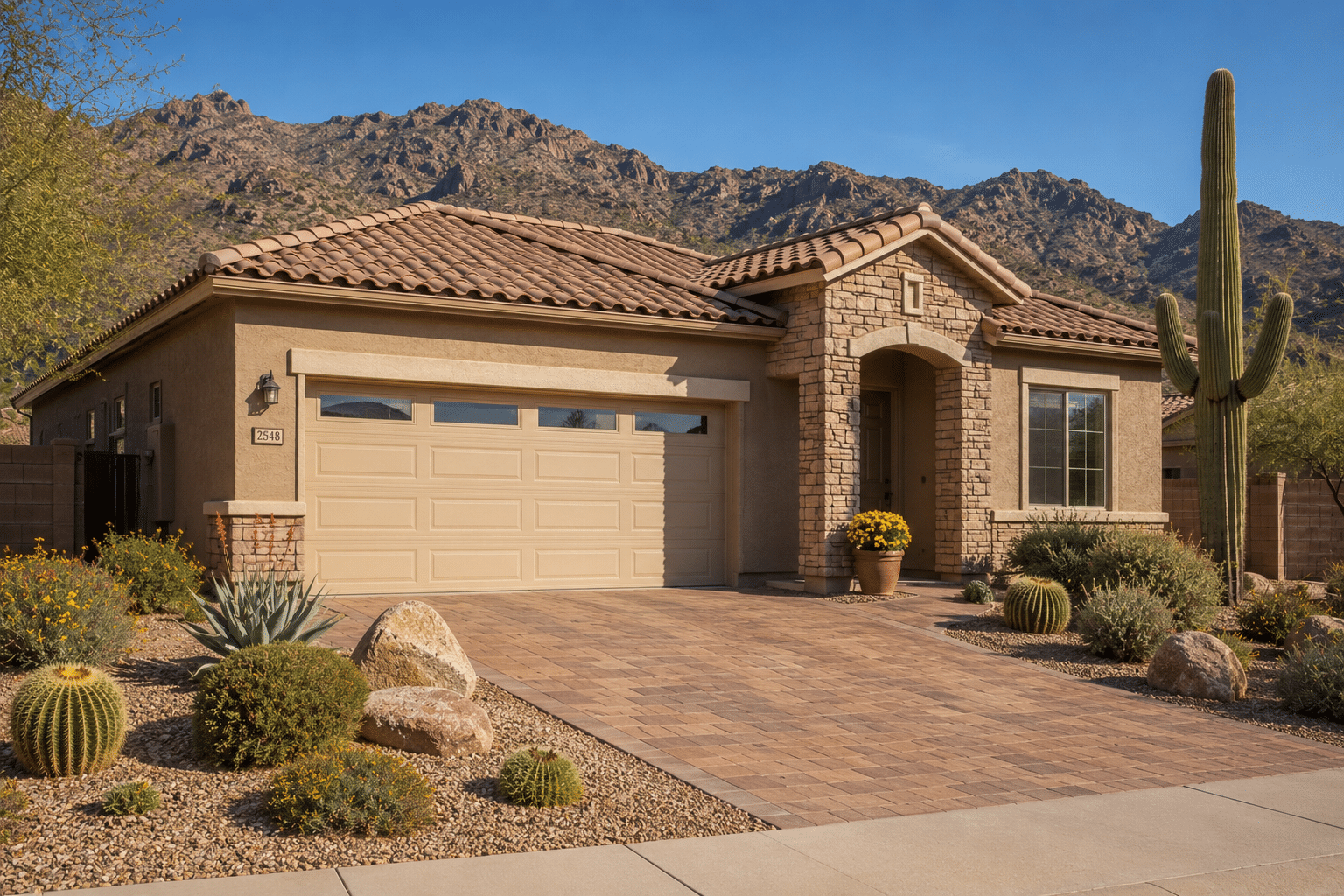
Del Webb built Solera at Johnson Ranch with just four single-story floor plans, ranging from approximately 1,400 to 1,900 square feet of conditioned living space. Every original home offered two bedrooms, two bathrooms, and a two-car garage as standard. Optional dens were popular, and many owners later converted them to a third bedroom or a home office. The compact plan family was a deliberate choice. For current prices, inventory and days on market in Solera at Johnson Ranch, see the market report linked on this page, which updates from ARMLS listing data.
The original buyer specifications at Solera at Johnson Ranch ran a step above the typical 2000s production-builder package. Standard features commonly included staggered maple cabinets, Corian countertops, and stainless appliances. Many homes feature gas stub-outs at the range, roll-out kitchen shelves, and 42-inch upper cabinets. Hard-surface flooring was widely upgraded at original sale.
Today, almost every resale home shows the imprint of at least one update cycle. Refreshed paint and updated lighting are common baselines. Replaced appliances and renovated primary bathrooms appear in many homes. Buyers who tour a half-dozen homes in a single day will see a clear spectrum from largely original to recently remodeled, and pricing tracks the gap predictably.
The community is past the period when a builder marketing center sets the conversation. Listings are agent-driven, and most homes change hands through traditional resale rather than estate or relocation cycles. Lot premiums survive in the resale market. Homes that back to open desert, foothill ridges, or the Johnson Ranch Golf Course command meaningful price differences from interior cul-de-sac homes on the same plan.
Block-wall yard fencing was not standard at original sale. The HOA allows it under reasonable rules, and previous owners have added it to many homes. Buyers who want a fully fenced yard for a dog or for privacy have a better chance of finding one already done than installing it after closing.

The 10,000-square-foot La Casa clubhouse anchors daily life at Solera at Johnson Ranch. The building is sized to fit the community’s footprint — compact enough to stay familiar, but large enough to keep two or three programs running at the same time. Inside, residents find a fitness center, an aerobics and dance studio, and a great room with a fireplace. Hobby and craft studios line one wing. A small library and a card-and-game room handle the quieter side of the building, and the ballroom hosts dances, holiday parties, and the activities director’s larger seasonal events.
The clubhouse opens to a heated outdoor pool and adjacent spa that anchor the social side of the season. The pool deck is shaded along its perimeter, and water classes run on the calendar through most of the year. A pair of tennis courts sits within easy walking distance, along with pickleball-suitable surfaces that residents share through a posted schedule. The bocce ball courts at La Casa stay popular into the warmer months because the mornings are still pleasant and the courts are walkable from most of the community.
Indoor programming at La Casa runs through the hobby studios. Residents find dedicated rooms for ceramics, jewelry-making, quilting, knitting, and other long-running craft groups. Many residents arrive at Solera at Johnson Ranch already skilled in one or two of these, and they tend to discover a third inside the first year. The library is small but actively curated, and a card-and-game room stays busy through the cooler months. The studios are a major reason the community functions through the summer, when outdoor amenity use thins out and the indoor programming carries the calendar.
Solera owners are full members of the larger Johnson Ranch master association. That membership brings access to the master community’s three recreation centers, additional outdoor pools, parks, sports fields, and a catch-and-release fishing pond. A public 18-hole championship golf course winds through Johnson Ranch with the San Tan Mountains as its backdrop. The crossover matters in practice. Grandkids visiting in spring break can swim at a master pool that allows children, while residents keep the age-restricted Solera amenities reserved for the adult side of the property.

The on-site activity director at Solera at Johnson Ranch curates a calendar but does not invent it. The clubs run themselves. New residents who have arrived in the past few years describe the same first-month pattern: show up at La Casa, look at the printed calendar, drop in on two or three different gatherings, and find a fit by the second week. The size of the community helps. A community of 726 households is large enough to support a real club for almost any common interest, and small enough that the same faces recur quickly across different rooms.
Active club programming at Solera at Johnson Ranch covers a wide range. Water volleyball and dance classes draw consistent groups, and hiking clubs head out to nearby San Tan Mountain Regional Park. Golf groups play the Johnson Ranch course in regular rotations. Book clubs meet in the library, and card and game groups fill weekday evenings. Faith fellowship groups, women’s clubs, and special-interest gatherings round out the schedule. The director’s role is mostly facilitation — a meeting space, a calendar slot, and an occasional outside instructor brought in for a short series.
The ballroom inside La Casa anchors the community’s seasonal calendar. Major holidays bring catered dinners and dances. Themed nights run through the cooler months, and the activities director pulls in live music from time to time for residents who want a Friday-evening event without driving out of the gate. The pace is steady rather than frenetic. Most full-time owners say the calendar gives them as much social structure as they want without crowding their week, and seasonal residents arriving in late October find a community already running at full programming pace.

Geography defines the day-to-day at Solera at Johnson Ranch as much as the community amenities do. The neighborhood sits at the eastern base of the San Tan Mountains, with foothills running directly into the property line and the Johnson Ranch Golf Course separating Solera from the larger master plan. The mountains read as a constant horizon line from the streets here, not a distant silhouette but a near-field landscape that residents see from their patios and walking paths. The vegetation is classic lower Sonoran Desert, with creosote flats, palo verde, mesquite, and saguaro spreading up into the foothills.
The community’s location places it about 40 miles southeast of central Phoenix, in the rural-fringe zone where San Tan Valley transitions toward open Pinal County desert. Hunt Highway is the primary east-west connector, carrying daily traffic from San Tan Valley into the established Queen Creek town center and on toward the Loop 202 Santan Freeway.
Drive times to the broader metro depend on direction, with Mesa or central Chandler running about 30 to 35 minutes and Tempe sitting around 45 minutes away. Phoenix Sky Harbor International Airport is roughly an hour and ten minutes in light traffic, but Phoenix-Mesa Gateway Airport in Mesa is the more practical option for many residents flying domestic routes — it sits about 13 miles from Solera and is served by Allegiant and other carriers.
The day-trip catalogue around Solera at Johnson Ranch leans rural. San Tan Mountain Regional Park sits about four miles from the community, a roughly 10,000-acre open-space property managed by Maricopa County Parks that offers miles of hiking, biking, and equestrian trails through lower Sonoran Desert vegetation.
Schnepf Farms, the long-standing agritourism operation in Queen Creek, draws residents for seasonal events and the peach-picking season. The Queen Creek Marketplace shopping center handles the practical errands. Super Target, grocery, pharmacy, and a steady set of casual dining options are all close by. For destination shopping or larger entertainment outings, residents typically drive west into Mesa or Chandler.

Healthcare planning at Solera at Johnson Ranch starts with Banner Ironwood Medical Center. It is a nearby acute-care hospital, located about four miles from the community on N. Gantzel Road. Banner Ironwood operates as a community hospital with a 24-hour emergency department and inpatient services. An attached medical office building houses primary care and several outpatient specialty practices. For most routine emergency, urgent, and inpatient situations, Solera residents drive minutes rather than tens of minutes to reach care. That is a meaningful difference compared with more remote Pinal County communities.
Banner Ironwood handles the routine layer of care that defines daily medical access for an active 55+ resident, with primary care visits, lab work, imaging, and urgent care all on campus and most non-major emergency presentations handled there as well. The medical office building is large enough to support a meaningful primary-care panel, and it hosts a rotating set of specialty practices covering cardiology, orthopedics, and other commonly used disciplines for active adults. Several urgent-care storefronts in the broader San Tan Valley and Queen Creek area provide additional walk-in access on evenings and weekends.
For higher-acuity specialty work, Solera residents typically drive west toward Chandler. Banner Ocotillo Medical Center, Chandler Regional Medical Center under Dignity Health, and other affiliated hospitals provide the deeper specialty bench, with the drive running about 25 to 35 minutes depending on time of day and routing through Hunt Highway and Riggs Road. Mayo Clinic Arizona’s broader institutional network in north Phoenix offers another option for complex tertiary care roughly an hour out. Most Solera at Johnson Ranch residents end up with a routine local panel anchored at Banner Ironwood, and the specialty referral pattern then pulls them west on the days that warrant the drive.
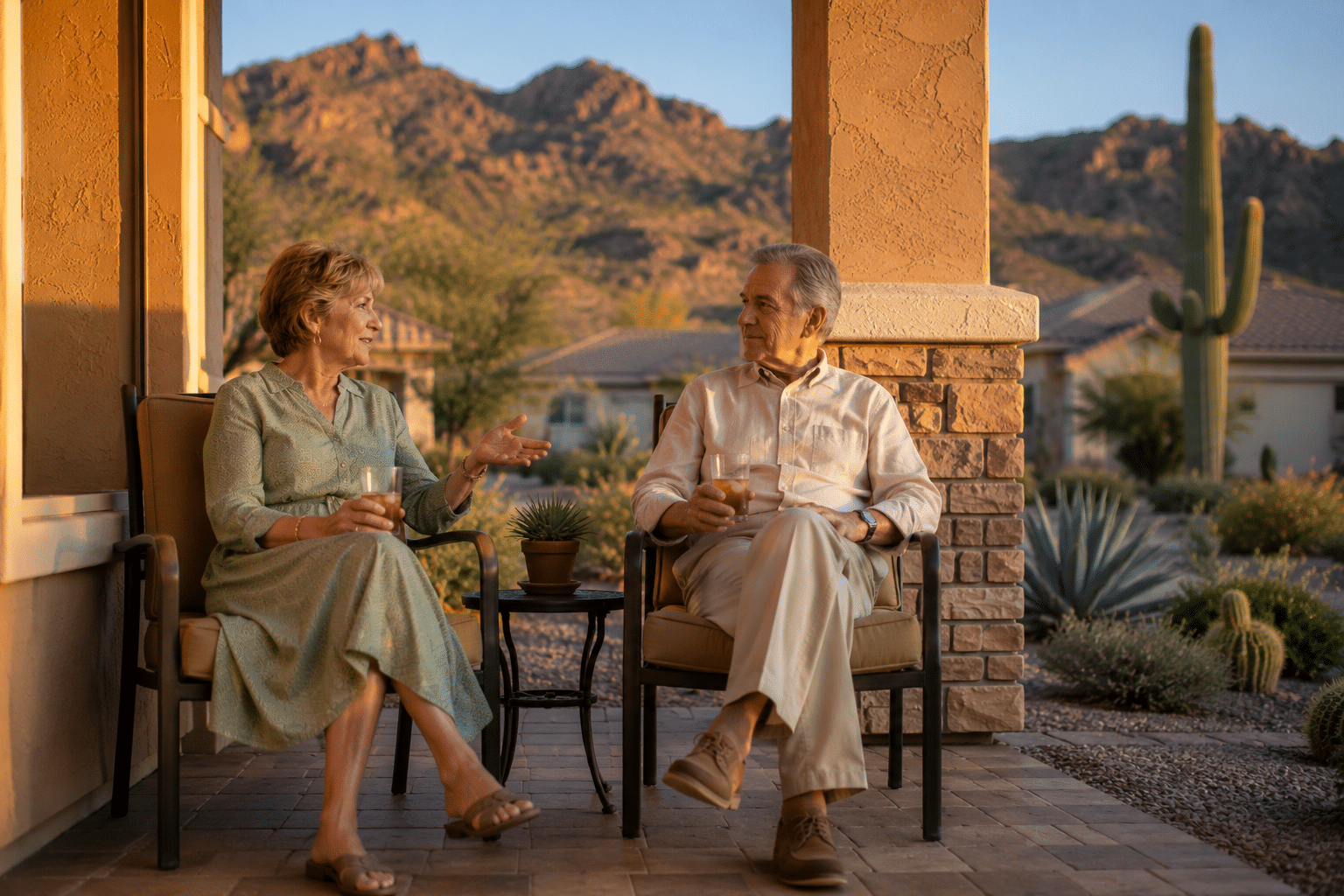
The financial picture at Solera at Johnson Ranch has three moving parts: the home purchase price, the dual HOA assessment structure, and Pinal County property taxes. Each one sits on a different ledger line, and each one shapes the monthly carrying cost in ways the headline price alone does not capture. The combined structure is not identical to communities in Maricopa County, nor is it identical to communities under a single master HOA.
Solera owners pay assessments to two associations. The first is the Solera-specific HOA. It funds the gated entry, the La Casa clubhouse, the private pool and amenities, the activities director, and the age-restricted side of community operations. The second is the broader Johnson Ranch master association. It funds the master amenities — recreation centers, master pools, parks, the fishing pond, and the trail and common-area maintenance through the larger 2,000-acre community.
Buyers should ask their agent for the most current assessment figures from both associations, as the combined total carries real weight in monthly budget planning. A two-line HOA structure is common in age-restricted enclaves embedded inside larger master plans, and the trade-off is meaningful: residents pay slightly more than a single-association community would charge, and in exchange they gain amenity access on both sides of the foothills.
Pinal County’s tax structure is its own consideration. Property tax rates and assessment patterns differ from Maricopa County in ways worth verifying with a local agent or directly through the Pinal County Assessor. Arizona’s senior property valuation freeze is available to qualifying owners 65 and older with income below state thresholds. Several Solera at Johnson Ranch residents make use of it after closing.
Resale pricing across the four floor plans tracks predictably, with the smallest plans on interior lots setting the floor and larger plans on view or golf-course lots setting the ceiling. Update level explains most of the spread in between. Pet rules at Solera follow standard Del Webb-era HOA conventions, with pets generally permitted under leash and household-count guidelines that residents should verify with the HOA prior to purchase.
Solera at Johnson Ranch is an age-restricted 55+ community. At least one resident in each home must be 55 or older, and the community is governed under federal Housing for Older Persons Act guidelines.
Residents typically pay a Solera-specific HOA assessment for the gated 55+ side and a separate Johnson Ranch master association assessment that funds the larger community amenities. Current quarterly figures should be confirmed with the HOA office or your agent before any offer.
Pets are generally allowed under standard Del Webb-era HOA rules, with leash requirements on common paths and reasonable limits on the number of household pets. Assistance animals are considered as a reasonable accommodation and are not subject to pet restrictions. Specific weight or breed conditions should be verified with the HOA before purchase.
Yes. Solera has its own gated entry separate from the larger Johnson Ranch master plan. The 55+ enclave sits behind a series of foothills and the Johnson Ranch Golf Course, giving the neighborhood a quiet, internal feel.
Banner Ironwood Medical Center sits roughly four miles from the community and serves as the primary nearby acute-care hospital. Routine and specialty care extend west into Banner Ocotillo Medical Center and the broader Chandler healthcare corridor.

A first-time tour of Solera at Johnson Ranch works best as a half-day, two-drive schedule. A quick walk through a single home will not do the job — the community sits far enough from central Phoenix that a short drive-through misses the texture of daily life here. The small scale of the property cuts the other direction, too, so a short list of homes can be walked thoughtfully in one morning rather than rushed through in an afternoon.
A useful sequence for a first visit: arrive at La Casa mid-morning, walk the clubhouse and amenity campus, and sit on the pool deck for ten minutes to read the social texture. Then tour two or three resale homes across different floor plans and lot positions. Lunch at one of the casual restaurants near Queen Creek Marketplace lets the conversation settle.
The afternoon is well spent driving the Solera streets at a resident’s pace. Cover more than the entry block, and drive a full circuit including streets that back to the foothills and streets that face the Johnson Ranch Golf Course. The drive time to Phoenix-Mesa Gateway Airport on the way out gives you a real-world reference point for any future travel planning.
To set up your tour and get current resale availability, visit the San Tan Valley 55+ communities hub or connect with a local active adult specialist. For broader context on the area, the Maricopa County Parks page for San Tan Mountain Regional Park is a good starting point. The Banner Ironwood Medical Center site offers an overview of nearby healthcare.
Buyers comparing Solera against other southeast-Valley options can also tour Trilogy at Power Ranch in Gilbert, explore Sun Lakes country-club living near I-10, or review the Encore at Eastmark profile for a newer-construction East Valley counterpart. Anyone weighing the Pinal County side of the metro alongside Solera should also read the Sun City Anthem at Merrill Ranch profile for a useful regional comparison.
We use cookies to improve your experience on our site. By using our site, you consent to cookies.
Manage your cookie preferences below:
Essential cookies enable basic functions and are necessary for the proper function of the website.
CloudFlare provides web performance and security solutions, enhancing site speed and protecting against threats.
Service URL: developers.cloudflare.com (opens in a new window)
Google Tag Manager simplifies the management of marketing tags on your website without code changes.
These cookies are used for managing login functionality on this website.
Statistics cookies collect information anonymously. This information helps us understand how visitors use our website.
Google Analytics is a powerful tool that tracks and analyzes website traffic for informed marketing decisions.
Service URL: policies.google.com (opens in a new window)
You can find more information about our Cookie Policy and Privacy Policy.