

There is a stubborn assumption that 55+ communities in the West Valley follow a single template. Single-story homes built three or four decades ago. Mature palms lining circular streets. The same handful of recognizable masterplans that defined active adult living when the category was invented. Sterling Grove Heritage was built to challenge that template.
The Heritage District at Sterling Grove is a Toll Brothers age-restricted neighborhood tucked inside a larger master-planned development on the northwest edge of Surprise. Greenway Road meets Sarival Avenue at the community’s southern edge, and Loop 303 carves the western horizon a few minutes away. It is among the newest 55+ addresses in the West Valley. The place did not exist a decade ago. It operates on a different design vocabulary than its established neighbors. Open floor plans designed for the way people actually live now. Architectural detailing borrowed from higher-end luxury subdivisions. A signature golf course routed through gentle desert terrain. For any buyer who assumed Surprise’s 55+ market was already settled, Sterling Grove Heritage rewards a closer look.
The active adult landscape across northwest Maricopa County has changed quickly over the past several years. Buyers who began their Arizona search in 2018 saw a market dominated by legacy masterplans. Buyers searching today see something more varied. Newer luxury 55+ developments have layered onto the established corridor. Builder lineups have broadened well beyond the original Del Webb model. Heritage stands at the leading edge of that shift. Understanding where the community fits — what it shares with its predecessors, where it diverges, and which buyer profile it best serves — is the starting point for any buyer considering it seriously.
Active adult communities in Arizona generally fall into one of two categories. The first is the established, lower-maintenance, single-story enclave that has been serving snowbirds and retirees for thirty-plus years. The second is the newer, smaller-scale infill development built within the bones of older neighborhoods. Sterling Grove Heritage represents a third and emerging category. It is a fully integrated luxury 55+ neighborhood within a larger non-age-restricted masterplan, designed from the ground up for active adults who want amenity, architecture, and finish levels that match their broader expectations of a primary residence.
This positioning matters in practice. Many Heritage residents arrived from the Pacific Northwest, the Midwest, the Bay Area, or the Front Range. Their previous home carried significant value. Their expectations of new construction were shaped by the post-2015 era of open-concept design and large-format windows. Sterling Grove was built for that buyer. The Heritage District inherits the broader masterplan’s amenity infrastructure while adding age-restricted privacy, a separate Heritage Clubhouse, and a calendar of activities tuned to a 55+ population.
Heritage attracts a slightly younger active adult buyer than the legacy Sun City corridor. The community sees a meaningful share of buyers in their late fifties and early sixties, often still working remotely full or part time, alongside the more traditional 65-and-up retiree segment. That demographic mix gives daily life at Heritage a different texture. Coworking-style use of clubhouse common areas in the morning. Organized social programming through the afternoon. A heavily used pickleball complex in the cooler hours of the day. The cadence is closer to a high-end resort than a traditional retirement enclave.

Toll Brothers is the homebuilder behind Sterling Grove, and the Heritage District represents the company’s age-restricted product line within the masterplan. Homes are exclusively single-story and weighted toward higher square-footage and higher-spec finishes than the typical Surprise 55+ inventory. Floor plan sizes generally span the mid-1,600s to roughly 2,800 square feet, with two- and three-bedroom configurations common, plus dedicated den or flex spaces in most plans.
The exterior architecture at Heritage borrows from desert contemporary, hacienda-influenced, and Tuscan-inspired vocabularies. Rooflines stay low-slung. Exterior color palettes lean into earth tones — warm tans, soft beiges, terracotta accents — that read against the desert hill backdrop rather than fighting it. Front yards feature water-conscious xeriscape: graveled stone fields, palo verde and mesquite specimen trees, accent boulders, and sculptural saguaro placements. The visual effect is intentionally less manicured than the older 55+ communities along the established corridor and more aligned with contemporary desert-modern design.
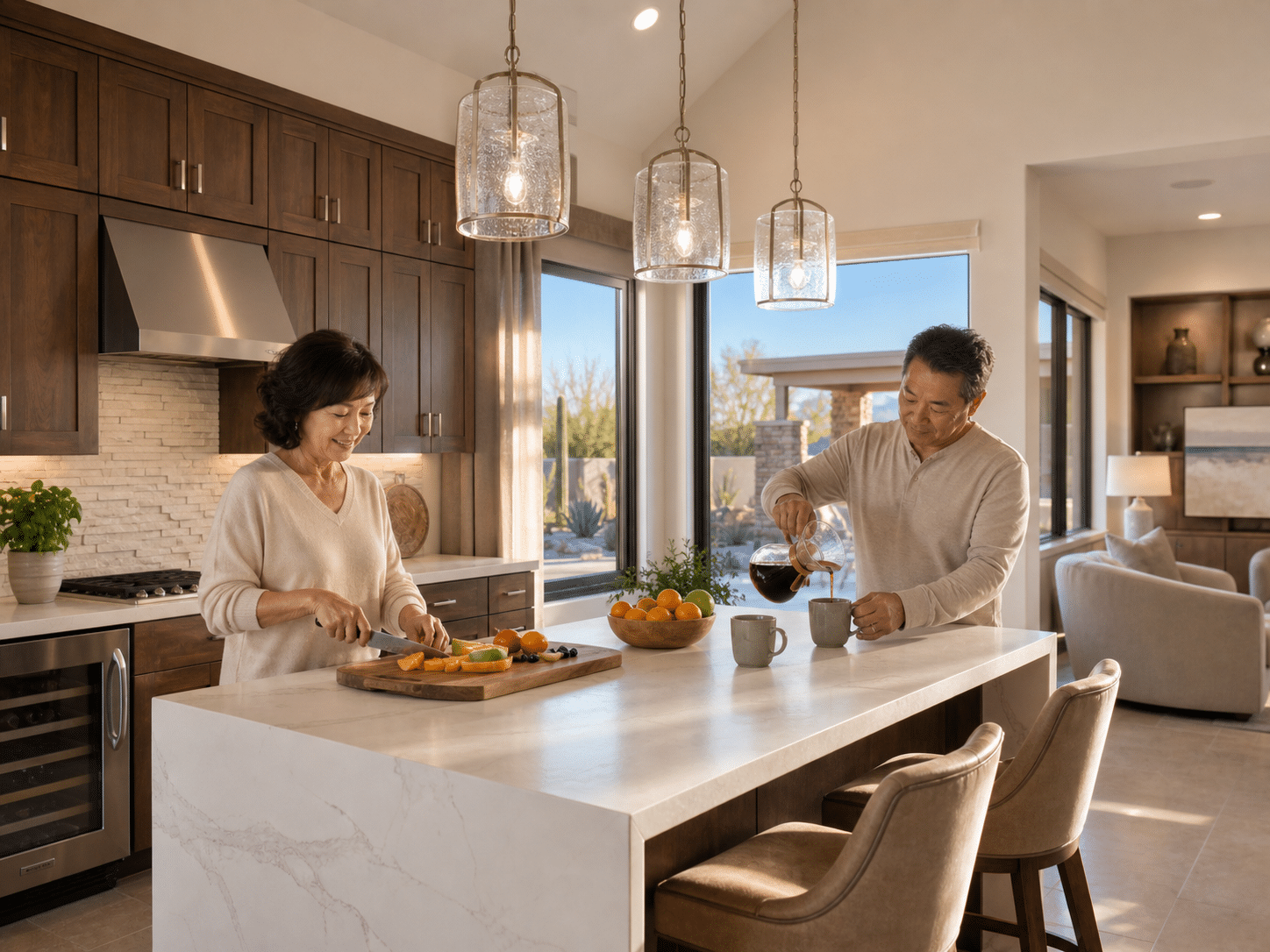
Inside, Toll Brothers delivers the finish level the company is known for. Vaulted ceilings of ten and twelve feet are common. Kitchens center on large quartz islands with waterfall-edge upgrades available. Primary suites sit at the rear of most plans with private patio access. The builder’s design studio offers extensive customization across flooring, cabinetry profiles, lighting, plumbing fixtures, and structural options like extended great rooms or expanded outdoor living spaces. Buyers who tour Heritage models often note that the experience feels closer to a custom-build process than the pick-from-three-packages approach common at lower price points.
Heritage residents enjoy a layered amenity structure unique to the community. The age-restricted neighborhood has its own dedicated Heritage Clubhouse, while also retaining access to portions of the larger Sterling Grove masterplan amenity package, including the signature golf course and main community spaces.
The Heritage Clubhouse is reserved for residents and their guests. It anchors the social side of the age-restricted district. Inside the building is a fitness center stocked with cardio equipment and free weights, a multipurpose room for classes and events, a billiards and game lounge, and a demonstration kitchen for cooking classes and wine programs. Outside the clubhouse, a heated pool and spa, ramada-shaded lounge areas, and outdoor cooking stations create a true second-living-room feel during the long Arizona swimming season.
The masterplan’s golf course routes through the broader community on gently rolling desert terrain. The course is open to Heritage residents alongside the rest of Sterling Grove, with membership tiers available [UNCONFIRMED on current tier structure]. The clubhouse beyond the eighteenth green serves as a second hospitality center for the community, offering food and beverage service, a pro shop, locker rooms, and event space for weddings, banquets, and tournaments. For Heritage golfers, walkable access to a high-end course is one of the community’s strongest differentiators against older Surprise alternatives.
Pickleball has become a central social sport at Heritage, just as it has across the broader 55+ category. Dedicated courts host morning ladders and evening league play. Tennis courts, bocce ball lanes, and a network of walking and biking paths complete the active recreation picture. Paths connect Heritage to the broader Sterling Grove trail system and ultimately to public sidewalk infrastructure along the Greenway Road corridor. Residents who want longer rides or hikes can extend toward the desert preserves and parks reached from Loop 303 within minutes.
Outdoor cooking and gathering spaces are a quiet strength of the amenity package. Ramadas equipped with grills and prep counters sit adjacent to the pool deck. Fire features anchor the patio for cooler evenings between November and March. The community garden lets residents grow heat-tolerant vegetables and herbs through the long Arizona growing season. Each of these smaller amenities turns into a meeting point during the cooler months, when residents move outdoors and the rhythm of the community shifts toward gathering and shared meals.

The social architecture of Heritage is what longtime residents describe as the deciding factor in their buying decision. Communities sell themselves on amenities. What residents actually buy is the texture of daily life with neighbors. Heritage has developed that texture quickly for a community its age.
A community lifestyle director coordinates the Heritage activity calendar. Standing programs include water aerobics classes, group fitness instruction, line dancing, art and pottery workshops, book clubs, wine and tasting events, and seasonal celebrations tied to holidays and the West Valley sports calendar. Beyond the structured programming, resident-led interest groups have organically formed around photography, hiking, classic cars, mahjong, gardening, and travel. Sign-up sheets in the clubhouse fill quickly during peak season.
Sterling Grove Heritage’s location inside a larger non-age-restricted masterplan produces a social dynamic worth understanding before buying. The age-restricted district itself functions as a self-contained community, but residents share the broader Sterling Grove footprint — the golf course, the main commercial frontages, the community-wide special events — with families and younger professionals living in the masterplan’s other neighborhoods.
For some buyers, that integration is an asset. Visiting grandchildren are not the only kids on the property. The community has a vitality across generations that pure age-restricted communities cannot replicate. For other buyers, the appeal runs in the opposite direction. The privacy of the gated Heritage section behind its own controlled-access points is the entire point. Both groups settle in comfortably. The seasonal snowbird-to-full-timer ratio sits in the middle of the range typical for new-construction West Valley 55+, and the cross-generational masterplan layer adds a dimension to everyday life that older single-purpose communities do not offer.

Sterling Grove sits on the far northwest side of Surprise, near the line where developed Maricopa County hands off to open agricultural and desert land. Greenway Road runs east-west along the community’s southern edge. Sarival Avenue runs north-south along the western edge. Loop 303 sits roughly two miles west, providing the primary freeway connection toward the broader Phoenix metro and the southern routes through Goodyear and Buckeye. The Greenway Corridor itself has emerged over the past decade as one of the most actively developing residential corridors in the West Valley, with new retail, dining, and medical infrastructure following the residential growth.
Daily errands settle inside a fifteen-minute drive. Costco, Fry’s, and Safeway anchor grocery shopping. The Marketplace at Surprise and Prasada offer broader retail. Spring training is part of the rhythm of life from late February through March, with Cactus League games at Surprise Stadium twenty minutes east. Day trips reach further. The Westgate Entertainment District in Glendale, home to State Farm Stadium and Desert Diamond Arena, sits roughly thirty minutes southeast for concerts and major events. Wickenburg’s Old West downtown is an hour northwest. Lake Pleasant Regional Park and its boating, fishing, and shoreline trails are about thirty-five minutes north on Loop 303 and AZ-74. Phoenix Sky Harbor International Airport sits roughly forty-five minutes southeast for travel.
Dining around Sterling Grove has matured alongside the residential growth. Chef-driven restaurants now sit within the Greenway Corridor that did not exist when the surrounding subdivisions were first platted. Resident favorites include Italian, modern Mexican, and southwestern American kitchens within ten to fifteen minutes of the gates. For longer evenings out, downtown Phoenix and the dining corridors of Scottsdale are accessible via Loop 101 and the Loop 303 connector. Cultural day trips include Sedona’s red rock country two hours north, Prescott’s historic downtown ninety minutes north on US-89, and the antique shops and art studios scattered along the Wickenburg corridor northwest.

Healthcare planning matters more in retirement than at any earlier life stage, and Sterling Grove’s location places residents inside a robust, multi-system network of West Valley medical infrastructure. Rather than orient around a single anchor hospital, Heritage residents tend to assemble their care across several systems, choosing primary care, specialists, urgent care, and hospital affiliations based on physician relationships and insurance networks.
Outpatient cardiology, orthopedics, gastroenterology, and oncology services have all expanded along the Greenway and Bell Road corridors. HonorHealth maintains an outpatient presence in north Surprise and operates urgent care locations within minutes of Heritage. NextCare and FastMed urgent care chains operate additional locations across the surrounding ZIP codes. For residents managing chronic conditions, the density of specialty practices in north Surprise has grown substantially since 2018. That growth has reduced the travel time for ongoing specialty care from what older West Valley residents historically experienced.
For inpatient and emergency care, Heritage residents have several full-service options within reasonable driving range. Banner Health operates the closest tertiary facilities in the corridor. HonorHealth, Abrazo, and Banner each maintain emergency rooms in Surprise or adjacent communities. Mayo Clinic Hospital in Phoenix sits roughly forty-five minutes east via Loop 303 and Loop 101 for residents with complex conditions or transplant-level care needs. Local agents and current residents often help newcomers navigate which provider network and physician relationships make sense given each buyer’s specific medical history.
Sterling Grove Heritage occupies the upper end of the Surprise 55+ pricing spectrum, and prospective buyers should think about acquisition cost, ongoing carrying cost, and long-term value distinctly.
Heritage homes have historically priced from the high $400,000s into the $700,000s and above, depending on plan, lot premium, and the structural and design upgrades selected. Premium golf course lots, corner lots, and homesites with mountain or course views command premiums above the base price. HOA fees cover access to the Heritage Clubhouse and amenities, common area maintenance, gated security, and a portion of broader Sterling Grove masterplan upkeep. Golf membership at the country club is separate, with multiple membership tiers offered for residents who want regular course access. Buyers comparing Heritage to nearby established neighborhoods should account for the difference between newer-construction warranty coverage, lower deferred-maintenance risk, and a higher initial price tag.
Pet policies at Heritage reflect the broader Sterling Grove rules and generally accommodate dogs and cats with standard leash and waste-cleanup expectations. Maricopa County property tax treatment is straightforward, and the Arizona senior property valuation protection program is available to qualifying residents 65 and older meeting the income threshold. The longer-term value case for Heritage rests on two factors. First, the community is new construction within a luxury masterplan, which preserves resale strength as the broader development matures. Second, the Greenway Corridor itself is in active growth, with ongoing residential, retail, and medical infill investment in the surrounding three-mile radius. Both factors support the long-term position of a Heritage home as an asset, not just a residence. The federal Housing for Older Persons Act framework — at least 80 percent of homes must have one resident aged 55 or older — governs the age policy and is administered through the buyer application process.
For buyers cross-shopping Heritage against other Surprise and West Valley alternatives, the practical comparison usually breaks across three dimensions. The first is acquisition cost. Heritage prices above the established communities along the Bell Road corridor and approaches the upper end of the Buckeye masterplans. The second is finish level. Toll Brothers homes typically deliver higher base specifications and broader design-studio customization than the volume builders in the area. The third is amenity context. The combination of a private 55+ clubhouse with shared access to a luxury masterplan golf course is genuinely uncommon at this price point. Buyers willing to pay for that combination tend to view Heritage as a category of one within the local market.
Sterling Grove Heritage is an age-restricted neighborhood operating under the federal Housing for Older Persons Act, requiring at least one resident in 80 percent of homes to be 55 or older. The age policy is administered by the Sterling Grove community association as part of the buyer application process.
HOA fees at Sterling Grove Heritage cover access to the Heritage Clubhouse and amenities, common area maintenance, gated security, and a portion of broader Sterling Grove masterplan upkeep. Exact figures vary and should be confirmed with a current Surprise 55+ specialist before any purchase decision.
Yes. Sterling Grove Heritage follows the Sterling Grove masterplan pet policy, which generally accommodates dogs and cats with standard leash and waste-cleanup expectations. Specific breed and weight limits, where applicable, are detailed in the community CC and Rs.
Yes. The Heritage District operates behind its own controlled-access gates, providing privacy from the surrounding non-age-restricted Sterling Grove neighborhoods while still offering shared access to the masterplan golf course and certain main community amenities.
Heritage residents have multiple medical systems within reasonable driving range, including HonorHealth outpatient and urgent care locations along the Greenway and Bell Road corridors, Banner Health and Abrazo emergency rooms in Surprise, and Mayo Clinic Hospital in Phoenix for complex specialty needs.

Sterling Grove Heritage is one of those communities that does not translate cleanly to a brochure. The pairing of Toll Brothers finish levels with a dedicated 55+ amenity package inside a broader masterplan is something most buyers grasp only by walking the property in person. The model homes. The Heritage Clubhouse. The fairways. The surrounding Greenway Corridor.
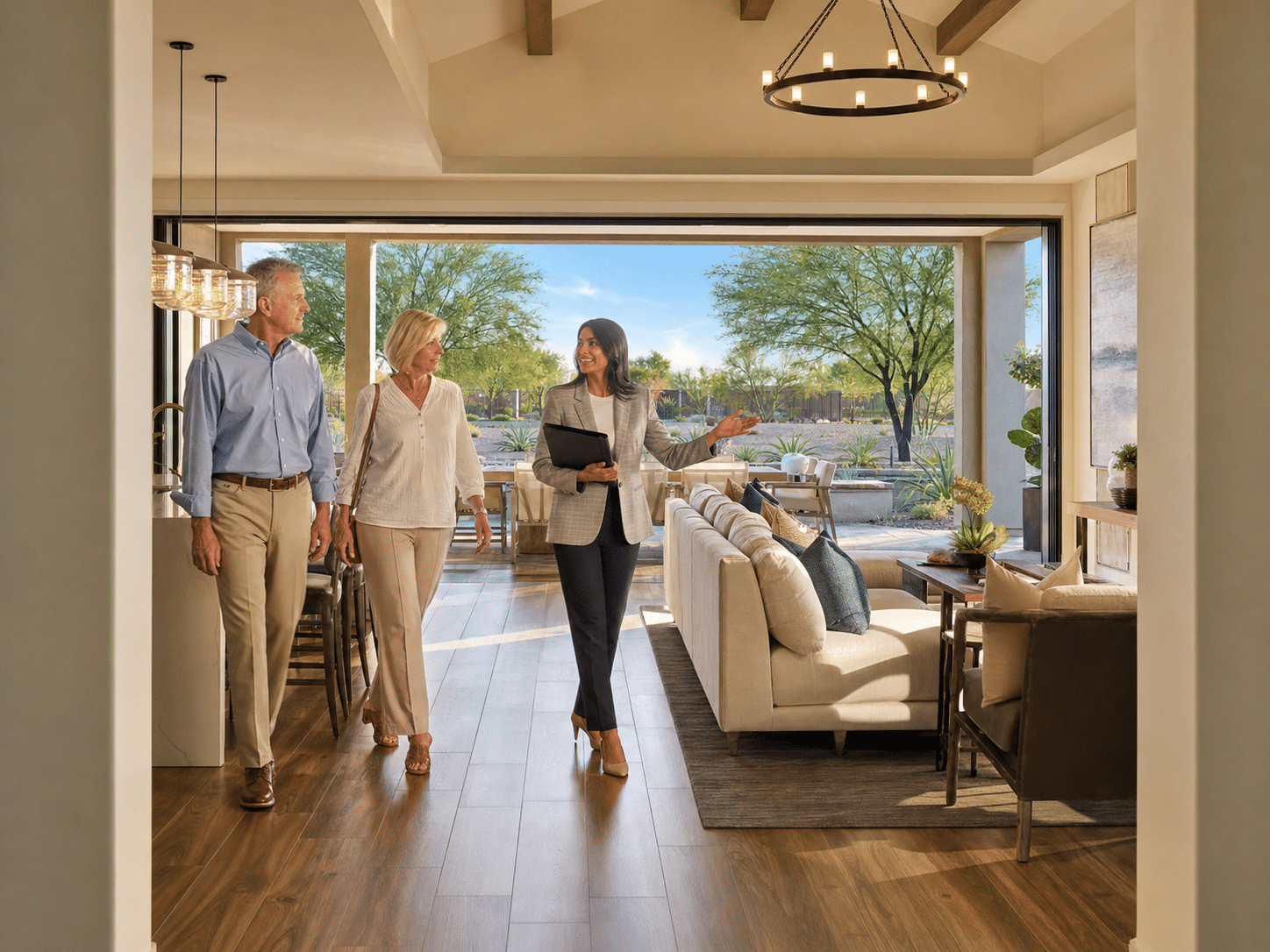
A Surprise-based real estate professional with current Sterling Grove experience is the practical key to a productive tour. Local specialists track the active inventory, the upcoming Toll Brothers releases, the resale options at any given moment, the differences between Heritage neighborhoods and the non-age-restricted Sterling Grove sections, and the comparison set against Sun City Festival, The Grand, Arizona Traditions, and other Surprise 55+ alternatives. Tour appointments work best when scheduled across a two- to three-day window. A buyer can then see the community at different times of day, attend a community event if the calendar allows, and meet residents informally at the clubhouse or pickleball courts. Fall and winter remain the strongest tour seasons, with mild temperatures, clear sky conditions, and the community at full seasonal occupancy. Whether a Heritage home becomes the right next chapter depends on a deeply personal set of factors. A thoughtful in-person visit answers most of the questions a buyer brings to the search. To begin planning a visit, contact a Surprise 55+ specialist and request a tour window aligned with your travel schedule.
We use cookies to improve your experience on our site. By using our site, you consent to cookies.
Manage your cookie preferences below:
Essential cookies enable basic functions and are necessary for the proper function of the website.
CloudFlare provides web performance and security solutions, enhancing site speed and protecting against threats.
Service URL: developers.cloudflare.com (opens in a new window)
Google Tag Manager simplifies the management of marketing tags on your website without code changes.
These cookies are used for managing login functionality on this website.
Statistics cookies collect information anonymously. This information helps us understand how visitors use our website.
Google Analytics is a powerful tool that tracks and analyzes website traffic for informed marketing decisions.
Service URL: policies.google.com (opens in a new window)
You can find more information about our Cookie Policy and Privacy Policy.