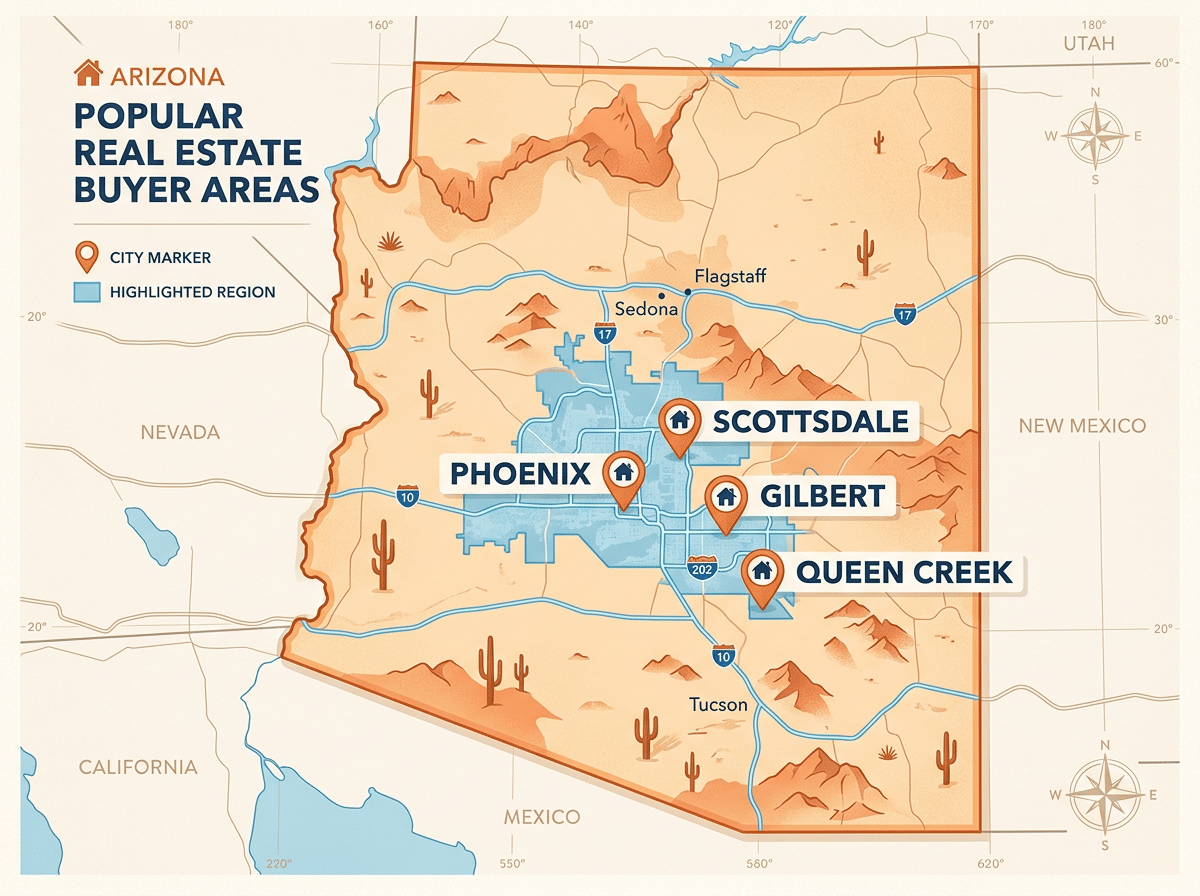
Buying a home comes with more than just a down payment—there are lender fees, title charges, prepaids, and other “cash to close” items that can add up fast. The good news is that seller concessions (sometimes called seller credits) can help lower your out-of-pocket costs at closing—especially for first-time buyers and relocators moving into Arizona markets like Phoenix, Scottsdale, Gilbert, and Queen Creek.
This guide breaks down how seller concessions work, what they can pay for, common loan-program limits, and how to negotiate them in a way that actually helps your budget.
Seller concessions: what they are and how they work
Seller concessions are an agreement where the seller contributes money toward certain buyer costs—most commonly closing costs and prepaid items—so the buyer brings less cash to the closing table.
Think of it like this: instead of the seller dropping the price by $10,000, the seller may agree to give the buyer a $10,000 credit that’s applied to approved closing-related expenses.
A few important “how it works” points:
- Seller concessions must be negotiated in the purchase contract (and properly disclosed).
- The credit is applied at closing—buyers don’t receive cash back in their pocket.
- Most loan programs cap how much a seller can contribute and what the credit can be used for.
For conventional loans, Fannie Mae treats these as interested party contributions that can cover borrower closing costs and certain prepaids (and even limited HOA assessments), but not the down payment.
If you’re early in the process, it helps to start with a realistic budget and then see which listings may be open to credits—your agent can help you spot opportunities while you browse Arizona homes for sale.
What seller concessions can pay for (and what they can’t)
In most Arizona transactions, seller concessions can help cover costs that commonly show up on a Loan Estimate / Closing Disclosure, such as:
Common costs seller concessions may cover
- Loan origination and underwriting fees
- Appraisal fee (if not already paid upfront)
- Title insurance and escrow fees
- Recording fees
- Prepaid homeowners insurance (often the first year)
- Prepaid property taxes (depending on timing)
- Discount points (including certain rate buydowns, if allowed by the loan program and lender)
Typically not allowed
- Down payment (most programs don’t allow credits to count toward minimum buyer down payment requirements)
- Cash back beyond legitimate prepaid/closing items
- Undisclosed “side deals” outside closing (this can cause serious loan problems)
Bottom line: concessions are best thought of as a tool to reduce cash to close, not as a way to avoid the down payment entirely.
Why seller concessions can be a big deal in Arizona markets
Arizona is full of different micro-markets—new builds with builder incentives, resale homes with negotiation room after inspections, and competitive neighborhoods where sellers hold the leverage.
Seller concessions tend to show up more often when:
- A listing has been sitting longer than similar homes nearby
- The seller wants a clean contract but knows the buyer is payment-sensitive
- Interest rates make a rate buydown attractive
- The home needs repairs and a credit is simpler than fixing everything before closing
This can play out differently depending on where you’re buying. For example, a home in the Phoenix real estate market might have different negotiation dynamics than a higher-priced property in Scottsdale, where jumbo or luxury financing rules can change the “best” strategy.
The trade-off: concessions vs. price (and why appraisal matters)
Seller concessions aren’t “free money.” In many cases, the buyer is offering one of two things in exchange:
- A slightly higher purchase price, or
- Other favorable terms (fewer repair requests, flexible closing date, etc.)
That’s not inherently bad—especially if the goal is minimizing upfront cash. But there’s one big watch-out:
If the appraisal comes in low, concessions can get messy
Many loan rules calculate allowable concessions based on the lower of the purchase price or appraised value. For conventional loans, Fannie Mae explicitly notes the maximum financing concessions are based on the lower of sales price or appraised value.
So if you negotiate a higher price to “make room” for concessions, your lender and appraisal still have to support the contract price.
A quick example: how seller concessions reduce cash to close
Let’s use an easy example (numbers vary by lender and scenario):
- Purchase price: $450,000
- Down payment (10%): $45,000
- Estimated closing costs + prepaids: $14,000
- Cash to close (before credits, ignoring earnest money for simplicity): $59,000
Now imagine you negotiate $10,000 in seller concessions.
- Closing costs + prepaids drop from $14,000 to $4,000 out of pocket
- New estimated cash to close becomes $49,000
In real life, this can be the difference between:
- closing now vs. waiting months to save more, or
- keeping an emergency fund intact after moving
This is also why concessions are especially helpful for out-of-state relocators who are juggling moving trucks, deposits, and overlapping housing costs.
Loan program limits: how much can sellers contribute?
Different loan types have different caps, and lenders can add overlays. Here are common guideline-level limits buyers often hear about:
Conventional loans (often Fannie Mae/Freddie Mac rules)
For principal residences and second homes, Fannie Mae’s maximum financing concessions are:
- 3% when LTV is greater than 90% (low down payment)
- 6% when LTV is 75.01%–90%
- 9% when LTV is 75% or less
For investment properties, Fannie Mae lists 2% across CLTV ratios.
FHA loans
FHA commonly limits interested party contributions (including seller concessions) to 6%.
VA loans
VA loans generally allow sellers to pay normal closing costs, and also limit certain “seller concessions” to 4% (with specific definitions of what counts toward the cap).
USDA loans
USDA guidance commonly limits interested party concessions to 6% of the sales price.
Because rules and lender interpretations vary, treat these as planning guardrails—not a guarantee. Your lender will tell you what’s allowable for your specific loan and property.
Smart ways to negotiate seller concessions without weakening your offer
Seller concessions are easiest to win when they’re framed as a clean, practical solution—rather than a vague “give me money” request. Here are strategies that tend to work:
1) Tie the request to real numbers
Instead of “seller to contribute $X,” a strong approach is:
- “Seller to credit buyer $X toward allowable closing costs and prepaids.”
That signals you know how credits are applied and keeps it lender-friendly.
2) Use inspections to justify a credit (instead of demanding repairs)
In Arizona, buyers often negotiate after inspections. A credit can be faster than coordinating contractors and receipts before closing. If you’re negotiating after an inspection period, it helps to understand timing and documentation—West USA’s guide to the Arizona BINSR process is a helpful overview.
3) Consider a rate buydown when monthly payment matters most
If your lender allows it, concessions can sometimes fund discount points or a temporary buydown (like a 2-1 buydown). This can lower the early years’ payment—useful if you’re moving up in home price or expect income growth.
4) Keep the offer attractive in other ways
If you’re asking for concessions, consider offsetting with:
- a flexible close date
- a reasonable repair request posture
- clean financing documentation (strong pre-approval)
This is where an experienced local agent really helps: they can structure the offer so the seller hears “less hassle,” not “more demands.”
For step-by-step guidance on building a strong offer, start with West USA’s Arizona home buying resources.
When seller concessions might not be the best move
Seller concessions are powerful—but not always optimal. You may prefer a different approach when:
- You have plenty of cash to close and want the lowest possible loan amount
- The home is highly competitive, and a clean offer beats a concession request
- Appraisal risk is high, and inflating price to cover concessions could backfire
- You’re focused on long-term interest savings, and a price reduction might lower total paid over time (depending on rate/term)
A good agent and lender team will run both scenarios: price reduction vs. credit vs. buydown, and show the real monthly and upfront differences.
FAQs about seller concessions in Arizona
Can seller concessions pay my down payment?
Usually no. Most programs don’t allow interested party contributions to count toward a borrower’s down payment or minimum required buyer contribution.
Do seller concessions reduce my loan amount?
Not directly. A credit reduces what you pay out of pocket at closing. But if you increase the purchase price to “build in” concessions, your loan amount could increase—assuming the appraisal supports the price.
Are seller concessions common in Arizona?
They can be, especially when sellers want to keep the contract moving, the home needs repairs, or the market favors buyers. The frequency depends heavily on neighborhood, price point, and inventory.
What happens if my closing costs are lower than the seller credit?
You generally can’t pocket the difference as cash. Excess credit may need to be reduced or reallocated to allowable items, depending on lender rules.
Are concessions different for new builds vs. resale homes?
Often, yes. Builders may advertise incentives that function like concessions (credits toward closing costs or rate buydowns), sometimes tied to using the builder’s preferred lender.
Conclusion: use seller concessions to keep more cash in your pocket
For many Arizona buyers, seller concessions are one of the most practical ways to reduce out-of-pocket costs—whether you’re trying to preserve savings, manage a move, or lower your upfront expenses while still buying the right home.
If you’d like help spotting listings where concessions may be possible (and structuring an offer that makes sense), connect with West USA Realty. You can start by browsing Arizona homes for sale and then lean on the tools in our buyer hub to plan your next steps.