
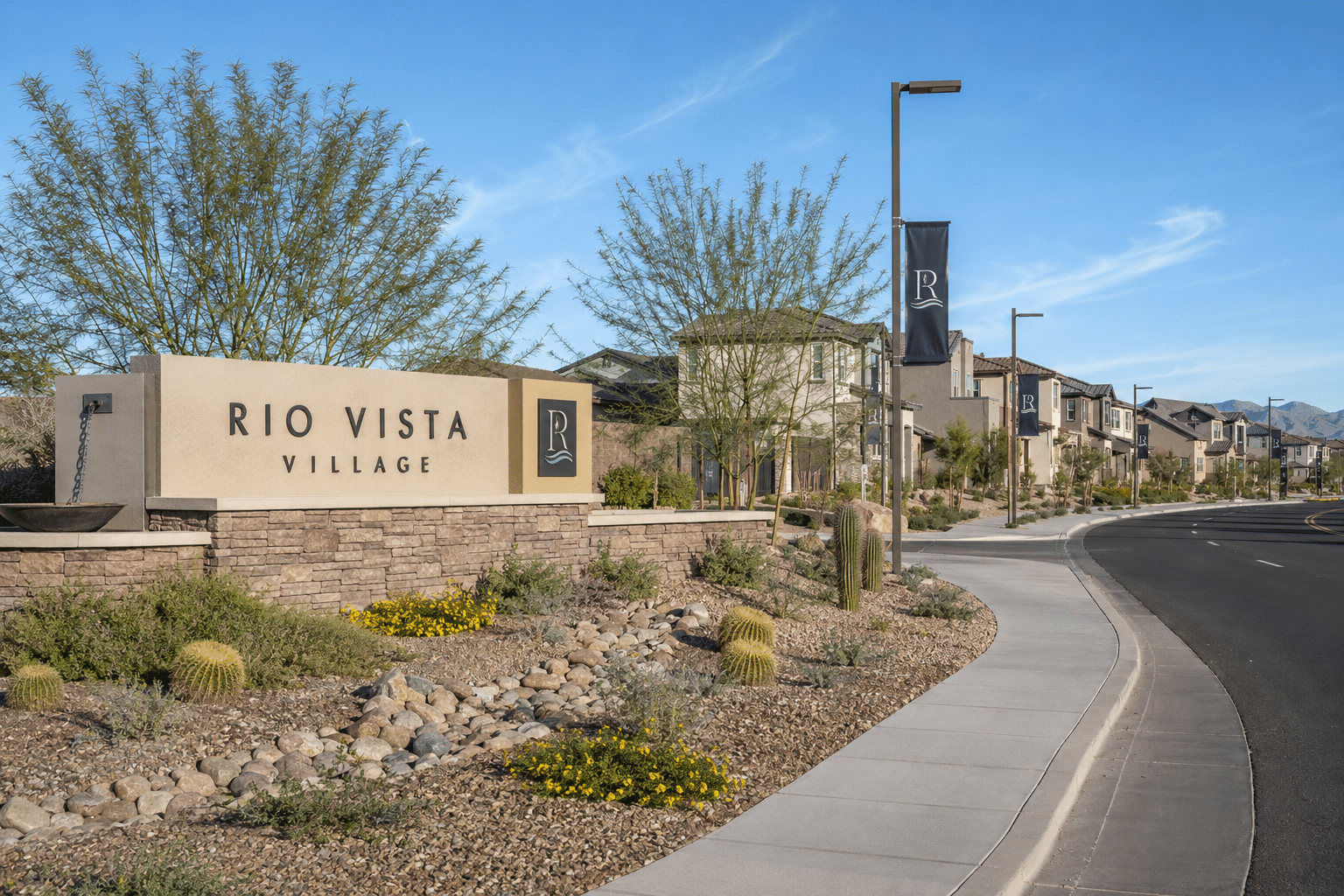
Rio Vista real estate sits at the southwest corner of Phoenix, inside the newest of the City of Phoenix urban villages. The Rio Vista Village was formally designated in 2015, carved from the western edge of Estrella, the southern edge of Maryvale, and a slice of South Mountain. Rio Vista Village real estate therefore behaves differently than every other Phoenix submarket: buyers comparing Rio Vista homes for sale find a housing stock inherited from three older neighbors, but a village identity built around the Loop 202 South Mountain Freeway corridor.
Most homes for sale in Rio Vista today fall inside the 85043 ZIP code, with smaller pockets reaching into 85009 to the east. Rio Vista Phoenix real estate has emerged as a distinct southwest Phoenix submarket primarily because Loop 202 closed the South Mountain gap in 2019, collapsing the commute to downtown Phoenix and Phoenix Sky Harbor by 15-25 minutes for nearly every address in the village. The Tres Rios wetlands at the confluence of the Salt and Gila rivers add a natural-area amenity no other Phoenix urban village owns inside its boundary. For broader city-level context, the Phoenix real estate hub covers each of Phoenix’s 15 urban villages individually.
The City of Phoenix recognizes 15 urban villages as the official geographic and planning subdivisions of the municipality, and Rio Vista Village is the most recently added — formally designated by the Phoenix City Council in 2015. Before that designation, the land that now defines Rio Vista was split across three older villages: the western portion of Estrella Village, the southern portion of Maryvale Village, and a thin slice of South Mountain Village along the Salt River.
The carving was driven by population growth, the planned route of the Loop 202 South Mountain Freeway, and the City’s recognition that southwest Phoenix had outgrown the planning capacity of its three older neighbors. The new village’s footprint runs roughly from Buckeye Road on the north to the Salt River and Tres Rios area on the south, with 99th Avenue forming the western boundary and the 51st Avenue corridor anchoring the eastern edge.
The Rio Vista Village Planning Committee — the standing citizen body that reviews zoning, general plan amendments, and major development inside the village — meets monthly under the City’s standard village-committee structure. For the City’s authoritative boundary map and a complete description of the planning framework, consult the official Rio Vista Village planning page on phoenix.gov. The practical takeaway for buyers and sellers is that Rio Vista real estate is governed by a younger, lighter-touch planning history than older Phoenix submarkets — there is less legacy overlay zoning to inherit and more flexibility on lot-by-lot use.
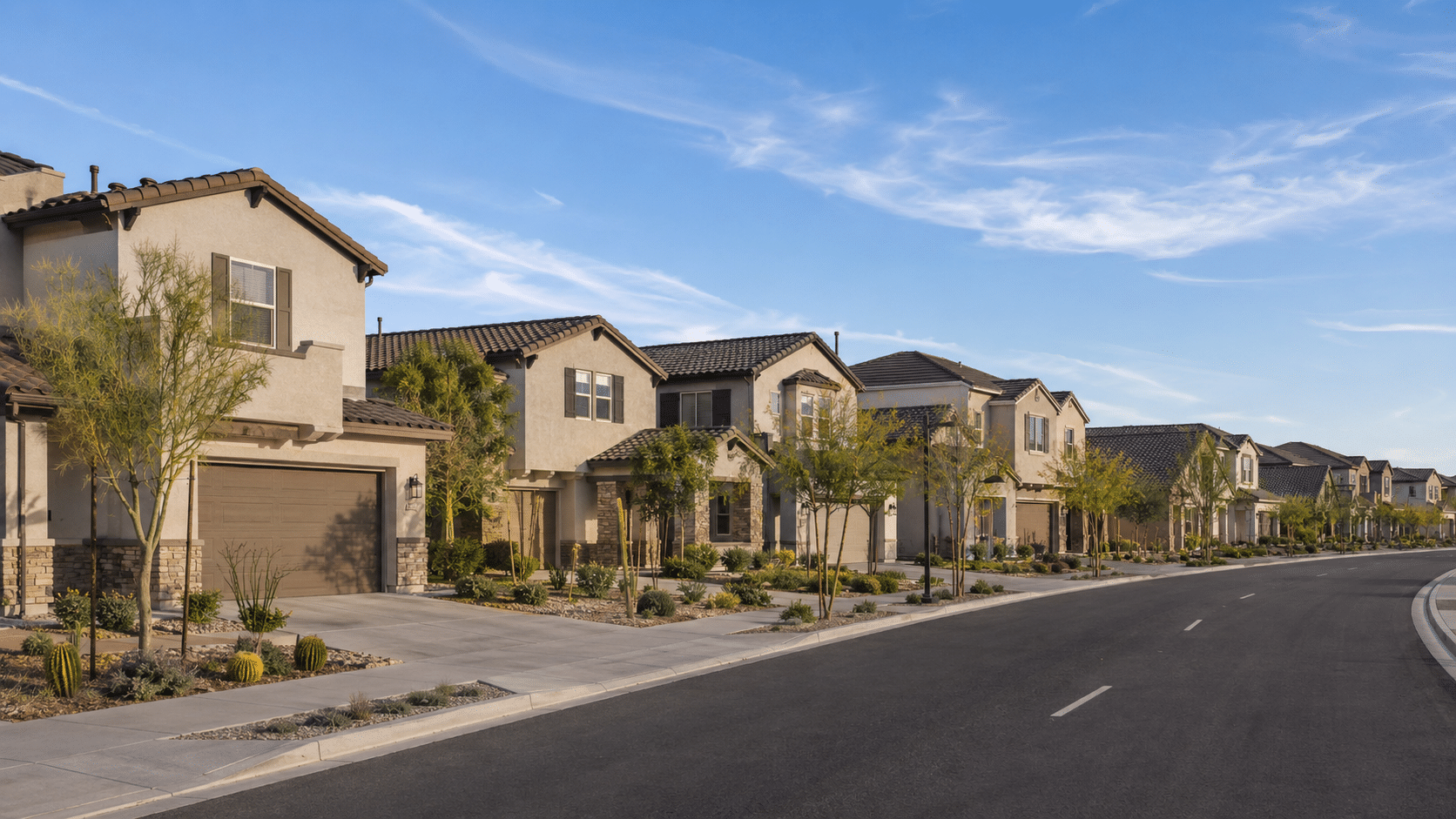
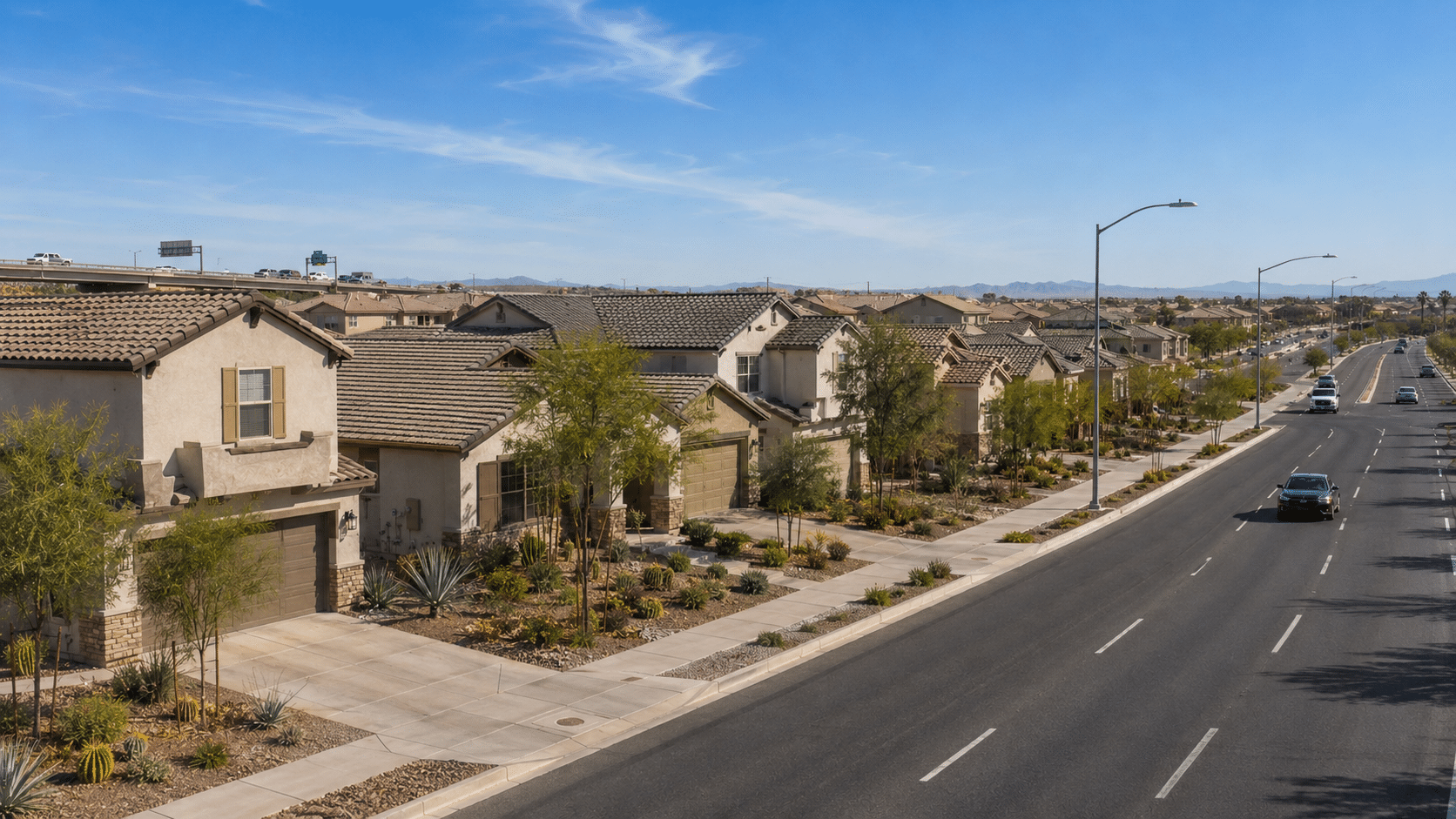
Rio Vista Village is built almost entirely around master-planned subdivisions developed since the late 1990s, with a few older 1980s-era pockets along the eastern edge near 43rd Avenue. Sienna Hills, the village’s largest single master-planned community, anchors the core of Rio Vista along 91st Avenue between Buckeye Road and Lower Buckeye Road. The community pairs three- to five-bedroom single-family homes on 5,500-to-9,000-square-foot lots with community parks, a pool, and gated sections within the Pendergast Elementary School District. Buyers searching for homes in this part of Rio Vista typically prioritize the Loop 202 South Mountain Freeway access and the Tolleson Union High School District assignment.
West of Sienna Hills, smaller master-planned enclaves along the Loop 202 corridor deliver similar three- and four-bedroom profiles at slightly newer build vintages — most homes in this band date from 2005 to 2014, with community-lake features that anchor central parks and walking paths. To the east near 67th Avenue and toward the 51st Avenue corridor, the established side of Rio Vista holds late-1990s and early-2000s construction on slightly larger lots, with mature landscaping and a more traditional Phoenix-stucco architectural mix. This eastern band shares school assignments and shopping with Maryvale Village immediately to the north across Buckeye Road.
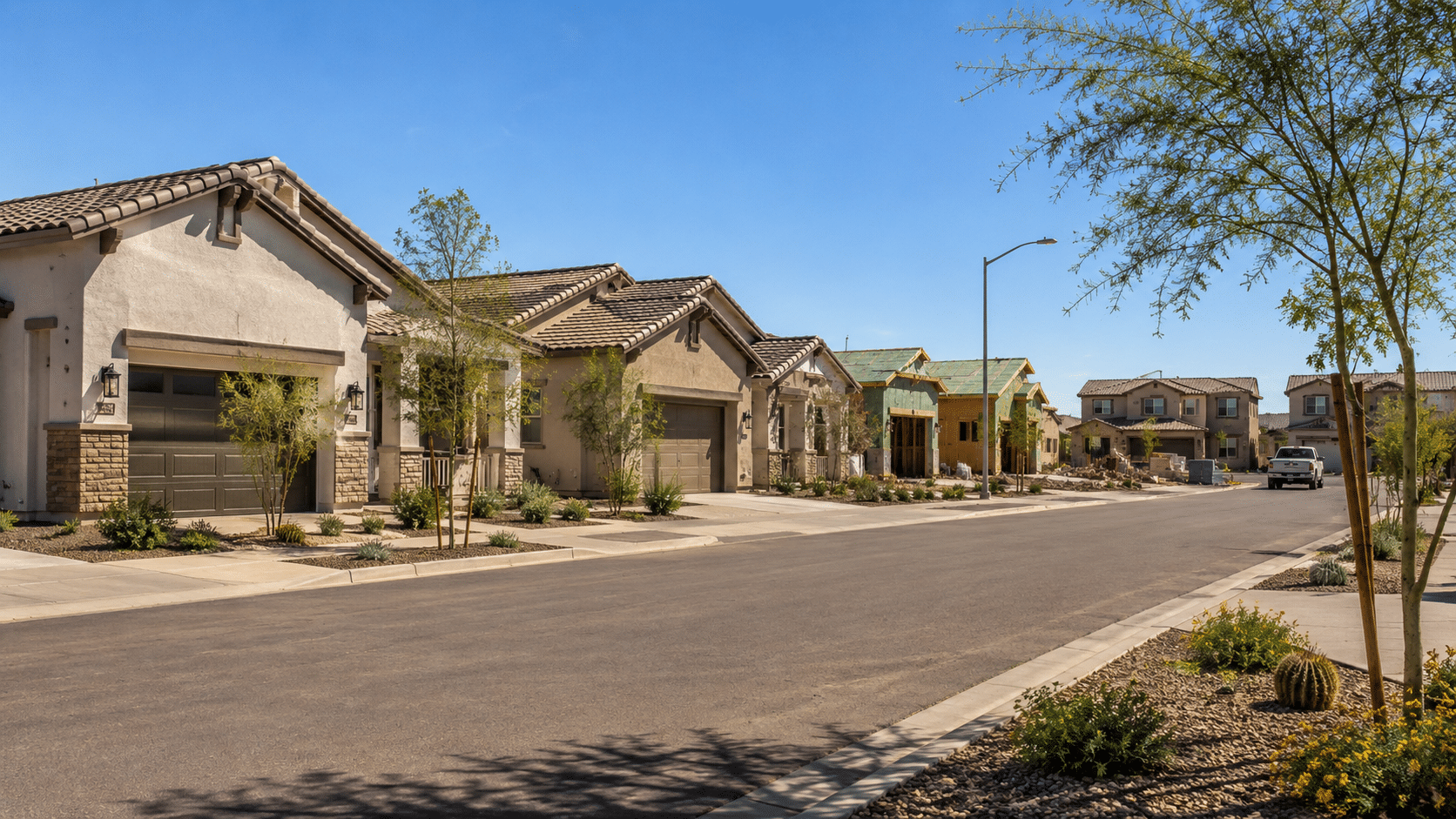
Newer construction inside Rio Vista clusters along the southern edge near the Laveen Village line, where post-2018 subdivisions have filled lots that previously held agricultural use. Buyers looking for genuinely new construction inside the village should focus on this southern band — the rest of Rio Vista is effectively built out.
Rio Vista is one of the few Phoenix urban villages served by more than one elementary school district. Most Rio Vista addresses fall inside either the Pendergast Elementary School District in the central and western portions of the village or the Cartwright Elementary School District along the eastern edge near 43rd and 51st Avenue. Smaller western and southern slivers also touch Fowler and Tolleson elementary boundaries. The boundary mix means two homes on the same street can carry different elementary school assignments — buyers should pull the current address assignment from the district lookup tool before writing an offer.
At the high school level, the picture simplifies. Nearly every Rio Vista address falls inside the Tolleson Union High School District, the dominant west-and-southwest-Phoenix high school district. Sierra Linda High School near 91st Avenue and Lower Buckeye Road serves the central core of Rio Vista — the heaviest single assignment for the village’s master-planned communities. Specific high school assignment varies by address, particularly for homes along the western edge near 99th Avenue and the eastern edge near 51st Avenue, where district boundary lines do not always follow major roads cleanly.
Families considering homes for sale in Rio Vista should treat school-district verification as a top-three checklist item alongside HOA review and roof age. For most Rio Vista buyers, the combination of newer construction, Loop 202 access, and entry-tier pricing outweighs the district trade-off.
The Loop 202 South Mountain Freeway is the single most important piece of infrastructure shaping Rio Vista real estate today. The freeway opened the South Mountain segment in December 2019, completing a 22-mile beltway from Interstate 10 in west Phoenix around the south side of South Mountain to Interstate 10 in Ahwatukee. Before that opening, drivers leaving Rio Vista for downtown Phoenix or Phoenix Sky Harbor International Airport had two practical routes — Buckeye Road eastbound surface streets or a north-then-east loop through I-10 west. Both options carried 35-to-50-minute peak-hour commute times. Post-2019, the Loop 202 collapsed those times to 18-to-28 minutes for nearly every Rio Vista address, with the village’s Loop 202 ramps at 51st Avenue, 59th Avenue, and 75th Avenue distributing traffic efficiently.
For the East Valley and Arizona State University in Tempe, the Loop 202 route via South Mountain is now the dominant choice — typical Tempe commute times sit at 25 to 35 minutes from central Rio Vista, comparable to what commuters from Laveen and Ahwatukee experience. West Valley commuters have it even easier: Loop 101 sits just minutes west of the village at the 99th Avenue boundary, opening direct access to Goodyear, Avondale, and the Glendale employment corridor. The full freeway-grid picture — I-10, Loop 101, Loop 202, and the State Route 85 connection west — makes Rio Vista one of the few Phoenix urban villages where a commuter can reach the West Valley, the East Valley, downtown, and Sky Harbor without leaving the freeway system. Read the full corridor history at the Wikipedia entry on Arizona State Route 202.
The Tres Rios area — the confluence of the Salt River, Gila River, and Agua Fria River just south and southwest of Rio Vista Village — is the single most distinctive natural-area amenity any Phoenix urban village can claim. The City of Phoenix’s Tres Rios Recreation Area, a constructed wetland project operating alongside the 91st Avenue Wastewater Treatment Plant, draws birders, weekend hikers, and trail-running groups for guided wildlife walks and seasonal bird counts coordinated with Audubon Arizona. The wetland complex hosts more than 150 bird species across migration cycles and is the only urban wetland system of its scale inside Maricopa County. Rio Vista buyers serious about outdoor recreation typically schedule a Saturday-morning tour through Tres Rios before writing an offer — the experience anchors the village’s lifestyle case more than any other amenity.
A short drive west on Loop 202 carries Rio Vista residents to Estrella Mountain Regional Park, the 19,840-acre Maricopa County preserve in neighboring Goodyear with more than 33 miles of multi-use trail and one of the largest equestrian-friendly day-use complexes in the West Valley. East of the village, the South Mountain Village holds the 16,000-acre South Mountain Park and Preserve, one of the largest municipal parks in the United States. The combination puts two regional-scale preserves within a 15-minute drive of nearly every Rio Vista address.
Inside the village, neighborhood-scale recreation runs through Cesar Chavez Park along Baseline Road and Maryvale Sports Complex along Lower Buckeye, both within easy reach of the master-planned communities along 91st Avenue and the Loop 202 corridor.
Several specific factors consistently move Rio Vista to the top of the consideration list for southwest Phoenix buyers:
Rio Vista Village real estate behaves as a clearly defined southwest Phoenix submarket inside the broader ARMLS reporting area. The dominant property type is the single-family detached home — three- to five-bedroom stucco-and-tile-roof construction on lots between 5,500 and 9,000 square feet. Condominium and townhome inventory is genuinely thin: under 5% of typical monthly listings inside the village. Buyers wanting attached-product options at Rio Vista’s price point typically look north into Maryvale or east into Laveen, where the condo and townhome inventory bands run two-to-three times deeper.
Pricing inside the village currently runs an estimated median sale price in the high-$300,000s to low-$400,000s for typical single-family inventory, with new construction along the southern Laveen line clearing meaningfully higher and older 1990s product on the eastern edge near 51st Avenue clearing meaningfully lower. Days on market sits around the Phoenix-wide median — typically in the 45-to-65-day range during a balanced cycle, with tightening during peak relocation season and softening through the summer months. The exact current figures should be pulled from a live ARMLS comparative market analysis at offer time; village-wide medians shift faster in newer submarkets than in established Phoenix submarkets, and Rio Vista’s 2015 origin means even short-term comparables carry meaningful sample-size sensitivity.
A small but distinctive band of large-lot rural-residential parcels — half-acre and larger — sits along the village’s southern edge near the Salt River, holding equestrian and semi-rural land uses that pre-date the 2015 village designation. These properties trade in a separate price band entirely, often at significantly higher absolute prices despite the older housing stock.
Buyers writing offers in Rio Vista Village should treat four items as a non-negotiable pre-offer checklist. First, verify the address-specific school district assignment through the relevant elementary district lookup tool — never assume from a neighbor’s assignment, especially given the multi-district reality. Second, request the full HOA disclosure packet: Rio Vista’s master-planned communities frequently layer a sub-HOA on top of the umbrella association, and dues structures vary materially across the village. Third, walk the property at peak commute hours for a Loop 202 noise band assessment if the home sits within roughly a quarter-mile of the freeway corridor. Fourth, secure well-or-septic verification for the large-lot rural-residential parcels along the southern Salt River edge — these properties trade differently from the master-planned interior.
The 91st Avenue Wastewater Treatment Plant — a working facility, not a buyer-irrelevant entity — sits west of the village and influences pricing on the westernmost addresses, so buyers there should ask their agent for a frank read on prevailing-wind impact during a Saturday morning tour.
Sellers preparing a Rio Vista home for market should expect a slightly longer marketing window than the Phoenix-wide median. The village’s 2015 origin means ARMLS comparables thin out fast outside the immediate subdivision, which gives appraisers and buyers more room to challenge listing strategy. Realistic pricing — anchored to verified subdivision-level comps rather than village-wide medians — sells faster and avoids the costly relist cycle. Buyer pool composition skews toward relocation, first-time buyers, and southwest-Phoenix move-up clients, so staging should emphasize move-in-ready condition and updated finishes. Sellers with newer construction inside the village benefit from leaning into builder warranties, smart-home features, and energy efficiency in listing copy — three differentiators that established Phoenix submarkets cannot match at comparable price points.
For buyers and sellers evaluating Rio Vista real estate, the village offers a value proposition no other Phoenix urban village matches in the same combination. Post-2000 master-planned inventory, Loop 202 South Mountain Freeway access, Tres Rios Wetlands proximity, and entry-tier pricing relative to established east and north Phoenix submarkets all stack inside the same village boundary. The 2015 origin story, the lightest overlay zoning footprint inside the City of Phoenix, and the freeway-grid that puts West Valley, East Valley, downtown, and Sky Harbor inside a 30-minute window give Rio Vista Village real estate a defensible position in any portfolio analysis.
The trade-offs are real. Thinner condo and townhome inventory, multi-district elementary school assignments that vary by address, and ARMLS comp data that thins out faster than in established submarkets all need direct disclosure before an offer goes in. The Carl Chapman process accounts for each through verified pre-offer checklists, subdivision-level comparative market analyses, and frank conversations about which homes for sale in Rio Vista fit which buyer profile. Anyone considering a move into southwest Phoenix should look at the complete Phoenix urban village directory before settling on a submarket — Rio Vista Phoenix real estate is the strongest fit for a specific buyer, and the directory makes that buyer-fit decision easier.
Rio Vista Village sits at the southwest corner of the City of Phoenix, bounded roughly by Buckeye Road on the north, 99th Avenue on the west, the Salt River and Tres Rios area on the south, and the 51st Avenue corridor on the east. It is the newest of the 15 urban villages recognized by the City of Phoenix planning framework, formally designated by the Phoenix City Council in 2015. The village was carved from the western edge of Estrella Village, the southern edge of Maryvale Village, and a slice of South Mountain Village. Most Rio Vista addresses fall inside the 85043 ZIP code, with smaller pockets reaching into 85009 to the east and 85339 along the Laveen border. The village core is anchored by the Loop 202 South Mountain Freeway corridor.
For the official boundary map and planning framework, see the City of Phoenix Rio Vista Village page.
The village-wide median sale price for Rio Vista Village real estate currently runs in the high-$300,000s to low-$400,000s for typical single-family inventory, based on recent ARMLS closings inside the village boundary. New construction along the southern Laveen line clears meaningfully higher, while older 1990s product near 51st Avenue and the eastern edge clears meaningfully lower. Large-lot rural-residential parcels along the Salt River trade in a separate higher band entirely, often exceeding the village-wide median by 50% or more despite older housing stock. Days on market sits in the 45-to-65-day range during a balanced cycle. Exact current figures should be pulled from a live comparative market analysis at offer time — Rio Vista’s 2015 origin means short-term comparables carry meaningful sample-size sensitivity.
Rio Vista is served by multiple school districts at the K-8 level. The Pendergast Elementary School District covers the central and western portions of the village, while the Cartwright Elementary School District covers the eastern edge near 43rd and 51st Avenue. Smaller western and southern slivers touch Fowler and Tolleson elementary boundaries. At the high school level, nearly every Rio Vista address falls inside the Tolleson Union High School District, with Sierra Linda High School near 91st Avenue and Lower Buckeye Road serving the central core as the heaviest single assignment. Specific assignment varies by address — buyers should pull the current address assignment from each district’s lookup tool before writing an offer. The multi-district reality is one of the most important pre-offer items for any Rio Vista buyer.
For broader background on the high school district, see the Tolleson Union HSD Wikipedia entry.
Rio Vista carries a distinct profile against the other 14 Phoenix urban villages. It is the newest, designated in 2015, with the lightest overlay zoning footprint and the deepest pool of post-2000 master-planned single-family inventory inside the City of Phoenix. Pricing runs meaningfully below established east and north Phoenix submarkets like Camelback East, Desert View, and Paradise Valley Village — note that Paradise Valley Village is the City of Phoenix urban village south of Loop 101, not the separate Town of Paradise Valley municipality east of it. Rio Vista delivers the strongest freeway-grid commute access in southwest Phoenix thanks to the 2019 Loop 202 South Mountain Freeway opening. Trade-offs include thinner condo and townhome inventory and school-district ratings that vary campus-by-campus.
Post-2019, the typical commute from Rio Vista Village to downtown Phoenix and Phoenix Sky Harbor International Airport runs 18 to 28 minutes via the Loop 202 South Mountain Freeway. Before the 2019 freeway opening, the same trip took 35 to 50 minutes during peak hours through surface streets or a northern loop via Interstate 10. The Loop 202 ramps at 51st Avenue, 59th Avenue, and 75th Avenue distribute Rio Vista traffic efficiently across the corridor. Commutes to Tempe and Arizona State University via the South Mountain segment of Loop 202 run 25 to 35 minutes from central Rio Vista. West Valley destinations including Goodyear, Avondale, and Glendale are reached via Loop 101 at the village’s 99th Avenue western boundary.
For full corridor background, see the Loop 202 South Mountain Freeway Wikipedia entry.
The dominant property type in Rio Vista is the single-family detached home, typically three- to five-bedroom stucco-and-tile-roof construction on lots between 5,500 and 9,000 square feet inside master-planned subdivisions. Build vintages range from the late 1990s in eastern established neighborhoods through 2005-2014 master-planned cores like Sienna Hills and active new construction along the southern Laveen line. Condominium and townhome inventory is genuinely thin, under 5% of typical monthly listings inside the village. A distinct band of large-lot rural-residential parcels — half-acre and larger — sits along the southern edge near the Salt River, holding equestrian and semi-rural land uses that pre-date the 2015 village designation. These large-lot properties trade in a separate price band entirely.
We use cookies to improve your experience on our site. By using our site, you consent to cookies.
Manage your cookie preferences below:
Essential cookies enable basic functions and are necessary for the proper function of the website.
CloudFlare provides web performance and security solutions, enhancing site speed and protecting against threats.
Service URL: developers.cloudflare.com (opens in a new window)
Google Tag Manager simplifies the management of marketing tags on your website without code changes.
These cookies are used for managing login functionality on this website.
Statistics cookies collect information anonymously. This information helps us understand how visitors use our website.
Google Analytics is a powerful tool that tracks and analyzes website traffic for informed marketing decisions.
Service URL: policies.google.com (opens in a new window)
You can find more information about our Cookie Policy and Privacy Policy.