
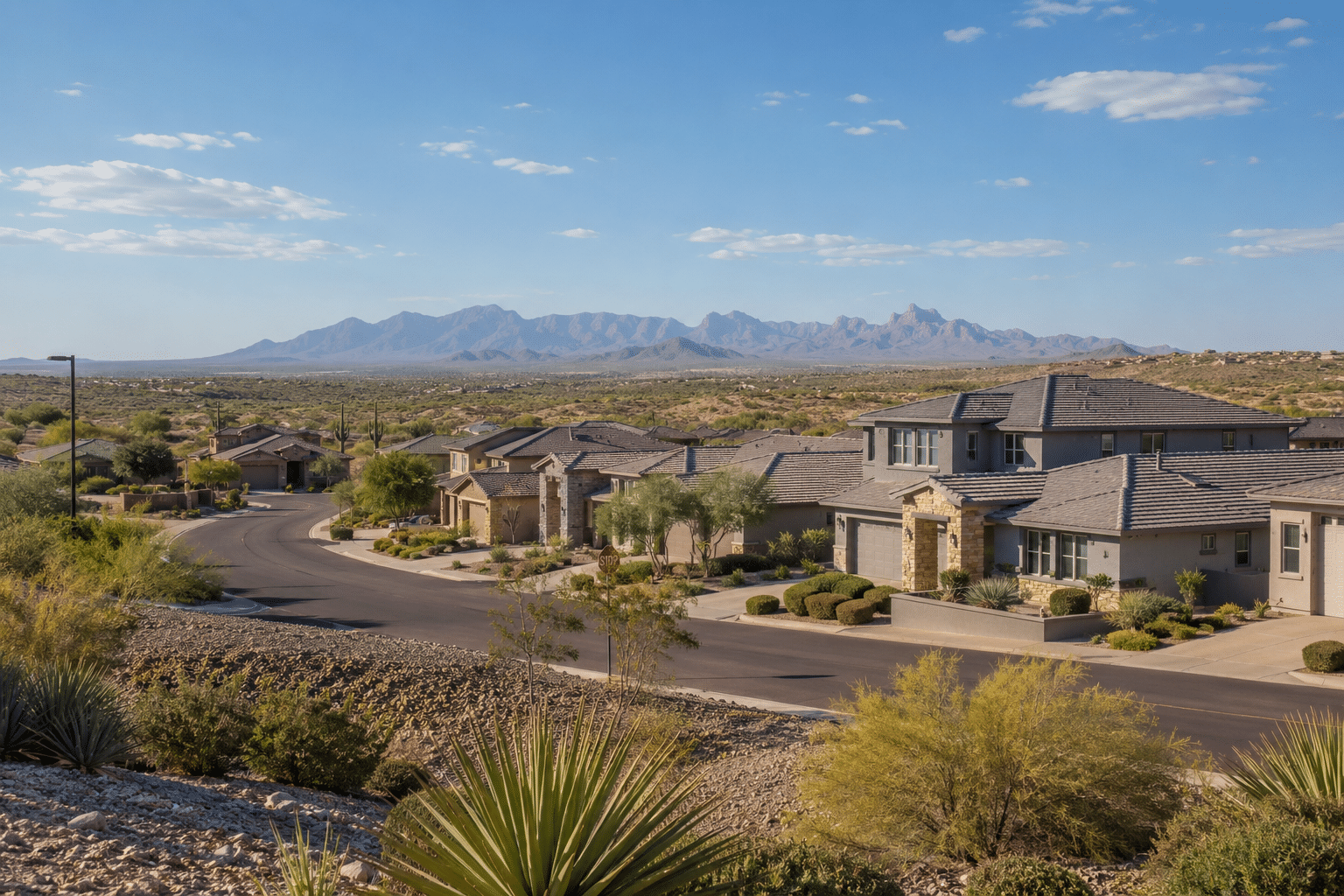
Desert View Village real estate spans one of the most distinctive submarkets in north Phoenix — an established Desert View Village that ranges from the high-density urban core along Loop 101 to dark-sky equestrian properties pressed up against the Phoenix Sonoran Preserve. Homes for sale in Desert View include the master-planned communities of Desert Ridge, the Tatum Boulevard corridor’s mid-priced single-family inventory, and the large-lot custom and horse properties that line the village’s northern edges.
The Desert View urban village is one of fifteen urban villages recognized by the City of Phoenix planning framework, and its scenic Sonoran Desert setting is the unifying element across every neighborhood within its boundaries. Buyers comparing homes in Desert View against the broader Phoenix real estate market typically prioritize three things: Loop 101 commute access, Paradise Valley Unified School District assignment, and proximity to the Mayo Clinic Hospital campus that anchors the village’s employment base.
Desert View Village divides naturally into three character zones, and the zone determines price tier, lot size, and lifestyle profile more reliably than any village-wide average. Desert Ridge, the urban core pressed against Loop 101 between Tatum Boulevard and Scottsdale Road, anchors the village’s mid- and upper-tier inventory. The community pairs contemporary single-family homes with upscale condominiums and townhomes in walking distance of the Desert Ridge Marketplace. Buyers searching for Desert Ridge homes for sale typically prioritize freeway access, school assignment, and the JW Marriott resort corridor’s restaurant and amenity density.
To the north and northeast, Tatum Highlands delivers a quieter master-planned profile along the Tatum Boulevard corridor as it climbs toward Cave Creek. Inventory here runs larger — three- to five-bedroom single-family homes on lots that open up beyond 8,000 square feet, with many properties carrying authentic mountain views toward the McDowell range to the east. Active Tatum Highlands listings appeal to growing families targeting Pinnacle High School assignment.
The eastern edge of the village holds Sky Crossing, a newer master-planned community in the 85050 ZIP code that opened buyers to the Desert View address at competitive new-construction price points. Inventory in the Sky Crossing community sits within minutes of the Mayo Clinic Phoenix campus.
North of Tatum Highlands, the village transitions into dark-sky equestrian land uses along the Cave Creek Road Scenic Corridor, where one-acre lots, horse properties, and custom estates dominate. This northern edge borders both Cave Creek and the City of Phoenix’s Paradise Valley Village to the south — note that Paradise Valley Village is the urban village within Phoenix, not the separate Town of Paradise Valley.
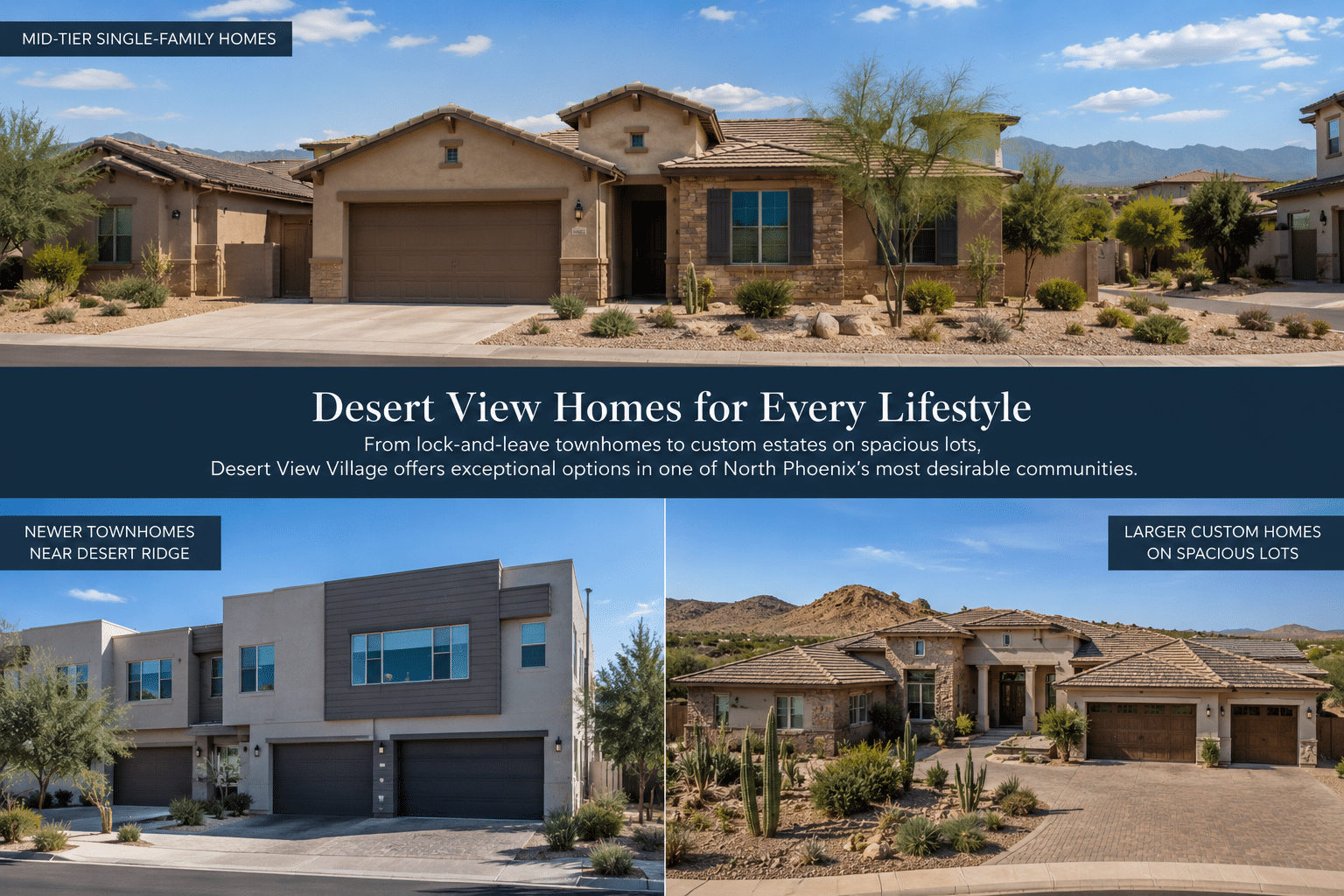
Desert View Village inventory spans a wider price range than most Phoenix urban villages because the village itself spans both the master-planned urban core and the large-lot equestrian north. Single-family homes for sale in Desert View typically run from $550,000 to $900,000 in the established mid-tier communities along Tatum Boulevard and within the Desert Ridge footprint, with the village-wide average sitting near $774,000 across recent closings. Custom estates along the northern edge — particularly in the Cave Creek Road Scenic Corridor pockets — extend well into seven figures and occasionally beyond, with view quality and lot orientation driving the sharpest price gaps.
Condominium and townhome inventory clusters in the Desert Ridge core and the Mayo Boulevard corridor near the hospital campus. These properties attract buyers who want the Desert View address and Paradise Valley Unified School District assignment without the maintenance load of a detached home. Entry points start in the upper $200s for one-bedroom condominium units and run into the $500Ks for newer two- and three-bedroom townhomes within walking distance of the Desert Ridge Marketplace.
New construction remains an active part of the Desert View market in a way that most established Phoenix urban villages cannot match — the village still holds undeveloped parcels along its northern and eastern edges, and several builders run active communities within Tatum Highlands and Sky Crossing. Buyers comparing builder inventory should pull current new construction guide incentives against resale comparables before signing.
Homes across Desert View Village are averaging approximately 61 days on market — close to the broader Phoenix metro figure. ARMLS data remains the authoritative source for current closed-sale comparables; automated estimates routinely miss the price-per-square-foot differences between the village’s master-planned and equestrian sub-areas. The Loop 101 corridor that frames the village’s southern boundary is the single biggest locational variable in Desert View pricing.
Most homes in Desert View Village fall within the Paradise Valley Unified School District footprint, more commonly referenced as PVUSD or PVSchools. The district serves more than 32,000 students across roughly 98 square miles of northeast Phoenix and north Scottsdale, operating 28 elementary schools, seven middle schools, five high schools, two alternative schools, and an online school. Paradise Valley Unified School District consistently earns A-grade ratings from Niche, and several of its campuses inside or immediately adjacent to Desert View are widely cited by families as primary drivers of the village’s residential demand.
At the elementary level, Fireside Elementary serves much of the Desert Ridge core and the southern half of the village. Explorer Middle School follows for sixth through eighth grade and is regularly cited for its performing arts and STEM elective programs. For high school, the dominant assignment is Pinnacle High School near Tatum Boulevard — an A-minus rated comprehensive high school with strong AP course depth and a recognized career and technical education program. The northern reaches of the village feed into Horizon High School instead, also within PVUSD. Families touring homes in Desert View should pull current assignment directly from PVUSD’s address lookup before making an offer; district boundary lines do shift over time, and assignment is the single highest-value disclosure to confirm pre-contract.
Charter and private school options round out the picture. Several nationally respected private schools — Brophy College Preparatory among them — sit within commutable distance, and PVUSD itself runs choice programs accessible to in-district families. The village’s school depth is one of the most consistently cited buyer advantages over comparable north-valley submarkets.

The single largest amenity within Desert View Village is also its defining geographic feature. The Phoenix Sonoran Preserve encompasses nearly 10,000 acres of protected Sonoran Desert terrain inside the village’s boundaries — more than 30 miles of multi-use trail across saguaro stands, washes, and ridgelines that most metro residents have to drive an hour to access. For homes along the village’s northern edge, the preserve trailheads sit within walking or short driving distance. For Desert Ridge and Tatum Highlands buyers, the preserve is a 10- to 20-minute drive that effectively serves as the village’s back yard.
To the southwest, Reach 11 Recreation Area covers 1,500 acres of multi-purpose recreation space alongside Loop 101. The complex includes 18 lighted soccer pitches, four baseball diamonds, a two-mile Barrier Free Nature Trail, and Horse Lovers Park — a dedicated equestrian facility with a competition-grade outdoor arena. Pinnacle Dog Park inside Reach 11 adds separate runs for small and large dogs. The mix is unusual: Desert View Village is one of the only Phoenix urban villages where a buyer can have organized youth soccer, a horse-property neighbor, and an undeveloped desert preserve trailhead all within a fifteen-minute radius.
The northern third of the village functions as a dark sky area by practical use rather than formal designation. Lot sizes open beyond an acre, light pollution drops sharply, and equestrian property is the dominant land use along the Cave Creek Road Scenic Corridor. For buyers who want stars over their patio and trail access from the back gate, Desert View Village is the most accessible option inside Phoenix city limits. The City of Phoenix’s official Desert View Village page documents the planning framework that protects this character through the Desert Character Area Overlay.
The Desert Ridge Marketplace, built by Vestar in 2001 at the intersection of Loop 101 and Tatum Boulevard, anchors daily life across Desert View Village. The open-air retail center carries more than 1.2 million square feet of national retailers, sit-down restaurants, a movie theater, and live music venues — a concentration that has effectively made Desert Ridge the regional commercial hub for the entire north Phoenix and Cave Creek market, not just the village itself. For Desert View residents, the practical effect is that most weekly errands stay inside a five-minute radius.
The retail core sits steps from the JW Marriott Phoenix Desert Ridge Resort & Spa, the largest convention-class resort in Arizona and the backbone of the village’s destination dining scene. Resort-side restaurants at the JW Marriott, plus a steady rotation of independent operators inside the Marketplace — Yard House, Barrio Queen, True Food Kitchen — give Desert View Village a daily-life dining profile that few comparable master-planned communities can match.
Just south of the village at Mayo Boulevard and Tatum sits the Musical Instrument Museum — the Musical Instrument Museum, or MIM — which opened in 2010 and now houses one of the most extensive instrument and audio-visual collections in the world. East across Scottsdale Road, TPC Scottsdale hosts the WM Phoenix Open each year, drawing several hundred thousand attendees and dropping the event squarely on Desert View’s eastern doorstep. The Mayo Clinic Phoenix campus and the WM Phoenix Open corridor together account for much of the village’s seasonal traffic profile.
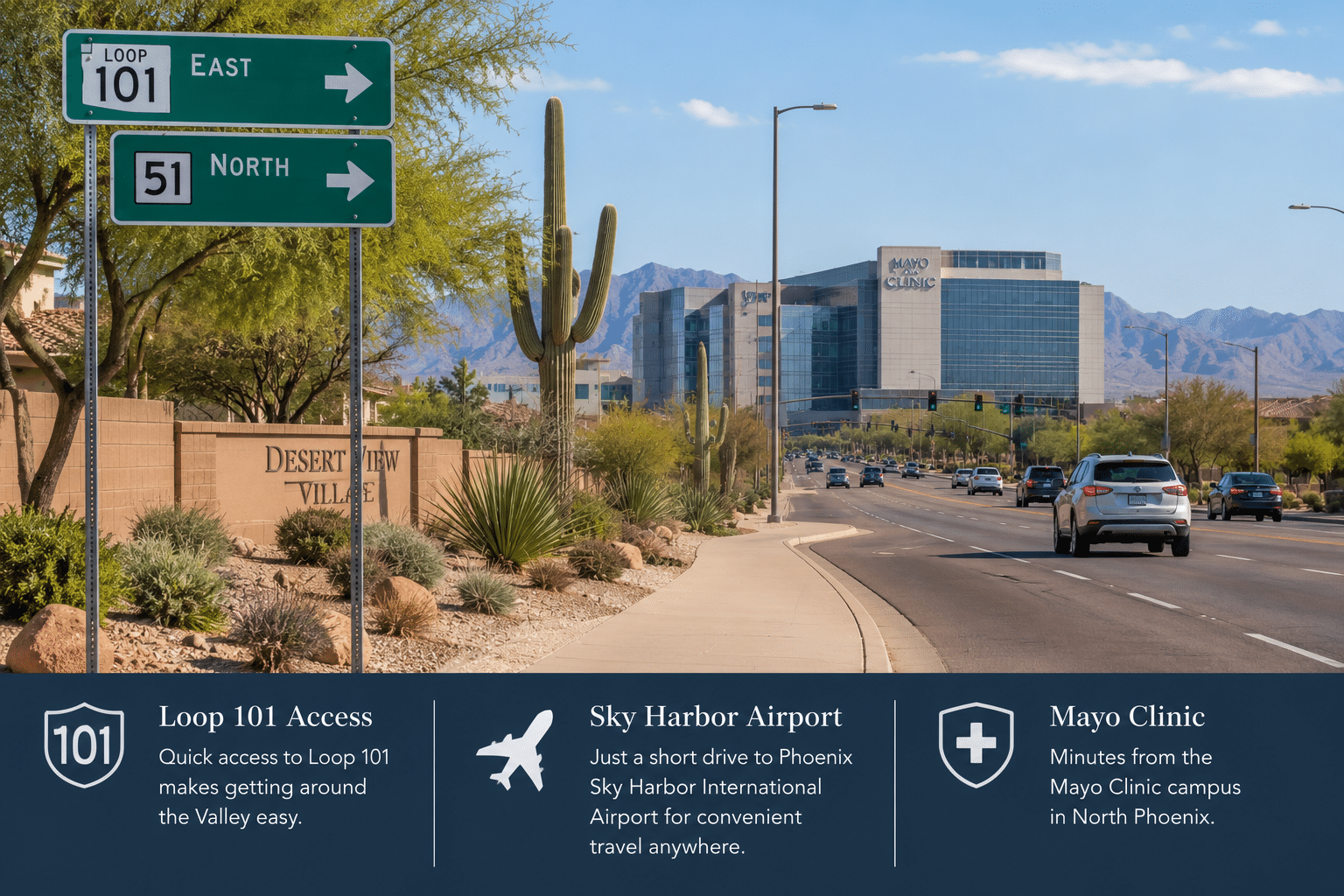
Loop 101 — the Pima Freeway segment that arcs along the southern edge of the village — is the single most important locational feature in Desert View Village real estate. The corridor connects directly to Loop 202 east toward Tempe and the East Valley, and west to Interstate 17 at the Deer Valley interchange. State Route 51 (the Piestewa Freeway) runs south from the Loop 101 interchange into central Phoenix and downtown, putting downtown employment cores roughly 25 to 30 minutes from most Desert View addresses. Tatum Boulevard and Scottsdale Road frame the village’s interior arterial grid; both run north into Cave Creek and Carefree.
For Desert View residents, employer proximity is a measurable home-value input. The Mayo Clinic Phoenix campus sits at Mayo Boulevard and 56th Street, with roughly half of Mayo’s regional 8,200 employees based at the Desert View location. Mayo Clinic Hospital is the largest single employer within or immediately adjacent to the village, and American Express maintains a major regional operation nearby. Phoenix Sky Harbor International Airport is approximately 19 miles south of most Desert View addresses — typically a 25-minute drive via Loop 101 and State Route 51.
Buyers comparing Desert View against the rest of north Phoenix often shortlist the village against Deer Valley Village to the west and North Gateway Village to the northwest before deciding which freeway corridor best matches their commute pattern.
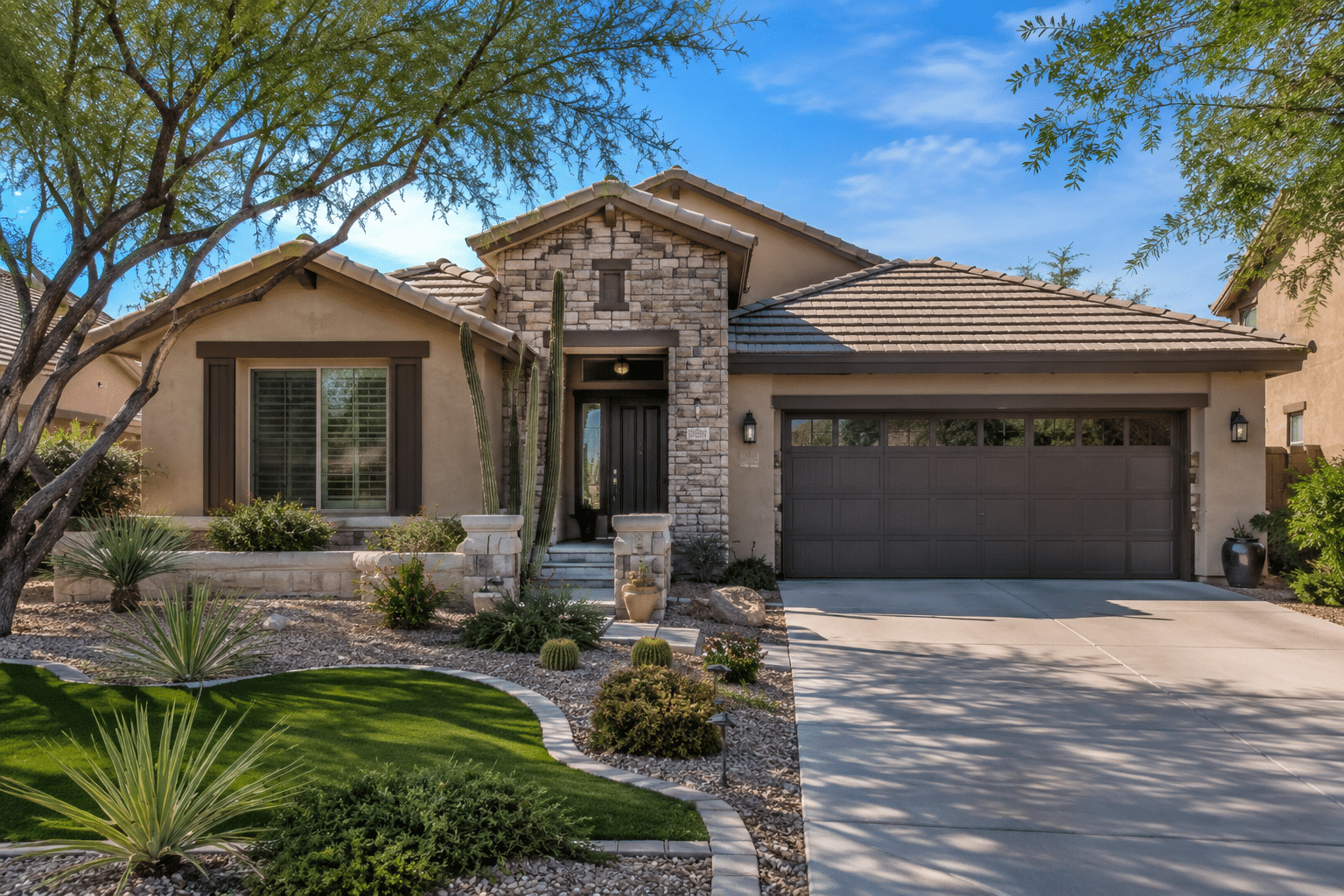
Desert View Village real estate sits at a premium to the Phoenix-wide median. While Phoenix metro single-family median sold prices have ranged between roughly $461,000 and $481,500 across recent quarters, Desert View homes for sale typically clear at meaningfully higher levels — the village-wide average sits near $774,000 across recent closings, and sub-market averages climb above $665,000 in established Desert Ridge inventory and above $900,000 in custom estate pockets along the village’s northern edge. Homes are averaging approximately 61 days on market in Desert View Village — close to the broader Phoenix figure, but the distribution is wider: well-priced single-family inventory in the Desert Ridge core moves faster, while large-lot custom homes on the equestrian edge often carry longer marketing timelines.
For sellers, the most expensive mistake in the current market is anchoring to peak-era estimates. The correct list price for a Tatum Highlands home is determined by Tatum Highlands comparables — not Phoenix-wide averages and not Scottsdale comparables across Loop 101. Seller concessions — rate buydowns and closing cost contributions — remain the most effective negotiating tool because they address the buyer’s monthly payment without re-anchoring future appraisals. ARMLS-sourced comparative market analysis is the only reliable basis for accurate pricing in this market.
For buyers, the village’s price spread is actually an advantage: condominiums in the upper $200s share a school district and a freeway corridor with seven-figure custom estates a few miles north. Many buyers shortlist Desert View Village against the Paradise Valley Village urban village immediately to the south — note that Paradise Valley Village is the City of Phoenix urban village, NOT the separate incorporated Town of Paradise Valley east of Tatum Boulevard. The two share school district overlap but differ on tax base, municipal services, and pricing tier. The buyer’s guide at West USA Realty covers loan types, new construction financing, and inspection priorities; the seller’s guide covers comparative market analysis and listing strategy for the current Phoenix market.
Desert View Village real estate rewards buyers and sellers who treat the village as the distinctive submarket it is, rather than averaging into Phoenix-wide medians. The combination of a dense master-planned core at Desert Ridge, top-rated Paradise Valley Unified School District assignment, Mayo Clinic Hospital employer proximity, Loop 101 freeway access, and nearly 10,000 acres of Phoenix Sonoran Preserve trail terrain inside the village boundary gives Desert View an entity profile no other urban village in the City of Phoenix can match. Whether you are an investor evaluating Sky Crossing new construction, a family targeting Pinnacle High School assignment in Tatum Highlands, or an equestrian buyer looking for a one-acre horse property along the Cave Creek Road Scenic Corridor, the right next step is a direct conversation about inventory, financing, and timing.
Whether you are exploring buying a home in Desert View, selling your Desert View home, or simply comparing Desert View homes for sale against the Phoenix urban village landscape under current market conditions, the next step is a direct conversation. Reach Carl at (602) 617-4440 or chapman@westusa.com to begin.
Desert View Village sits at the northern edge of the City of Phoenix, bounded roughly by Loop 101 on the south, the City of Scottsdale on the east, the Cave Creek and Carefree town boundaries on the north, and the North Gateway Village line on the west. The village covers some of the city’s most varied terrain — from the master-planned urban core at Desert Ridge along Loop 101, north through the Tatum Boulevard corridor, and up to dark-sky equestrian properties along the Cave Creek Road Scenic Corridor. It is one of fifteen urban villages recognized by the City of Phoenix planning framework and is one of the larger villages by land area.
The village-wide average for Desert View Village real estate sits near $774,000 across recent ARMLS closings, with single-family homes typically clearing between $550,000 and $900,000 in the established master-planned sub-areas. Condominiums and townhomes in the Desert Ridge core start in the upper $200s. Custom estates along the equestrian northern edge frequently exceed $1.5 million, with view quality and lot orientation driving the largest price gaps. Desert View Village homes are averaging approximately 61 days on market — close to the Phoenix-wide figure but with a wider distribution between the urban core and the custom-estate north.
Most homes in Desert View Village fall within the Paradise Valley Unified School District (PVUSD), one of the highest-rated districts in Maricopa County. The dominant high school assignment is Pinnacle High School near Tatum Boulevard, with Horizon High School serving northern portions of the village. Common feeder elementary and middle schools include Fireside Elementary and Explorer Middle School. PVUSD is rated A overall by Niche and operates 28 elementary schools, seven middle schools, and five high schools across northeast Phoenix and north Scottsdale. School boundary lines do shift, and families should pull current address assignment from the PVUSD lookup before making an offer. The Desert View master-planned core also sits within commuting distance of several nationally recognized private schools, including Brophy College Preparatory.
For more on the master-planned communities inside the village, see the Desert Ridge Wikipedia entry.
No. Desert View Village is the City of Phoenix urban village covering the northeastern corner of the city, north of Loop 101. Paradise Valley Village is a different City of Phoenix urban village located immediately south of Desert View, on the south side of Loop 101 — it is also inside the City of Phoenix. The Town of Paradise Valley is a separate incorporated municipality with its own town council, taxation, and school district overlay, located east of Desert View across Tatum Boulevard. All three areas share parts of the Paradise Valley Unified School District, but they are governed by different municipal entities and carry different property tax structures. Confusing them costs buyers and sellers real money at appraisal, insurance, and contract stages.
Desert View Village is the only Phoenix urban village that combines a dense master-planned urban core (Desert Ridge), a regional commercial hub (Desert Ridge Marketplace), a major hospital employer (Mayo Clinic Hospital), and nearly 10,000 acres of protected Sonoran Desert preserve land inside its boundary. The village ranges from condominium inventory near the Loop 101 freeway to dark-sky equestrian properties on one-acre-plus lots along the Cave Creek Road Scenic Corridor. The Desert Character Area Overlay protects the rural northern third of the village from the kind of infill development that has erased equestrian land use in most other parts of Maricopa County.
For the City of Phoenix’s boundary record, consult the official Desert View Village page.
Phoenix Sky Harbor International Airport sits approximately 19 miles south of most Desert View Village addresses — typically a 25- to 30-minute drive via Loop 101 west to State Route 51 south. Downtown Phoenix is roughly 18 to 22 miles south of the village core, reachable in 25 to 30 minutes by car via State Route 51. The Mayo Clinic Phoenix campus is inside or immediately adjacent to the village, depending on the address. Scottsdale Road, Tatum Boulevard, and Cave Creek Road serve as the village’s primary north-south arterials, while Loop 101 frames the southern boundary for direct east-west access to Loop 202, the East Valley, and the I-17 corridor. The freeway-and-arterial combination is one of Desert View’s most consistently cited buyer advantages over comparable established north Phoenix neighborhoods.
We use cookies to improve your experience on our site. By using our site, you consent to cookies.
Manage your cookie preferences below:
Essential cookies enable basic functions and are necessary for the proper function of the website.
CloudFlare provides web performance and security solutions, enhancing site speed and protecting against threats.
Service URL: developers.cloudflare.com (opens in a new window)
Google Tag Manager simplifies the management of marketing tags on your website without code changes.
These cookies are used for managing login functionality on this website.
Statistics cookies collect information anonymously. This information helps us understand how visitors use our website.
Google Analytics is a powerful tool that tracks and analyzes website traffic for informed marketing decisions.
Service URL: policies.google.com (opens in a new window)
You can find more information about our Cookie Policy and Privacy Policy.