
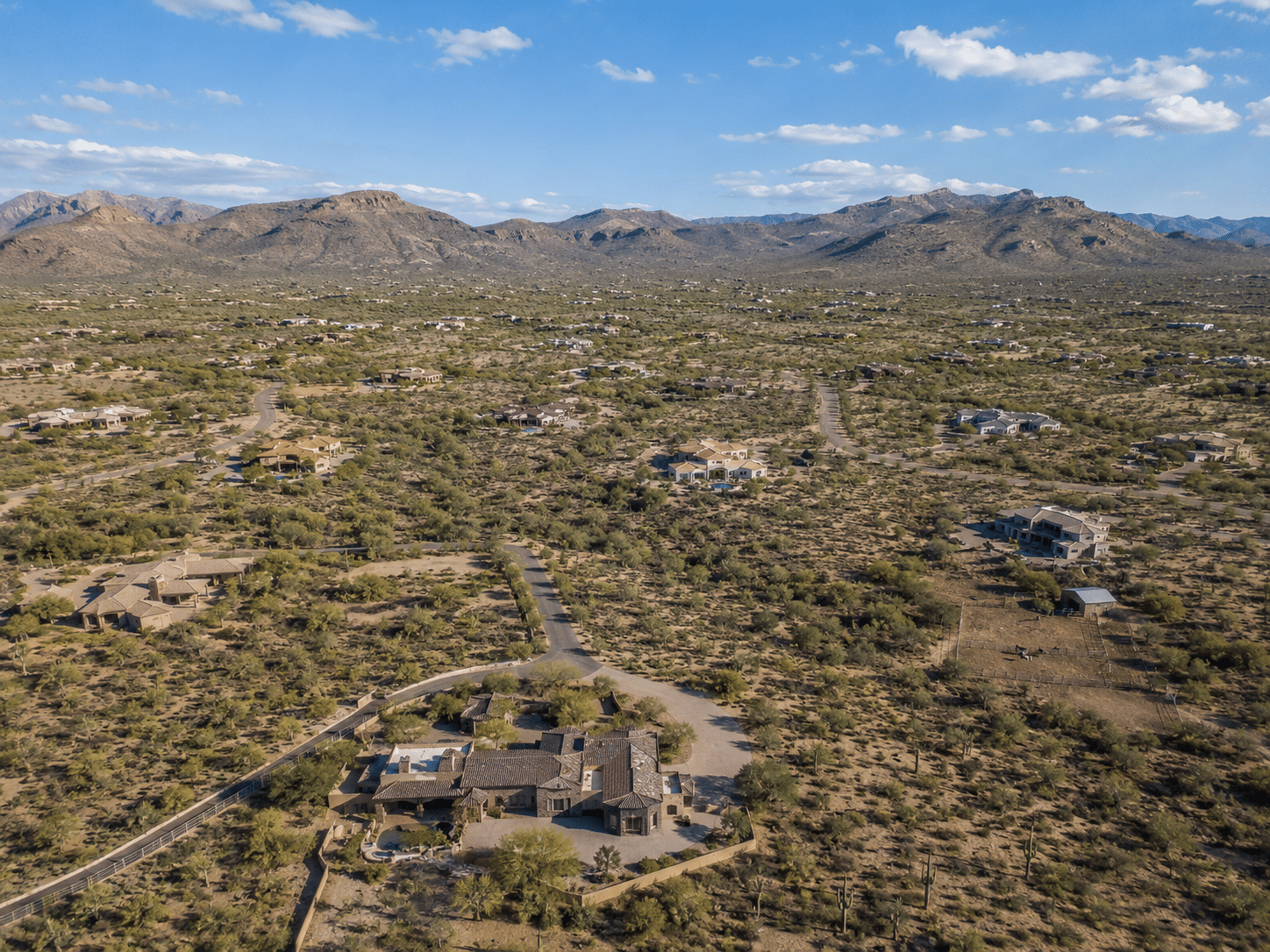
Desert Hills is one of North Phoenix’s most distinctive and coveted residential communities — an unincorporated Maricopa County enclave where wide desert panoramas, generous lot sizes, and genuine rural character coexist with convenient access to the Valley of the Sun’s full range of amenities. Situated roughly 30 miles north of downtown Phoenix in ZIP code 85086, Desert Hills spans more than 16 square miles, bounded approximately by Carefree Highway to the south, 35th Avenue to the west, 28th Street to the east, and Desert Hills Drive to the north. The community sits at an elevation of roughly 1,700 feet — meaningfully higher than the Phoenix basin — which contributes to slightly cooler temperatures, cleaner sightlines, and the sweeping mountain-and-desert vistas that define the area’s character. Development began in earnest in 1955, when a land corporation subdivided what had been the Sam Joy Ranch into 10-acre parcels, laying the groundwork for a neighborhood that prizes space and privacy above all else.
As an Associate Broker with West USA Realty, I’ve had the privilege of helping countless families and individuals discover everything that Desert Hills homes for sale have to offer. This community draws a remarkably diverse buyer pool: equestrians who want horse-zoned acreage, remote professionals who work from home and want room to breathe, and families drawn by outstanding schools and preserved open space. The lifestyle promise here is simple but powerful — you get the serenity of the Sonoran Desert without sacrificing the convenience of the modern Phoenix metropolitan area.
Desert Hills departs from the master-planned playbook that defines most of the Phoenix Valley, and that distinction is precisely what its residents cherish. Rather than a single developer’s vision, the community has evolved organically through decades of custom construction and small-builder activity, resulting in a rich architectural variety that no single streetscape can summarize.
PHK Custom Home Builders is among the most established custom builders active in Desert Hills, offering full design-build services for clients who want a ground-up home tailored to both their lifestyle and the Sonoran terrain. Custom builders from throughout the Valley frequently acquire parcels here, delivering everything from modern desert-contemporary designs with clean rooflines and floor-to-ceiling glass to traditional Southwestern adobe and ranch styles with covered patios and exposed beam ceilings. The result is a neighborhood where no two properties look identical — a rarity in an era of production housing.
The named subdivisions and enclaves within the broader Desert Hills footprint include Desert Hills Estates, Desert Hills Ranch, Desert Hills — Non Subdivision No HOA, and various metes-and-bounds parcels described simply as Unincorporated Desert Hills. This reflects the community’s deeply independent character: a substantial number of homes carry no HOA whatsoever, and buyers who prioritize freedom from architectural review committees find this to be a singular feature of the market.
The housing inventory itself is strikingly varied. Expect to find custom single-family homes on lots ranging from approximately one acre to five or more acres, manufactured homes on large parcels offering exceptional value, and purpose-built equestrian estates with barns, stalls, arenas, and hay storage. Two-story contemporary builds on elevated lots with mountain views compete for buyers alongside sprawling single-level ranch homes on flat desert land. What unites this diversity is a commitment to space: lot sizes that would be unthinkable in Scottsdale or Chandler are routine in Desert Hills, and the sense of elbow room is immediate and unmistakable.
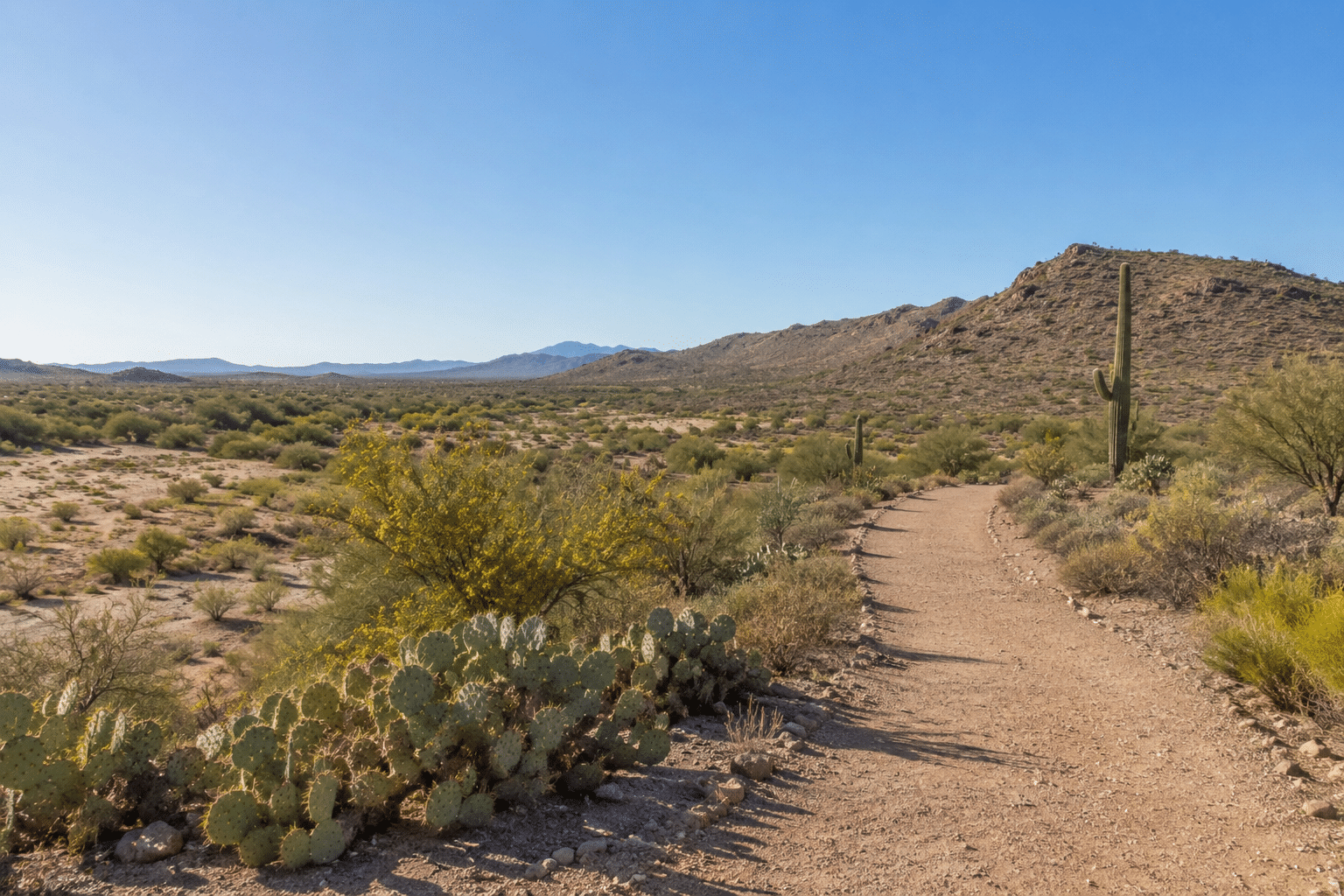
Desert Hills sits at the intersection of two magnificent public lands — placing residents within minutes of some of the finest outdoor recreation available anywhere in the greater Phoenix area.
While Desert Hills itself does not host an on-site private golf club, the broader region is well served. The renowned courses of Cave Creek and the legendary private Desert Mountain club in nearby Scottsdale — home to six Jack Nicklaus–designed courses — are within a comfortable drive for the avid golfer. Numerous public and semi-private courses along the I-17 corridor and in the Anthem and North Phoenix submarkets round out the options.
Cave Creek Regional Park, managed by Maricopa County Parks and Recreation, lies directly adjacent to the Desert Hills community and is one of the desert Southwest’s premier outdoor destinations. Spanning approximately 2,922 acres of upper Sonoran Desert at elevations between 2,000 and 3,060 feet, the park offers:
Horses, mountain bikes, and leashed dogs are welcome throughout the park, and a nature center offers ranger-led programs throughout the cooler months.
The Phoenix Sonoran Preserve, one of the largest municipally owned preserves in the United States at over 9,600 acres, sits to the south and southwest of Desert Hills. Three trailheads — Apache Wash, Desert Hills Trailhead (directly accessible from Carefree Highway), and Desert Vista — provide entry to 36 miles of interconnected trails. Standout routes include the Apache Wash Trail, a 5.6-mile multi-use path through cactus gardens; the Badger Brawl Trail, which follows the Cave Creek riverbed with spectacular desert views; and the Cliff Walk Trail, which traces the Cave Creek corridor and delivers some of the most photogenic riparian scenery in the North Valley.
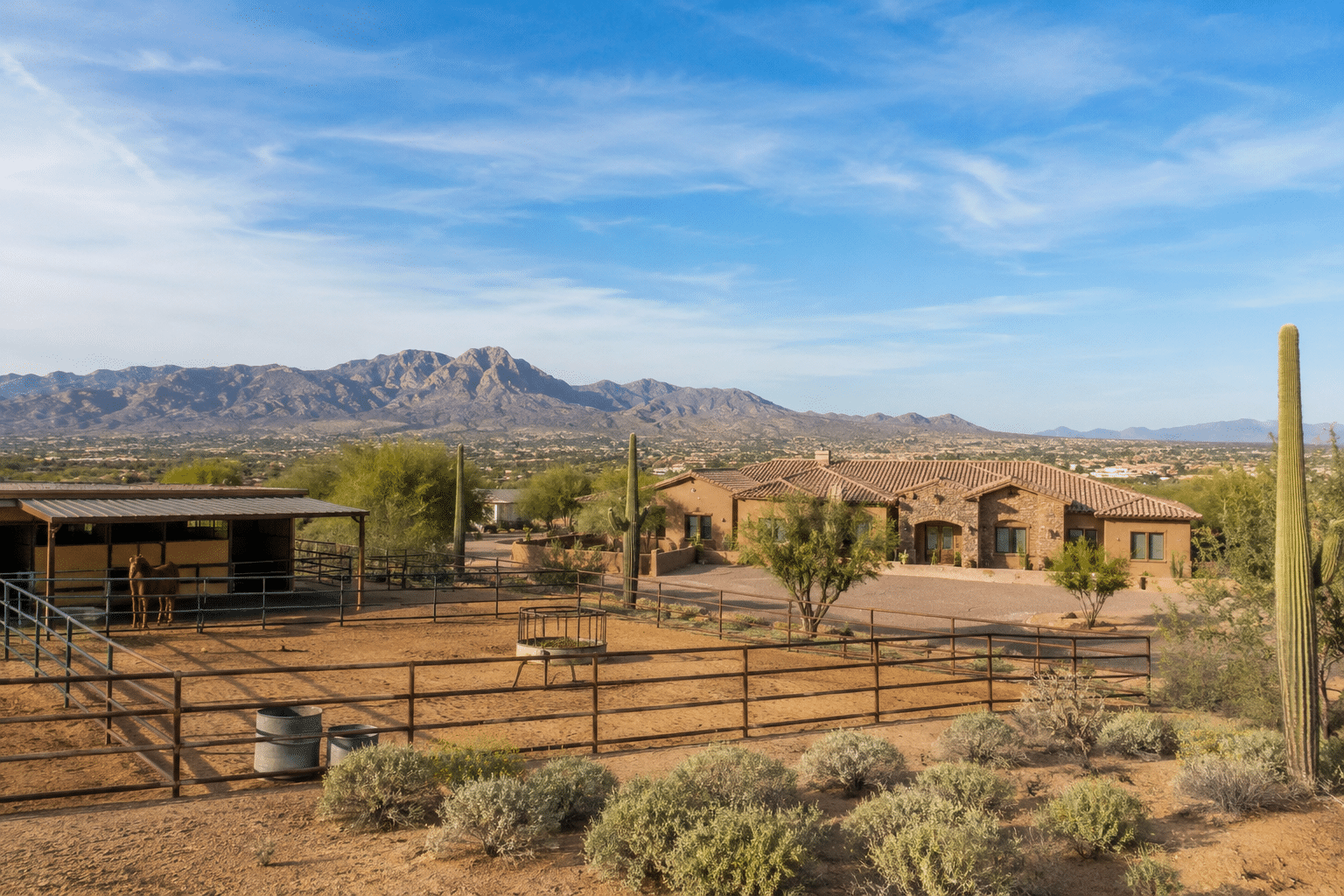
Desert Hills is one of Maricopa County’s premier equestrian communities, and the terrain is built for it. Trails connect directly to Cave Creek Regional Park’s extensive equestrian network, and the generous lot sizes mean that private corrals, arenas, and boarding facilities are standard features rather than exceptional amenities.
Desert Hills is served primarily by Deer Valley Unified School District #97 (DVUSD), one of Arizona’s most respected school districts and the fifth largest in the state, earning an ‘A’ Grade from the Arizona Department of Education. Portions of the community also draw students from the highly regarded Cave Creek Unified School District No. 93 (CCUSD), which consistently ranks among the state’s strongest small districts.
Desert Mountain School, located at 35959 N. 7th Avenue in Desert Hills itself (DVUSD), serves Pre-K through grade 8 with a student-teacher ratio of approximately 15:1. The school’s embedded K–8 structure provides remarkable continuity for families who want a single-campus experience from kindergarten through middle school. Within CCUSD, Horseshoe Trails Elementary School is a National Blue Ribbon School offering a PreK–6 program with an on-site horsemanship component — a genuinely rare distinction that speaks to the equestrian culture of this corner of Maricopa County. Lone Mountain Elementary School (CCUSD) operates as a PreK–6 STEAM campus emphasizing the Engineering Design Process, earning consistently strong 4- to 5-star SchoolDigger ratings with math proficiency rates reaching 81%.
At the middle-school level, Sonoran Trails Middle School (CCUSD, grades 7–8) holds designation as a World Language School of Excellence — a distinction earned through rigorous world language programming rather than mere elective offerings. For high school, Boulder Creek High School (DVUSD), located at Gavilan Peak Parkway in Anthem, is the primary feeder for Desert Hills families within that district, offering Advanced Placement coursework and a broad CTE program. Students zoned to CCUSD attend Cactus Shadows High School, which offers the prestigious International Baccalaureate (IB) program alongside AP and CTE pathways and has been recognized as a Top 10 Comprehensive High School in Arizona. Together, these campuses give Desert Hills families access to a range of academic environments without sacrificing quality at any level.
Desert Hills occupies a purposefully rural corner of Maricopa County, and residents embrace the trade-off: the everyday conveniences of suburban Phoenix are a short drive away rather than across the street. That drive is well rewarded.
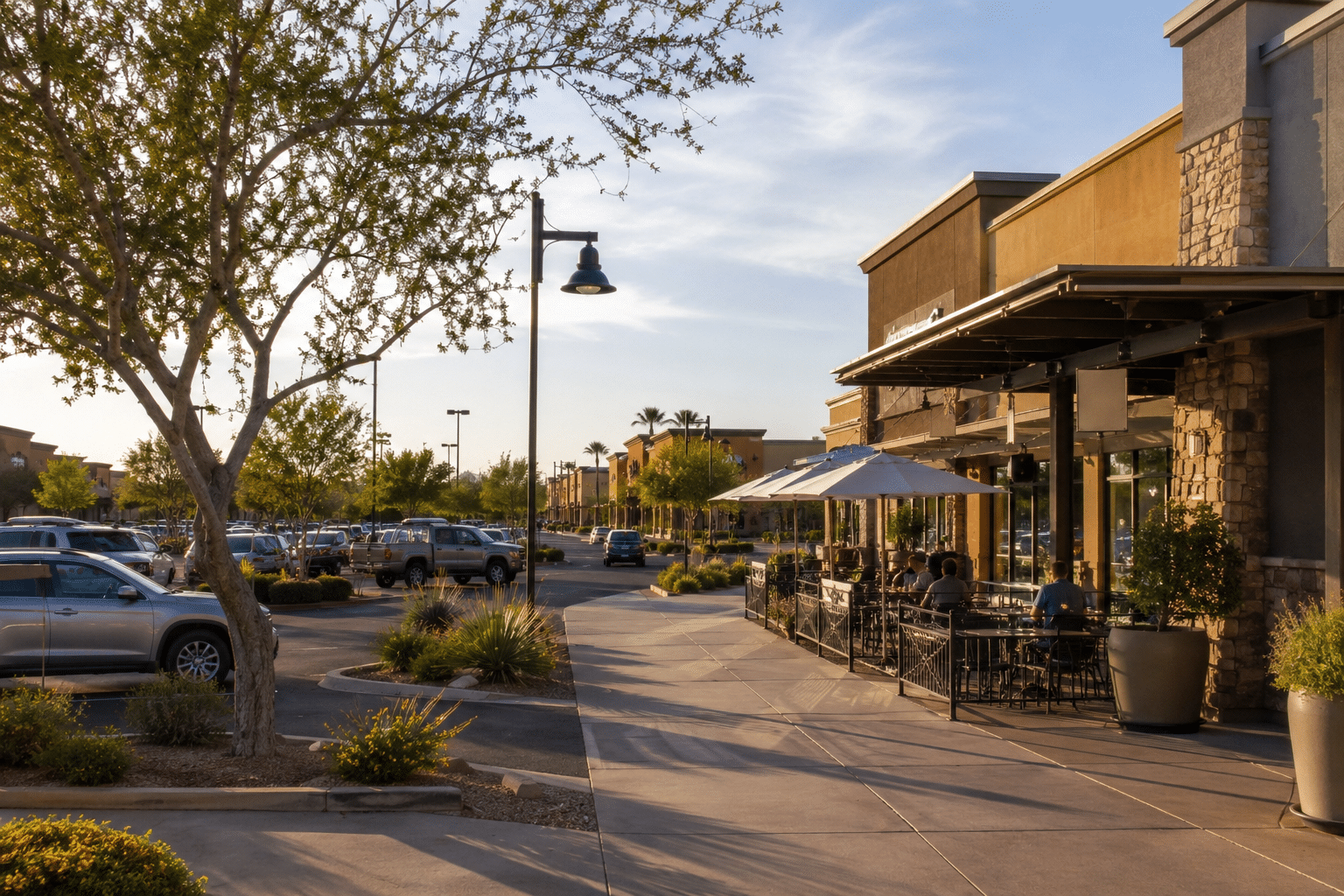
The primary commercial hub for Desert Hills residents is the Anthem corridor, approximately 10 to 15 minutes south via I-17. Anthem Marketplace, anchored by a Walmart Supercenter at 4435 W. Anthem Way, includes a full range of everyday retail. Anthem Crossroads, centered at 39504 N. Daisy Mountain Drive, offers additional neighborhood retail and service tenants. Dining options within a short drive include Two Brothers Kitchen (a highly regarded breakfast and brunch destination at Anthem Marketplace), The Tennessee Grill (a local favorite for American comfort food), Gio’s Pizza (family-owned New York and Sicilian pies), and Legends Bar & Grill for casual American dining.
For a broader retail experience, The Shops at Norterra — a lifestyle center located approximately 20 minutes south along I-17 — delivers department-store-quality shopping without the Scottsdale prices. Tenants include TJ Maxx/HomeGoods, Dick’s Sporting Goods, Best Buy, PetSmart, Barnes & Noble, World Market, and a Harkins Theatres 14-screen cinema complex. Lowe’s Home Improvement and additional dining and wellness tenants round out this walkable lifestyle destination.
HonorHealth Deer Valley Medical Center, located at 19829 N. 27th Avenue in Phoenix, is the anchor healthcare facility for the Desert Hills area. This 238-bed full-service hospital holds Magnet® designation for nursing excellence, is certified as a Cardiac Arrest Center and Primary Stroke Center by the Arizona Department of Health Services, and underwent a major renovation and expansion completed in 2026. Additionally, the North Valley Regional Library in Anthem provides robust programming, digital resources, and community event space.
Interstate 17 is the community’s primary arterial, placing residents within a 30-to-35-minute drive of downtown Phoenix under normal conditions. Carefree Highway (State Route 74) serves as the southern boundary and connects Desert Hills westward toward Peoria and Loop 303, and eastward toward Cave Creek and Carefree. Sky Harbor International Airport is approximately 40 miles and 45 minutes from Desert Hills, a reasonable commute given the lifestyle advantages of living in this part of the North Valley.
Desert Hills represents something increasingly rare in the Phoenix metropolitan area: a community where the Sonoran Desert is not a backdrop but a backdrop — it is the experience itself. Wide-open lots, unfettered mountain views, equestrian acreage, and a genuine absence of cookie-cutter development make Desert Hills homes for sale among the most distinctive and sought-after offerings in Maricopa County. Whether you are drawn here by a desire for space, a passion for horses, a need for privacy, or simply the appeal of waking up to unobstructed desert sunrises, this community delivers in ways that no master-planned neighborhood can replicate.
As your REALTOR®, I bring deep market knowledge and a genuine commitment to matching buyers with the right property in the right location. Desert Hills real estate requires a broker who understands land, lot orientation, well and septic considerations, and the nuances of unincorporated Maricopa County zoning — and that is exactly what I provide.
Ready to discover your perfect Desert Hills home? Contact Carl Chapman at (602) 617-4440.

Desert Hills attracts buyers seeking something the broader Phoenix market rarely delivers: custom homes on large lots with no HOA restrictions. Current listing activity in the community shows median asking prices in the range of $650,000 to $1,300,000, with custom estates on premium acreage occasionally reaching $1.5 million and above. Price per square foot for the core Desert Hills market has tracked in the $280–$405 range depending on finishes, lot size, and vintage. Average days on market have ranged between 40 and 80 days in recent cycles, reflecting a patient buyer pool and a relatively thin inventory — the community simply does not turn over quickly. The mix skews heavily toward single-family custom homes on one-acre-plus parcels, with a meaningful segment of equestrian-configured properties. Appreciation trends have remained positive over the long term, anchored by the area’s land scarcity and the continued influx of buyers priced out of comparable lot sizes in Scottsdale and Paradise Valley.

Deer Valley Unified School District #97 holds an ‘A’ Grade from the Arizona Department of Education and serves Desert Hills with schools recognized for both academic achievement and programmatic depth. Desert Mountain School on site in Desert Hills provides a seamless Pre-K through grade 8 experience. Cave Creek Unified School District No. 93 complements DVUSD with a portfolio of nationally and state-recognized campuses: Horseshoe Trails Elementary is a National Blue Ribbon School, Lone Mountain Elementary is a STEAM campus with proficiency rates approaching 80% in ELA, and Cactus Shadows High School holds an International Baccalaureate designation and is a Top 10 Comprehensive High School in Arizona. Gifted programming and AP offerings are available across both districts, and the area’s proximity to Anthem supports access to supplemental tutoring and enrichment providers.

The amenity profile of Desert Hills is anchored in nature rather than clubhouses. Cave Creek Regional Park — immediately adjacent to the community — delivers more than 15 miles of hiking, mountain biking, and equestrian trails within a nearly 3,000-acre preserve. The Phoenix Sonoran Preserve adds 36 miles of multi-use trails across 9,600 acres accessible via the Desert Hills Trailhead off Carefree Highway. For golf, the Jack Nicklaus–designed courses of Desert Mountain are within reach, and numerous public courses line the I-17 and Anthem corridors. Many properties include private pools, outdoor kitchens, RV garages, and equestrian facilities — the kind of custom amenity packages that HOA communities actively prohibit. Community parks and green space within Anthem, a 10-to-15-minute drive, include Anthem Community Park with its aquatic center, sports fields, tennis and pickleball courts, and fitness facilities.

Anthem Marketplace and Anthem Crossroads, both accessible within roughly 10 to 15 minutes via I-17, meet the community’s everyday retail and dining needs. Walmart Supercenter, specialty dining at Two Brothers Kitchen and The Tennessee Grill, and national chains including Freddy’s Steakburgers & Custard and Taco Bell are all within easy reach. For larger shopping excursions, The Shops at Norterra — approximately 20 minutes south — brings TJ Maxx/HomeGoods, Dick’s Sporting Goods, Best Buy, Barnes & Noble, and a Harkins 14-screen theater to the North Valley. Cave Creek and Carefree, roughly 15 minutes east along Carefree Highway, add boutique retail, art galleries, and the distinctive Western dining scene anchored by venues like the Roadrunner Restaurant & Saloon.

Interstate 17 is the community’s freeway spine, connecting Desert Hills directly to downtown Phoenix in approximately 30 to 35 minutes under typical conditions and to the broader I-17/Loop 101/Loop 202 system. Carefree Highway (SR-74) runs along the community’s southern edge and provides east-west connectivity toward Loop 303 to the west and Cave Creek Road to the east. Sky Harbor International Airport is approximately 40 miles and 45 minutes from the heart of Desert Hills. Valley Metro bus service has limited reach in this rural area, reflecting the predominantly auto-dependent character of the community — a consideration buyers should weigh against the significant lifestyle advantages. Maricopa County road maintenance handles primary arterials.

Desert Hills benefits from the low crime rates typical of rural Maricopa County communities at this income level. The Maricopa County Sheriff’s Office provides law enforcement services to the unincorporated community, with patrol frequency commensurate with the area’s geography. The absence of dense urban development, combined with large lot sizes that naturally create distance between properties, contributes to the area’s security profile. While many Desert Hills properties carry no HOA and are not gated, the community’s rural character functions as a self-reinforcing deterrent — large lots with long driveways, well-lit properties, and a tight-knit neighbor culture all contribute to residents’ sense of safety. Several enclaves within the broader Desert Hills geography do feature perimeter fencing and controlled access.

HonorHealth Deer Valley Medical Center, located at 19829 N. 27th Ave. in Phoenix, is the primary full-service hospital serving the Desert Hills area. The 238-bed facility earned Magnet® designation for nursing excellence and carries Arizona Department of Health Services certification as a Cardiac Arrest Center and Primary Stroke Center — a comprehensive acute-care footprint that underwent expansion in 2026. Urgent care facilities in Anthem are available within approximately 15 minutes. Emergency medical response times in this part of Maricopa County reflect the community’s distance from urban cores; residents should confirm their specific parcel’s response zone with Maricopa County. For specialty care, the Banner Health and HonorHealth networks provide broad physician access throughout the North Valley.

Outdoor living is not a feature of Desert Hills — it is the entire point. Cave Creek Regional Park, immediately adjacent to the community, delivers year-round hiking, mountain biking, and equestrian riding across more than 15 miles of maintained trails in 2,922 pristine Sonoran Desert acres. The Phoenix Sonoran Preserve extends the accessible trail network to 36 miles across 9,600 acres. Resident equestrians ride directly from their properties onto trail systems that connect to the regional network — a capability that simply does not exist in standard suburban communities. Birdwatching, wildlife observation, seasonal wildflower viewing, and stargazing under genuinely dark skies round out the outdoor calendar. The community’s elevation of approximately 1,700 feet provides micro-climatic relief during summer months, extending the comfortable outdoor season meaningfully compared to lower-elevation Phoenix neighborhoods.

The character of Desert Hills community life reflects its independent, land-loving population. Informal neighborhood associations and equestrian clubs foster social connection among horse owners and trail riders. The broader Anthem area, a 10-to-15-minute drive, offers a rich HOA-organized event calendar including seasonal festivals, farmers’ markets, community concerts, and holiday celebrations at Anthem Community Park. Cave Creek and Carefree — roughly 15 minutes east — host the acclaimed Cave Creek Rodeo, Western art shows, and a vibrant gallery scene. The North Valley Regional Library in Anthem supports book clubs, educational programs, and community gatherings. Volunteer opportunities through the Maricopa County Parks system — including trail maintenance and ranger-assistant programs at Cave Creek Regional Park — allow residents to contribute meaningfully to the natural environment they prize.

Desert Hills enjoys Arizona’s signature climate — more than 300 days of sunshine annually, warm and dry winters with daytime temperatures commonly in the 60s and low 70s, and hot summers tempered by the community’s elevation advantage. Summer highs in Desert Hills typically run 5 to 8 degrees cooler than central Phoenix, a modest but meaningful difference during the hottest months of June through August. Annual rainfall averages approximately 8 inches, with the summer monsoon season (July through mid-September) delivering dramatic afternoon thunderstorms, spectacular lightning displays, and the vivid desert greening that long-time residents count among the year’s highlights. Winter temperatures rarely dip below freezing, making outdoor activities accessible year-round.

Desert Hills is unincorporated Maricopa County, which means it is governed by county zoning ordinances rather than a municipal code. The predominant zoning classification is rural residential, accommodating single-family homes, horses, and accessory structures on lots typically one acre or larger. A significant portion of properties carry no HOA, meaning architectural review and land-use restrictions are minimal compared to most Phoenix submarkets — a distinguishing feature for buyers who want to add barns, detached garages, RV storage, or custom outbuildings without committee approval. Flood zone status varies by parcel and should be confirmed at the county level before purchase. Energy-efficiency standards follow Maricopa County’s residential building codes; newer custom construction frequently incorporates solar, foam insulation, and high-efficiency HVAC systems suited to Arizona’s climate.

The economic story of Desert Hills is increasingly shaped by proximity to the I-17 Deer Valley Employment Corridor, which hosts approximately 52,000 jobs across financial services, healthcare, and technology sectors. Major employers within commuting distance include USAA, Discover Financial Services, American Express, Cigna, Farmers Insurance, and Wells Fargo — together employing more than 12,500 workers within a short drive of the I-17/Anthem interchange. Taiwan Semiconductor Manufacturing Company (TSMC), whose landmark $165 billion north Phoenix campus represents the largest foreign direct investment in Arizona history, is bringing thousands of high-skilled technology and manufacturing jobs to the I-17 corridor. HonorHealth and Banner Health are major healthcare employers in the broader region. Remote professionals — a growing segment of the Desert Hills buyer pool — cite the community’s high-speed internet infrastructure and home office square footage as decisive factors.

Property taxes in unincorporated Maricopa County follow the county’s standard framework, with effective rates typically ranging from approximately 1.0% to 1.3% of assessed value. On a home priced at $850,000, buyers can reasonably model annual property taxes in the range of $8,500 to $11,000, though the actual figure depends on exemptions, classification, and the specific parcel’s assessed ratio. A majority of Desert Hills properties carry no HOA fees — a significant long-term financial advantage over comparable homes in master-planned communities where HOA assessments of $300 to $800 per month are routine. Utility costs vary based on home size, solar penetration, and well-versus-municipal-water status; buyers should confirm whether a parcel relies on a private well and propane, as both require additional operational planning. The absence of HOA fees and the lower cost-of-living profile of the North Valley versus Scottsdale make Desert Hills a compelling value proposition for buyers seeking large-lot acreage without resort pricing.

As an unincorporated Maricopa County community, Desert Hills is served directly by Maricopa County government rather than a city. Trash collection and recycling services are available through Maricopa County’s contracted service providers, though rural properties on private wells and septic systems handle water and wastewater independently. The Maricopa County Board of Supervisors provides legislative oversight and representation. Road maintenance for primary arterials is handled by Maricopa County Public Works, while private roads on individual parcels remain the property owner’s responsibility. Fire protection is provided by the Daisy Mountain Fire Department, which serves the north Phoenix, Desert Hills, and New River areas. Residents can access Maricopa County services — including permitting, zoning inquiry, and public works requests — through the county’s online portal or in-person offices in downtown Phoenix.
We use cookies to improve your experience on our site. By using our site, you consent to cookies.
Manage your cookie preferences below:
Essential cookies enable basic functions and are necessary for the proper function of the website.
CloudFlare provides web performance and security solutions, enhancing site speed and protecting against threats.
Service URL: developers.cloudflare.com (opens in a new window)
Google Tag Manager simplifies the management of marketing tags on your website without code changes.
These cookies are used for managing login functionality on this website.
Statistics cookies collect information anonymously. This information helps us understand how visitors use our website.
Google Analytics is a powerful tool that tracks and analyzes website traffic for informed marketing decisions.
Service URL: policies.google.com (opens in a new window)
You can find more information about our Cookie Policy and Privacy Policy.