

Eagle Mountain stands as one of Fountain Hills’ most distinguished guard-gated communities — a 550-acre, approximately 1,000-unit master-planned enclave draped across the southeastern ravines of the McDowell Mountains. Positioned at the border of Fountain Hills and northeast Scottsdale, the community sits roughly 500 feet above the Phoenix valley floor, delivering commanding views of natural box canyons, rolling desert ridgelines, and distant landmarks including Four Peaks, Red Mountain, and Camelback Mountain.
Development began in the mid-1990s, with the Eagle Mountain Golf Club opening in 1996 as the community’s defining anchor. The neighborhood evolved from that foundation into a cohesive desert sanctuary, with homes oriented toward canyon vistas and a design philosophy centered on the flow between interior living spaces and Arizona’s year-round outdoor environment. Protected tribal lands on multiple sides — the Salt River Pima-Maricopa Indian Community and the Fort McDowell Yavapai Nation — ensure the surrounding desert will remain open indefinitely.
Eagle Mountain delivers something genuinely rare: desert seclusion without sacrificing access to Scottsdale’s world-class dining, shopping, and healthcare. Eagle Mountain homes for sale offer privacy, preserved natural beauty, and a lifestyle anchored by golf and outdoor recreation.
Eagle Mountain presents a diverse housing inventory within a unified architectural vision, spanning from 1996 to the present with home sizes from approximately 1,524 to over 7,500 square feet.
MCO Properties, the master developer of the broader Fountain Hills townsite, shaped Eagle Mountain’s land plan around its natural canyon topography — routing roads along existing ridgelines and ravines to preserve the irreplaceable desert views that define every homesite. Several distinct enclaves reflect the community’s range. Eagle Mountain Estates holds the most expansive custom lots, where single-family homes regularly incorporate casitas, resort pools, and multi-car garages. Summit Ridge captures elevated homesites with panoramic Valley of the Sun views, while Canyon Views positions homes directly above the natural desert washes. The community’s townhome and patio home enclaves — often called the Eagle Mountain Villas neighborhoods — appeal to lock-and-leave buyers seeking low-maintenance luxury with architecture consistent with the surrounding custom-home standard.
Named floor plan models including the Aruba, Bali, Inverness, and Jokake span three-bedroom configurations near 2,100 square feet to expansive multigenerational layouts. Morgan Taylor Homes represents the caliber of boutique custom and semi-custom builder active in Fountain Hills. Desert contemporary architecture dominates throughout: flat and low-pitched rooflines, natural stone and stucco exteriors, and covered patios aligned to capture sunrise over the canyon and sunset across the Valley of the Sun.
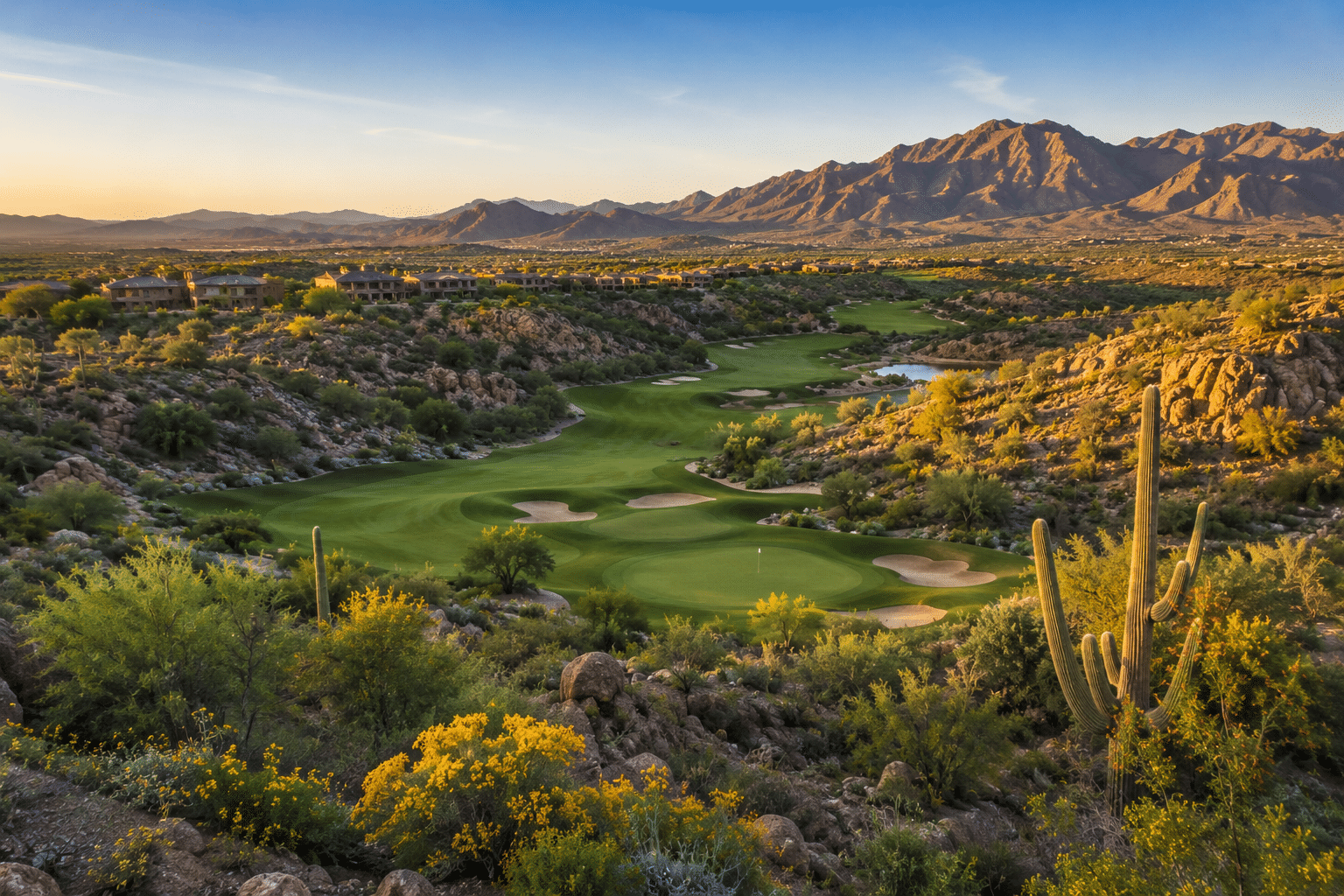
Eagle Mountain residents live at the edge of one of the most spectacular outdoor recreation networks in the Sonoran Desert. The opportunities — on and off the golf course — are both exceptional in quality and varied enough to fill every weekend of the year.
The community’s anchor is the Eagle Mountain Golf Club, an 18-hole, par-71, 6,800-yard championship course designed by architect Scott Miller and opened in 1996. Managed by Troon, the course was named one of the Top 10 Best Overall Courses in Arizona by Colorado AvidGolfer and ranked the #2 Most Improved Course in the U.S. by Golf Advisor in 2022. The layout departs from target-style desert golf, threading instead through natural arroyos, rolling hills, and lush desert valleys — an experience course architect Miller described as “man’s creation in harmony with nature.” Four tee sets (5,065–6,800 yards), a course rating of 71.7, and a slope of 139 ensure challenge at every skill level. The Grille at Eagle Mountain Golf Club serves breakfast and lunch daily against panoramic southeast Valley views.
Bordering Eagle Mountain to the north, McDowell Mountain Regional Park encompasses more than 21,000 acres with nearly 80 miles of trail open to hikers, mountain bikers, and equestrians. Top named trails include:
The Adero Canyon Trailhead (14800 N. Eagle Ridge Drive) provides access to the Fountain Hills McDowell Mountain Preserve, with routes including the challenging Andrews-Kinsey Trail (6.7 miles, difficult), the Promenade Trail (0.9 miles, intermediate), and the Lake Overlook Trail (1.5 miles, easy-moderate) with views across Fountain Park and the Fort McDowell Yavapai Nation lands. Javelinas, roadrunners, coyotes, and great-horned owls are routine wildlife sightings throughout the preserve.
Eagle Mountain is served exclusively by the Fountain Hills Unified School District. The district’s compact structure spans pre-K through grade 12. School assignments can change, so confirm the schools for a specific address with the district’s school locator.
Eagle Mountain occupies an enviable position: the seclusion of a guard-gated desert enclave with rapid access to dynamic retail and dining options just minutes west.
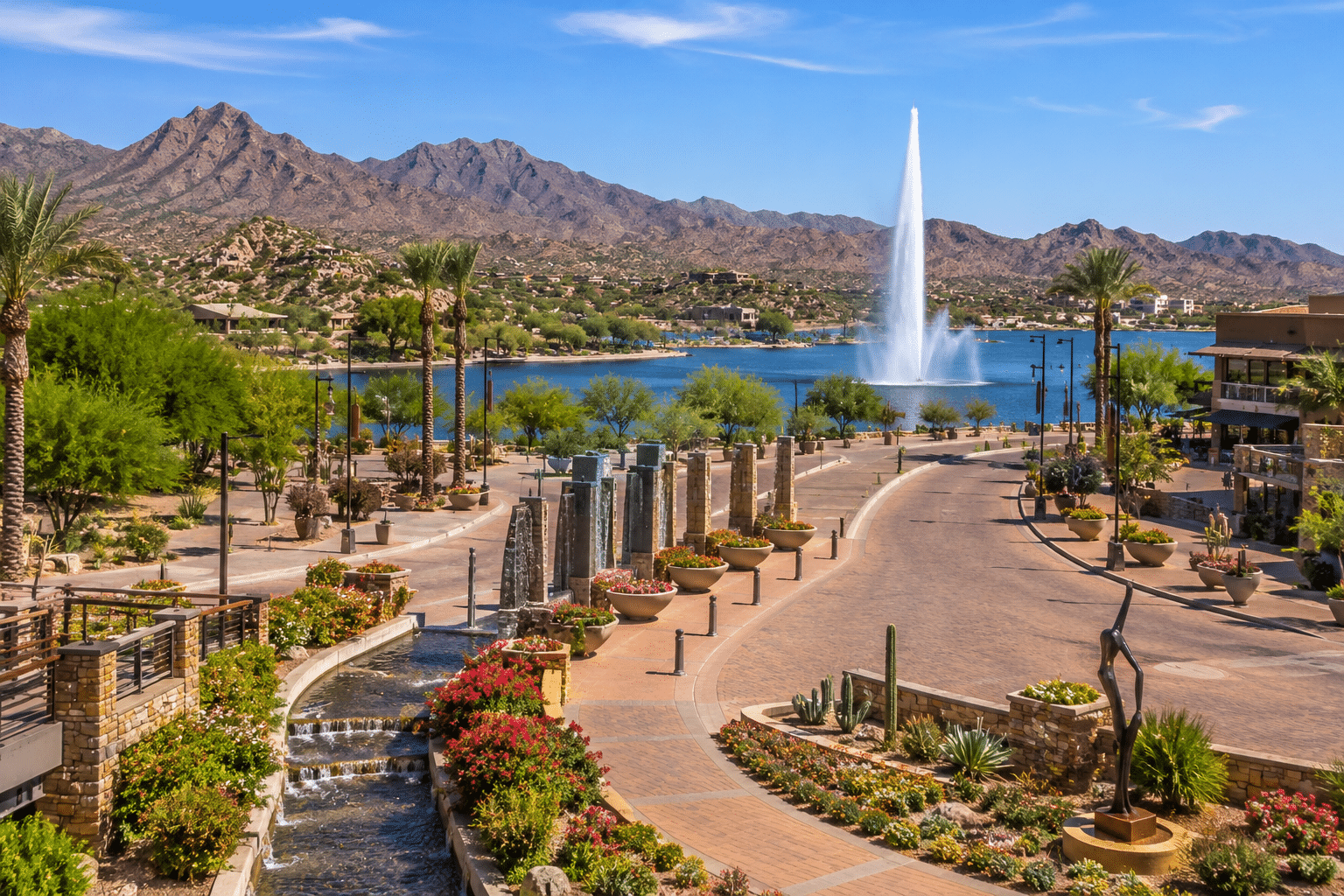
The Avenue of the Fountains anchors Fountain Hills’ downtown, surrounding the iconic Fountain Park — home to the world’s fourth-tallest fountain at 560 feet, operating on the hour. The lakeside corridor includes local dining destinations such as Pietro’s Fine Dining (Italian), Desert Decanter Wine Bar, Sofrita (Latin American), and Sapori D’Italia, plus the Fountain Hills Botanical Garden and River of Time Museum. A seasonal farmers’ market and regular outdoor concerts enliven the park year-round.
Within the community, the Inn at Eagle Mountain — a 37-suite boutique hotel below the 18th green — functions as a resident amenity as much as a destination. The on-site restaurant Pietro’s serves elegant Italian cuisine on an outdoor patio with sweeping southwestern views. The Grille at Eagle Mountain Golf Club rounds out the on-property dining with a casual full-service menu daily.
Eagle Mountain connects to northeast Scottsdale via Shea Boulevard in under 25 minutes, unlocking Scottsdale Fashion Square (Neiman Marcus, Nordstrom, Macy’s, plus flagship boutiques) and the open-air Scottsdale Quarter. The Eagle Mountain Marketplace on Shea provides everyday grocery, pharmacy, and casual dining closer to home. The Loop 101 (Pima Freeway) is approximately 17 miles west via Shea, with the Beeline Highway (SR-87) providing the primary north-south spine. Downtown Phoenix is 40–50 minutes; Phoenix Sky Harbor International Airport lies roughly 30 miles southwest. Valley Metro Bus Route 514 provides public transit service between Fountain Hills and Scottsdale.
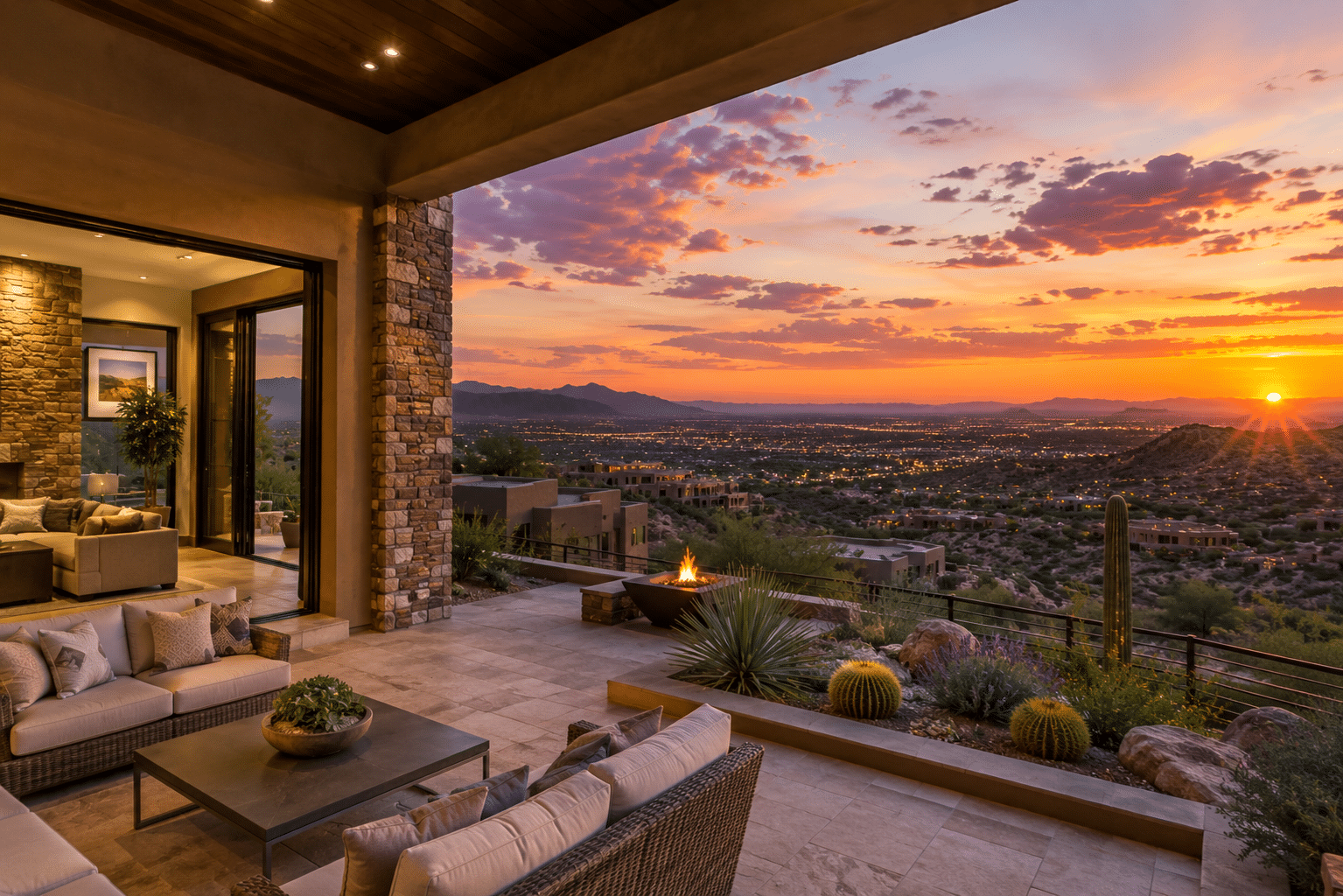
Eagle Mountain offers a proposition that is difficult to replicate in the greater Phoenix market: a guard-gated desert sanctuary where championship golf, preserved Sonoran Desert wilderness, and Scottsdale’s cultural and healthcare amenities converge within a finite, coveted address. Whether the draw is panoramic canyon views, the rhythm of a golf-centric lifestyle, or the intimacy of a close-knit community, Eagle Mountain homes for sale reward buyers who understand what makes the Northeast Valley’s most distinctive enclaves valuable. For current prices, inventory and days on market in Eagle Mountain, see the live market report on this page, which updates from ARMLS listing data.
A West USA Realty agent brings market depth, local relationships, and negotiating expertise to every transaction — from the first private community tour to the closing table. Clients benefit from access to off-market opportunities and a transaction process designed to protect their investment at every stage.
Ready to discover your perfect Eagle Mountain home? To get started, contact Carl Chapman with the Zona Team at West USA Realty: call or text (602) 617-4440 or email chapman@westusa.com.

Eagle Mountain encompasses approximately 1,000 homes built from 1996 to the present, ranging from patio homes to custom canyon-view estates. No significant new construction land remains within the gates. For a specific home’s property tax, look up the parcel on the Maricopa County Treasurer’s website.

Eagle Mountain is zoned entirely to the Fountain Hills Unified School District, which spans pre-K through grade 12.

The Eagle Mountain Golf Club anchors the community’s amenity profile — an 18-hole, par-71 course designed by Scott Miller, managed by Troon, with four tee sets (5,065–6,800 yards) and a slope rating of 139. Community pools, fitness centers, and tennis courts exist within specific sub-associations. HOA dues vary by sub-association; confirm current fees with the association or in the HOA disclosure during escrow. Walking and biking paths connect through desert corridors to the McDowell Mountain Regional Park trail network at the Golden Eagle Trailhead. The Inn at Eagle Mountain adds a resort dimension with a full-service spa, outdoor pool, and on-site dining available to the broader community. Guard-gated entry with 24-hour staffing is standard throughout.

Daily needs are covered at Eagle Mountain Marketplace on Shea Boulevard, with grocery, pharmacy, and casual dining. Fountain Hills’ Avenue of the Fountains — five minutes from the gate — hosts Pietro’s Fine Dining, Desert Decanter Wine Bar, Sofrita, and Sapori D’Italia, plus seasonal farmers’ market events at Fountain Park. A 20–25 minute drive west on Shea reaches Scottsdale Fashion Square (Neiman Marcus, Nordstrom) and Scottsdale Quarter. For entertainment, We-Ko-Pa Casino Resort is approximately 10 minutes northeast, featuring Ember Steakhouse and resort amenities. ADERO Scottsdale Resort — with CIELO farm-to-table dining and a destination spa — is accessible via Palisades Boulevard, rounding out a dining and entertainment portfolio that rivals much denser urban neighborhoods.

Eagle Mountain accesses the regional freeway network via State Route 87 (Beeline Highway) southbound to Mesa and the US 60 Superstition Freeway, and via Shea Boulevard westbound to the Loop 101 (Pima Freeway). The Loop 101 connects to Loop 202 (Red Mountain Freeway) for East Valley access. Downtown Scottsdale is 25–30 minutes; downtown Phoenix is typically 40–50 minutes. Phoenix Sky Harbor International Airport lies approximately 30 miles southwest — a 35–45 minute drive. Valley Metro Bus Route 514 (Scottsdale Express) provides public transit linking Fountain Hills to Scottsdale and Phoenix. Eagle Mountain’s elevation (approximately 1,520–1,600 feet) results in slightly cooler driving conditions in summer, a small but meaningful comfort advantage over the valley floor.

Eagle Mountain is within the Town of Fountain Hills.
Service boundaries can change at community edges, so confirm the agencies for a specific address with the Town of Fountain Hills. For police reports and statistics, contact the Maricopa County Sheriff’s Office directly.

Eagle Mountain residents access healthcare at multiple tiers. The Fountain Hills Medical Center in town provides 24-hour emergency services, while HonorHealth Urgent Care and Primary Care handles same-day non-emergency needs locally. Approximately 20–25 minutes west via Shea Boulevard, Mayo Clinic’s Scottsdale campus, an outpatient clinic, offers specialty care. HonorHealth Scottsdale Shea Medical Center along the same corridor provides inpatient surgical, cardiac, and oncology services. The combination of local urgent care access and proximity to two major medical campuses gives Eagle Mountain buyers a healthcare profile typically associated with urban core addresses.

Eagle Mountain’s outdoor calendar runs all twelve months. The Golden Eagle Trailhead — minutes from the north gate — opens directly into McDowell Mountain Regional Park‘s nearly 80-mile shared-use trail network for hiking, mountain biking, and horseback riding. The Adero Canyon Trailhead accesses the Fountain Hills McDowell Mountain Preserve for more technical desert terrain. Desert wildlife encounters are routine: javelinas, coyotes, roadrunners, and great-horned owls share the landscape daily. The Salt River (kayaking, tubing) and Saguaro Lake (boating, paddleboarding) are reachable in 20–30 minutes via SR-87, and Fountain Park provides a lakeside walking path five minutes from Eagle Mountain’s gate. Native saguaro, palo verde, and brittlebush landscaping deliver a spectacular spring wildflower display that rewards the patient observer.

Fountain Hills supports one of the Phoenix metro’s most active small-town event calendars. The Fountain Hills Great Fair (February) ranks among the Southwest’s premier street fairs, drawing Valley-wide attendance. The Thunderbird Artists’ Fountain Hills Fine Art & Wine Affaire brings juried fine art twice annually to the Avenue of the Fountains. The fountain is dyed green for St. Patrick’s Day — a beloved local tradition. A seasonal Farmers’ Market and programming at the Fountain Hills Botanical Garden round out the year. Eagle Mountain’s HOA sponsors its own social events, fostering close-knit community dynamics. The We-Ko-Pa Casino Resort on adjacent Fort McDowell Yavapai Nation lands provides entertainment, live events, and dining options just minutes from the gate.

Eagle Mountain enjoys the Valley of the Sun’s signature climate — more than 300 days of sunshine annually, mild winters (December–February daytime highs in the low-to-mid 60s°F), and summer highs (100–106°F in July) that are perceptibly moderated by the community’s elevation of approximately 1,500–1,800 feet above sea level. Annual rainfall averages roughly 8–10 inches, concentrated in winter and the mid-July through September monsoon season. Eagle Mountain residents relish monsoon season: dramatic afternoon storm cells build over the McDowell ridgeline before cooling rains sweep through, and gatherings on canyon-view patios to watch the show are a beloved local ritual. Desert landscaping — native saguaro, palo verde, and brittlebush — requires minimal supplemental water and delivers a vivid spring wildflower display that makes early-morning walks a seasonal reward.

Eagle Mountain operates under a layered HOA structure: a master community association governs community-wide standards, while individual sub-associations manage specific enclaves. The Eagle Mountain Community Facilities District assessment is an additional parcel-level obligation (confirm current levy via the Town of Fountain Hills). Architectural guidelines require HOA review committee approval for all exterior modifications — paint, additions, landscaping changes, pool installations — preserving the community’s cohesive desert aesthetic. Short-term vacation rentals are restricted per HOA governing documents. Most of Eagle Mountain carries a low-risk flood zone designation, though canyon-adjacent parcels warrant individual verification. Newer construction within the community incorporates energy-efficient building standards, enhanced insulation, and low-VOC materials consistent with current Maricopa County requirements.

Eagle Mountain residents draw primarily from Scottsdale’s employment corridor, accessible in 25–30 minutes via Shea Boulevard. Mayo Clinic Scottsdale ranks among the region’s most prestigious healthcare employers, with clinical, research, and administrative roles. HonorHealth (Scottsdale Shea Medical Center and system-wide campuses) is another major anchor along the same commute corridor. The Loop 101 technology and financial services corridor hosts regional offices for national firms. WestWorld of Scottsdale drives convention and hospitality-related employment; We-Ko-Pa Casino Resort and the Fountain Hills hospitality sector serve local service workers. The Fort McDowell Yavapai Nation is itself a meaningful employer through casino resort operations. Remote and hybrid work arrangements have made Eagle Mountain’s relative distance from downtown Phoenix increasingly practical for a broad range of professionals.

The Eagle Mountain Community Facilities District assessment is confirmed separately at the parcel level. The Town of Fountain Hills levies no local income tax, and Arizona’s competitive state income tax structure adds to overall affordability. Summer electrical costs are higher due to central A/C demands; winter heating costs are modest. Buyers should consult a mortgage professional regarding jumbo loan thresholds and current Maricopa County conforming limits. Title and escrow costs follow standard Arizona norms, typically 1.0–1.5% of purchase price.

Eagle Mountain falls within the incorporated boundaries of the Town of Fountain Hills, which provides roads, parks, code enforcement, planning, and water utility services sourced from the Salt River Project and Central Arizona Project. The Fountain Hills Town Council governs local policy with elections that draw strong resident engagement. The Eagle Mountain Community Facilities District coordinates infrastructure matters specific to the community in collaboration with the town. Trash and recycling collection is managed through the town’s contracted haulers. Town library services, senior programs, and parks and recreation programming are available through the Fountain Hills Community Services department, adding meaningful public amenities to the community’s private ones.
We use cookies to improve your experience on our site. By using our site, you consent to cookies.
Manage your cookie preferences below:
Essential cookies enable basic functions and are necessary for the proper function of the website.
CloudFlare provides web performance and security solutions, enhancing site speed and protecting against threats.
Service URL: developers.cloudflare.com (opens in a new window)
Google Tag Manager simplifies the management of marketing tags on your website without code changes.
These cookies are used for managing login functionality on this website.
Statistics cookies collect information anonymously. This information helps us understand how visitors use our website.
Google Analytics is a powerful tool that tracks and analyzes website traffic for informed marketing decisions.
Service URL: policies.google.com (opens in a new window)
You can find more information about our Cookie Policy and Privacy Policy.