

Forty-five minutes northeast of central Phoenix, past the McDowell Mountains and across the Verde River, Trilogy at Verde River sits on a high-Sonoran-desert site that Shea Homes opened as the most remote address in its Trilogy line. The drive itself filters the buyer pool. State Route 87 trades the loop freeways for two lanes of open road, the city skyline drops out of the rearview, and by the time the Rio Verde Drive turn appears, the landscape has already changed from West Valley flatness to rolling boulder country with saguaro on every ridge.
Buyers who reach this gate did so on purpose. That is the first thing to understand about the community Shea built here, and it is the thread that runs through everything below. For prospective residents researching Rio Verde 55+ communities, Trilogy at Verde River reads as a destination rather than a default option. The geography is the amenity. The remoteness is the appeal. What follows is a practical guide to the community, the homes, the membership structure, and the trade-offs of buying into a Shea Homes 55+ luxury community an hour from the urban grid.
A typical morning at Trilogy at Verde River starts with light rather than an alarm. The desert at 1,800 feet of elevation cools overnight in a way the lower valley does not, and residents learn to read the early hour by the angle of the sun on the McDowell ridges to the east. A walk on the perimeter loop or a tee time on the back nine of the Verde River course fills the first part of the day. By late morning, attention shifts inside: a fitness class at the wellness center, a pickleball round on the courts behind the main clubhouse, or a quiet hour with a coffee on the Verde Cafe patio.
The pace here is intentional. Shea Homes designed Trilogy at Verde River around the assumption that residents would spend their days using a small set of high-quality amenities deeply, rather than rotating through a sprawling activity menu. The architecture supports that pattern. Most homes face open desert or course views, and the central clubhouse sits within walking distance of the largest neighborhoods. Many residents leave the gate only twice or three times a week. A grocery run to Fountain Hills, a medical appointment in north Scottsdale, a dinner in Cave Creek — the trips are real, but they are deliberate, not constant. The remoteness is the appeal, not a problem to manage.
The lifestyle has a rhythm that maps to the Sonoran calendar. November through April is full-occupancy season, when the community fills with full-time residents, second-home owners, and the cross-border Canadian and Midwestern owners who treat Verde River as a winter address. Summer is quieter. Temperatures still climb, though less brutally than in the lower valley, and many homes go dark while owners head north. For full-time residents, summer is the season the community returns to its quieter self, and several long-tenured owners describe it as their favorite stretch of the year. The amenities operate year-round, the staffing scales seasonally, and the social calendar shifts from large gatherings in the cooler months to smaller, more intimate clubs in the warmer ones.

Trilogy at Verde River is a Shea Homes community, built and sold under the Trilogy lifestyle brand that Shea has refined across more than a dozen properties in the Western United States. The floor plans available here typically range from compact single-story homes near 1,700 square feet to larger four-bedroom layouts above 3,000 square feet [UNCONFIRMED — verify with current Shea Homes inventory]. The single-story bias is consistent: nearly every plan offers an aging-in-place layout with no interior steps, wide hallways, and primary suites positioned on the main level.
The architecture leans contemporary Southwest. Earth-tone stucco, deep eaves over patios sized for outdoor living, oversized windows oriented to capture mountain views, and roof lines that step down to keep the homes visually low against the desert horizon. The result is a streetscape that reads as modern but settles into the surrounding terrain rather than fighting it. Resident updates and renovations have begun to layer over the original Shea finishes in the older neighborhoods, while newer phases continue to build out under current Shea construction standards. Comparing this floor-plan stock to its sister property at Trilogy at Vistancia in north Peoria is instructive: Vistancia leans into the Kiva and Mita club split, while Verde River concentrates everything around a single Verde River Golf and Social Club campus.
Pricing at Trilogy at Verde River runs above the Shea Trilogy line average and reflects the community’s positioning as a destination luxury 55+ community rather than a value-tier active adult option. Resale homes typically transact in a band that starts in the upper six figures and reaches well into seven figures for premium-lot luxury homes [UNCONFIRMED — verify current resale data with a Rio Verde 55+ specialist]. New construction, where available, prices similarly. Buyers comparing this community to the broader Trilogy portfolio should expect the cost premium to track to lot quality, view orientation, and proximity to the Verde River Golf and Social Club. The pricing pattern is closer to a north Scottsdale custom-home neighborhood than to a typical West Valley active adult subdivision.
Lot premiums at Trilogy at Verde River matter more than they do in flat West Valley communities. A homesite that backs to open desert, faces the McDowell ridge, or sits along the golf course corridor commands a meaningful premium over an interior lot of the same plan. View-corridor pricing is part of the local resale market culture, and a tour of the community typically includes a discussion of how to read those orientations. The single-story design language across the inventory makes view-line preservation a baseline rather than a luxury — buyers can shop confidently knowing that the home next door will not block the ridge.

The Verde River Golf and Social Club is the gravitational center of the community. The clubhouse is the address most residents give when describing where they spend the bulk of their non-home hours, and the campus around it — restaurant, fitness facility, spa, pool deck, courts, social rooms — is laid out for daily use rather than special-occasion visits. The combined footprint is smaller than the multi-clubhouse setups at Shea’s larger Trilogy properties, and the concentration is the design intent: one campus, walked daily, learned within weeks of moving in.
The golf course at Trilogy at Verde River is an 18-hole championship layout designed by Gary Panks. The course routes through native high-desert terrain, with elevation changes, washes, and dramatic boulder outcroppings shaping the holes. Residents who play it regularly describe the course as challenging without being punishing — the kind of layout that rewards course management over distance, which suits a 55+ membership well. A practice facility sits adjacent to the clubhouse, and the pro shop is staffed throughout the season. Tee times for members tend to fill the morning blocks from October through April, with a lighter pace through the summer when the course shifts to early-morning-only play to manage heat.
The amenity stack outside the clubhouse extends the use case beyond golfers. The resort pool deck is the central social hub from October through May, with a heated lap pool sized for fitness laps and a separate resort-style pool for shallow-water programming and casual gathering. Pickleball courts — the most actively used recreational courts at most Trilogy communities, and Verde River is no exception — sit within walking distance of the clubhouse, alongside tennis courts and bocce. The outdoor patio at the Verde Cafe is a natural pre- or post-round gathering point and stays busy through the cooler months. Residents who spend an afternoon at the pool deck rarely leave without running into someone they know, which is the social engineering Shea built the campus around.
Inside the clubhouse, a fitness center handles strength training, cardio, and a regular schedule of group classes oriented to active adults. Yoga, Pilates, balance work, and aqua programming run year-round. A spa offers massage, skincare, and other services on-site, which spares residents the drive to north Scottsdale for routine treatments. The combined fitness, pool, and spa footprint is engineered for the daily-use case Shea built the community around — the kind of stack that residents can rely on without leaving the gate. Programming is updated quarterly, and many resident-led groups overlap with the wellness staff schedule, so a class taken once tends to introduce neighbors who become regular partners on the courts or the trails.
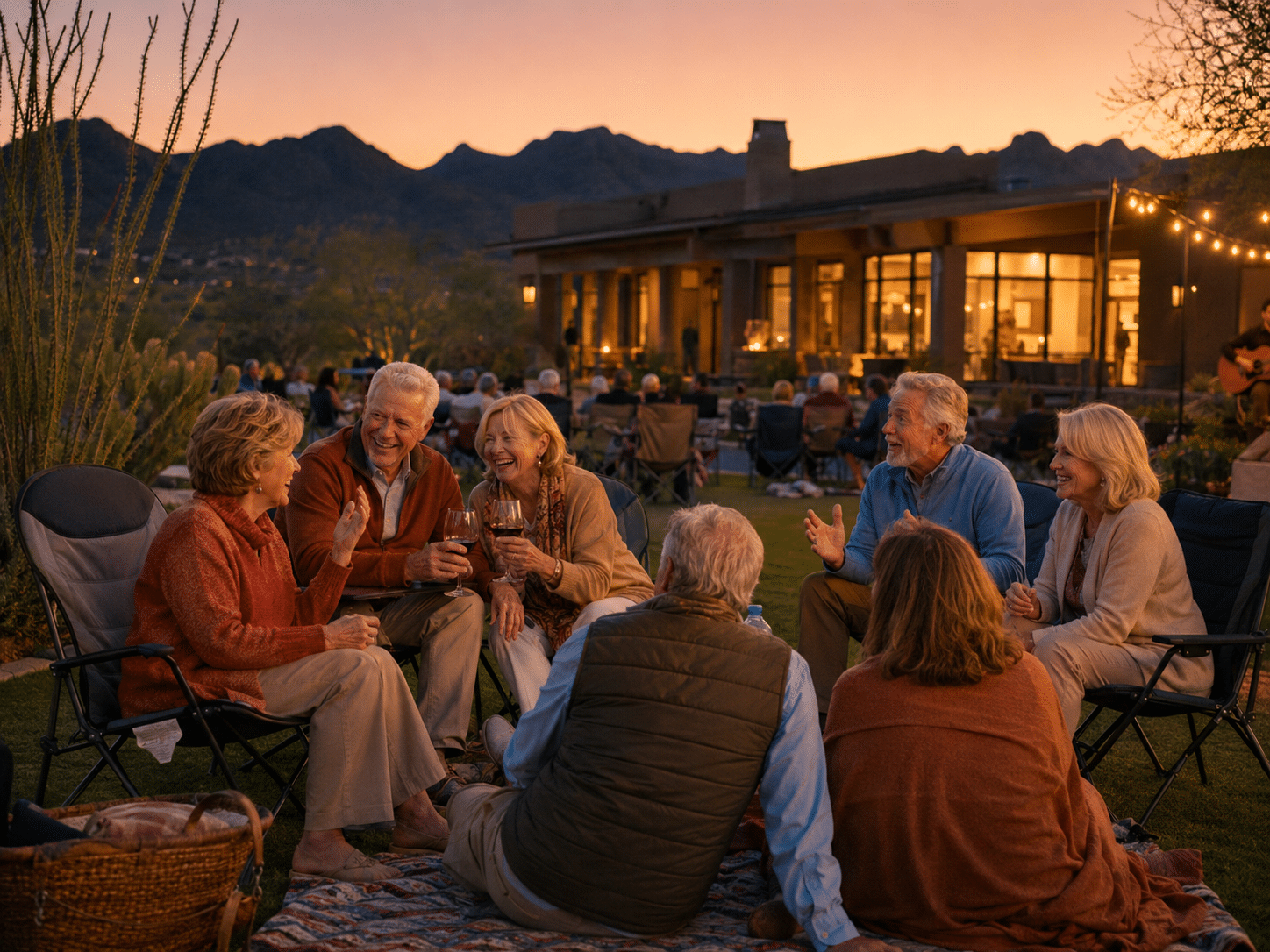
The activity calendar at Trilogy at Verde River follows the Sonoran cooling cycle. Major member events cluster between October and April, with quieter programming through the summer. The clubs themselves are resident-organized and resident-run, which keeps the calendar responsive to who actually lives in the community in any given year.
The roster of clubs covers the expected categories — book groups, wine and culinary, art, photography, hiking, women’s and men’s golf leagues — and several less expected ones, including a desert ecology group that organizes guided walks in the surrounding land and a writing circle that meets in the social rooms. The annual events calendar typically includes outdoor concerts on the lawn, holiday gatherings at the clubhouse, and the larger seasonal parties that mark the start and end of full-occupancy season. New residents are typically welcomed at a quarterly orientation evening where club leaders introduce themselves directly. The result is a faster on-ramp into community life than most resort 55+ communities offer.
Seasonal ownership at Trilogy at Verde River has its own character. A meaningful share of the community’s part-year residents come from Western Canada — particularly Alberta and British Columbia — and the Upper Midwest. That mix shows up in the calendar: late January and February typically bring the highest event attendance, and the community’s social culture has absorbed enough cross-border presence that several long-running clubs operate with regular Canadian leadership. Unlike denser West Valley 55+ communities, where seasonal owners blend into a larger snowbird wave, Verde River’s seasonal residents tend to be active club participants, course members, and regulars at the cafe — the remote setting selects for owners who want to use the community fully when they are here. For buyers comparing seasonal-ownership patterns across the Shea portfolio, Trilogy at Wickenburg Ranch reads similarly, though Verde River draws a slightly higher share of cross-border owners.
Geography is the first fact about Trilogy at Verde River, and the daily logistics of living here flow from it. State Route 87, known locally as the Beeline Highway, is the access road. Most residents reach the metro Phoenix grid via Shea Boulevard, Loop 101, and the north Scottsdale corridor for routine trips, and via the same route for the airport. Fountain Hills, fifteen to twenty minutes south, is the closest commercial town and the nearest point for groceries, dining, and basic medical services. Cave Creek and Carefree, similar drive times to the west, round out the immediate retail and dining options. Buyers comparing the Verde River geography to closer-in alternatives should also look at the Scottsdale 55+ landscape for context on how the trade-offs of distance versus density play out across the metro.
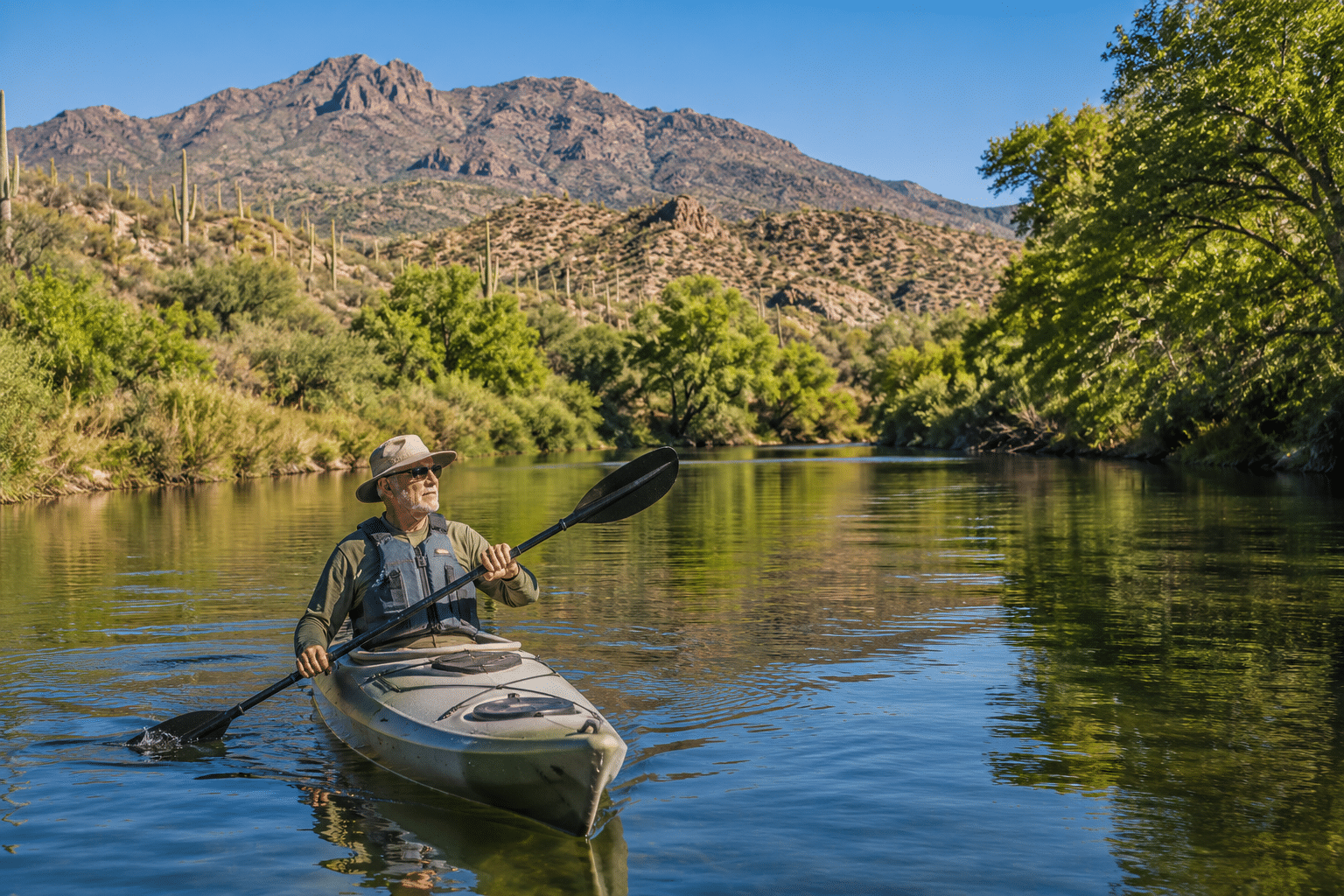
McDowell Mountain Regional Park, the 21,000-acre Maricopa County park that abuts the community, is effectively a private backyard for residents who hike. Trail access from the community side is direct, and the park’s network of multi-use trails covers terrain ranging from easy desert loops to harder ridge climbs. The McDowell Sonoran Preserve, slightly farther west, adds another dimension to the trail map. Riverbed access along the Verde River corridor offers kayaking and birdwatching during higher-flow seasons. The combination — a regional-park-grade trail network paired with a championship golf course inside the gate — is unusual at this price point and is part of why buyers describe Verde River as a “destination” community rather than a neighborhood. Day trips to Sedona, Payson, and the Mogollon Rim country are also closer from this side of the metro than from West Valley addresses, which factors into how Verde River residents plan weekends.

Healthcare access is the part of life at Trilogy at Verde River that prospective buyers ask about most often, and the honest answer is that it requires planning. There is no hospital in Rio Verde. Routine care, urgent care, and specialty care all involve a drive. The good news is that the drive lands residents in one of the strongest medical corridors in metro Phoenix. The trade-off is that the corridor is not five minutes away, and a buyer who weights immediate-access medical care above all other factors should look at a different community.
Routine primary care for Verde River residents typically runs through the HonorHealth network in north Scottsdale and the Cave Creek and Carefree corridor. HonorHealth Sonoran Crossing offers the closest hospital-grade urgent care in the immediate area, and primary-care offices throughout north Scottsdale take Verde River patients regularly. Telehealth has narrowed the practical distance for non-acute appointments, and several Verde River residents describe a hybrid pattern — video visits for routine follow-ups, in-person trips for procedures and labs. Several local concierge-medicine practices operate out of north Scottsdale and Cave Creek, and they have absorbed a meaningful share of the Verde River resident population.
For specialty and acute care, the destination is Mayo Clinic Phoenix in north Scottsdale, roughly forty minutes from the gate via Shea Boulevard. The Mayo campus is widely considered the strongest specialty-care anchor in the metro region, and proximity to it is one of the genuine medical advantages of the Verde River location. Cardiology, oncology, orthopedics, and neurology all run out of the Mayo campus, and the drive — while long compared to an in-town address — is direct and predictable outside of weekday rush hour. Residents who anticipate ongoing specialty care often build their week around a Tuesday or Wednesday Mayo appointment, then chain a Scottsdale lunch or a north-valley errand onto the same trip.

The cost of living at Trilogy at Verde River divides into three components a buyer should weigh separately: the home purchase, the community association assessment, and the club membership at the Verde River Golf and Social Club. Each works on a different timeline, and combining them into a single number obscures the actual ownership math.
Home prices at Trilogy at Verde River sit toward the top of the Shea Trilogy line. Resale homes generally transact between the upper six figures and well above one million dollars for view-premium properties, with new-construction inventory pricing in a similar band [UNCONFIRMED — ask a current Rio Verde 55+ specialist for live data]. The premium reflects the location, the lot orientations, and the build quality that Shea applies to its higher-end Trilogy properties. Compared to the broader 55+ market, Verde River prices like a destination luxury community rather than a value 55+ option, and that is the right framing for a buyer’s expectation-setting.
The community association assessment covers shared infrastructure — gates, common-area landscaping, private roads, the security service. Club membership at the Verde River Golf and Social Club is separate and runs in tiers: a base social membership unlocks the pool, fitness center, spa, restaurant, and most non-golf programming, while a full golf membership adds course access at a higher monthly rate. Buyers should request the current dues schedule and membership tier sheet from the Shea sales office or HOA, because both pieces are reviewed and adjusted on a regular cycle. For a sense of how dues stack against a flat-fee Trilogy property, comparing Verde River to Trilogy at Power Ranch in Gilbert highlights the membership-tier model. Pet policy at Verde River is permissive in keeping with most Maricopa County 55+ communities; dogs and cats are common and the trail network is dog-friendly. Arizona’s senior property valuation freeze is available to qualifying owner-occupants statewide and is worth reviewing with a tax professional during the purchase process. A consolidated HOA fee guide is useful background reading before pricing the full ownership cost.
Trilogy at Verde River is an age-restricted 55+ community. At least one resident in each home must be 55 or older, in keeping with the Housing for Older Persons Act.
Trilogy at Verde River uses a two-part fee structure: a community association assessment that covers shared infrastructure, and separate club membership tiers for access to the Verde River Golf and Social Club. Buyers should request the current fee schedule from the sales office, as both components are reviewed periodically.
Pets are permitted at Trilogy at Verde River under the community’s standard CC and Rs. Dog walkers are common along the trails, and the surrounding desert offers wide informal walking routes. Buyers should confirm any breed or count restrictions with the HOA before closing.
Yes. Trilogy at Verde River is gated, with controlled vehicle access at the entry off Rio Verde Drive. The community sits in unincorporated Maricopa County, surrounded by open high-Sonoran-desert land.
Routine and urgent care are typically reached through the north Scottsdale and Cave Creek corridor, including HonorHealth Sonoran Crossing in Phoenix’s far north and the broader HonorHealth network. Specialty and acute care are within roughly forty minutes at Mayo Clinic Phoenix in north Scottsdale.

Most first-time visitors to Trilogy at Verde River fly into Phoenix Sky Harbor International Airport and drive northeast through Scottsdale and along the Beeline corridor. The drive is part of the tour, and the right rhythm is to give it the time it deserves rather than treating it as a logistics problem. A tour of Verde River that starts at the airport and wraps with a sunset on the Verde Cafe patio is the most useful first impression a buyer can build.
A Rio Verde 55+ specialist can sequence the visit so the community reads correctly. The order that tends to work best: an early-morning walk through the clubhouse and amenity campus while the courts and pool are most active, a mid-morning home tour through both the established and newer phases, lunch at the Verde Cafe to see the social texture, and an afternoon drive down Rio Verde Drive to feel the geography from the resident perspective. Because the buyer pool here is unusual — a higher share of out-of-state and cross-border purchasers than a typical Phoenix-area 55+ community — working with an agent who has closed Verde River deals before tends to shorten the learning curve. Background reading in the 55+ buyer’s guide and a quick scan of the broader Arizona active adult community catalog can also help a first-time buyer arrive prepared. Direct sales-office information is available on the Shea Homes Trilogy at Verde River page, and current State Route 87 conditions can be checked on the Arizona Department of Transportation site. Schedule a tour, give the day its full hours, and let the desert make its own argument.
We use cookies to improve your experience on our site. By using our site, you consent to cookies.
Manage your cookie preferences below:
Essential cookies enable basic functions and are necessary for the proper function of the website.
CloudFlare provides web performance and security solutions, enhancing site speed and protecting against threats.
Service URL: developers.cloudflare.com (opens in a new window)
Google Tag Manager simplifies the management of marketing tags on your website without code changes.
These cookies are used for managing login functionality on this website.
Statistics cookies collect information anonymously. This information helps us understand how visitors use our website.
Google Analytics is a powerful tool that tracks and analyzes website traffic for informed marketing decisions.
Service URL: policies.google.com (opens in a new window)
You can find more information about our Cookie Policy and Privacy Policy.