
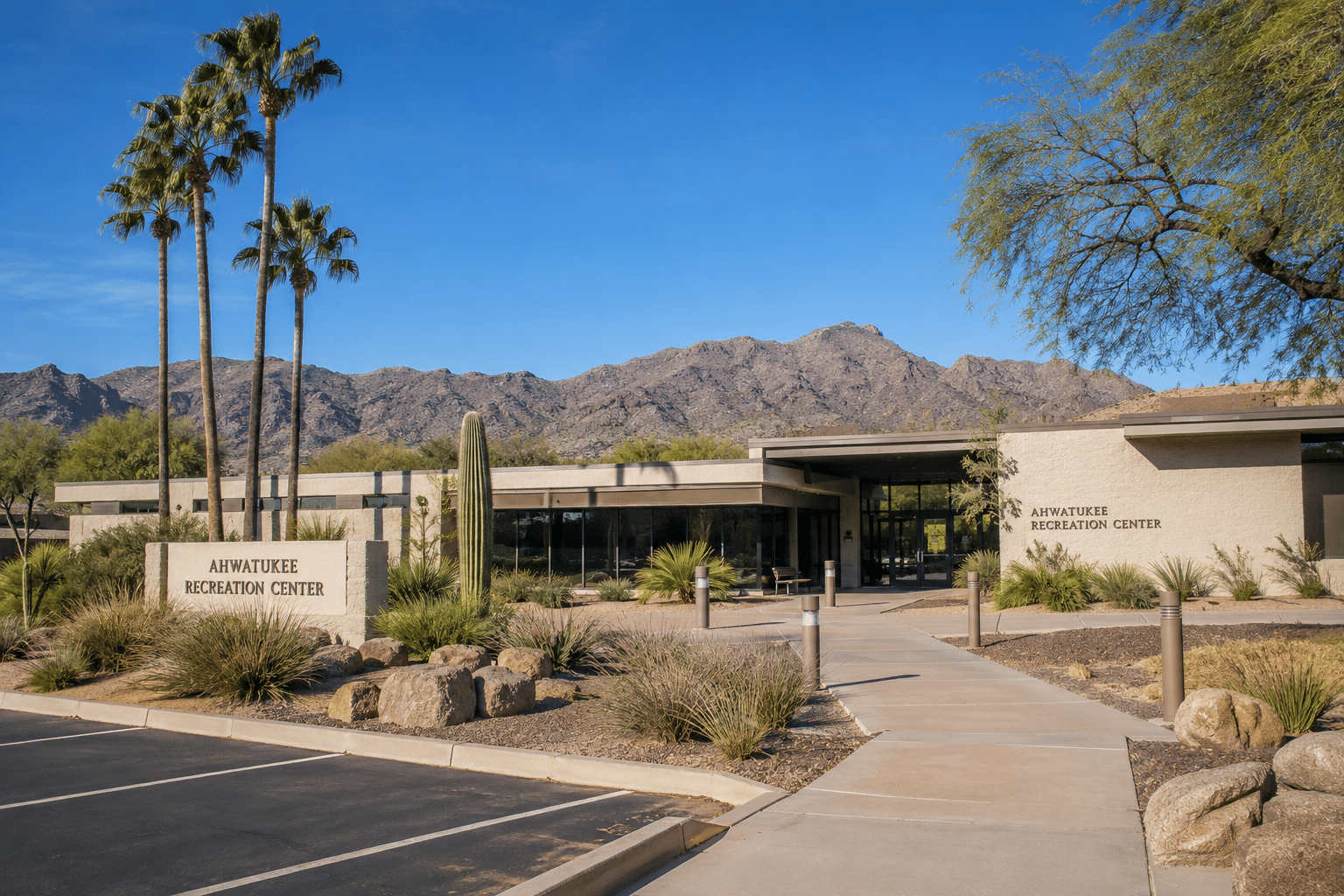
In 1971, the Presley Company of Arizona purchased thirty-five square miles of South Phoenix on the far side of the South Mountains and began drawing a master plan for what would become Ahwatukee. Three years later, in 1974, the company opened a recreation center on East Cheyenne Drive and built a small ring of single-story homes around it, reserved exclusively for residents fifty-five and older.
The choice was unusual for the era. Most active-adult communities of the time stood alone behind their own gates, separate from the families and schools and grocery runs of regular suburban life. Ahwatukee did the opposite. The 55+ neighborhood was designed as a distinct subdivision inside a much larger multigenerational master plan, with its own dedicated amenity center but its address in the same urban village as everyone else. The City of Phoenix recognizes the official Ahwatukee Foothills Village as one of fifteen urban villages that make up the city.
Half a century later, that decision still shapes daily life inside Ahwatukee Retirement Village. The 1,686 homes built between 1974 and 1987 still organize themselves around the Ahwatukee Recreation Center. The embedded-village concept that seemed unusual in 1974 has aged into one of the community’s most distinctive features.
Residents call the recreation center the ARC. What buyers notice first is pace. Mornings begin at the ARC for many. Aqua aerobics fills the indoor pool by seven. The woodshop opens shortly after, and a coffee crowd rotates through the main building. Afternoons split between courts, studios, and the trails that climb into South Mountain Park just to the north. The course-adjacent streets fill with golf carts on the way to lunch. The pattern is built into the community by design rather than scheduled by committee, which is part of why it has held together for fifty-plus years.
Most 55+ communities built in the 1970s functioned as walled-off islands. They had their own entries, their own retail, sometimes their own ZIP codes. The community inverted that template. The 55+ homes share streets, mailboxes, and the surrounding Phoenix urban village with the non-age-restricted homes around them. Only the ARC and its membership belong exclusively to residents fifty-five and older.
The result reads as the social density of a 55+ lifestyle community without the visible isolation that some age-restricted properties produce when summer thins them out. Ahwatukee’s larger year-round population keeps the urban-village character steady through every season, which is part of why winter snowbirds tend to blend into the wider community rather than concentrate inside the 55+ subdivision.
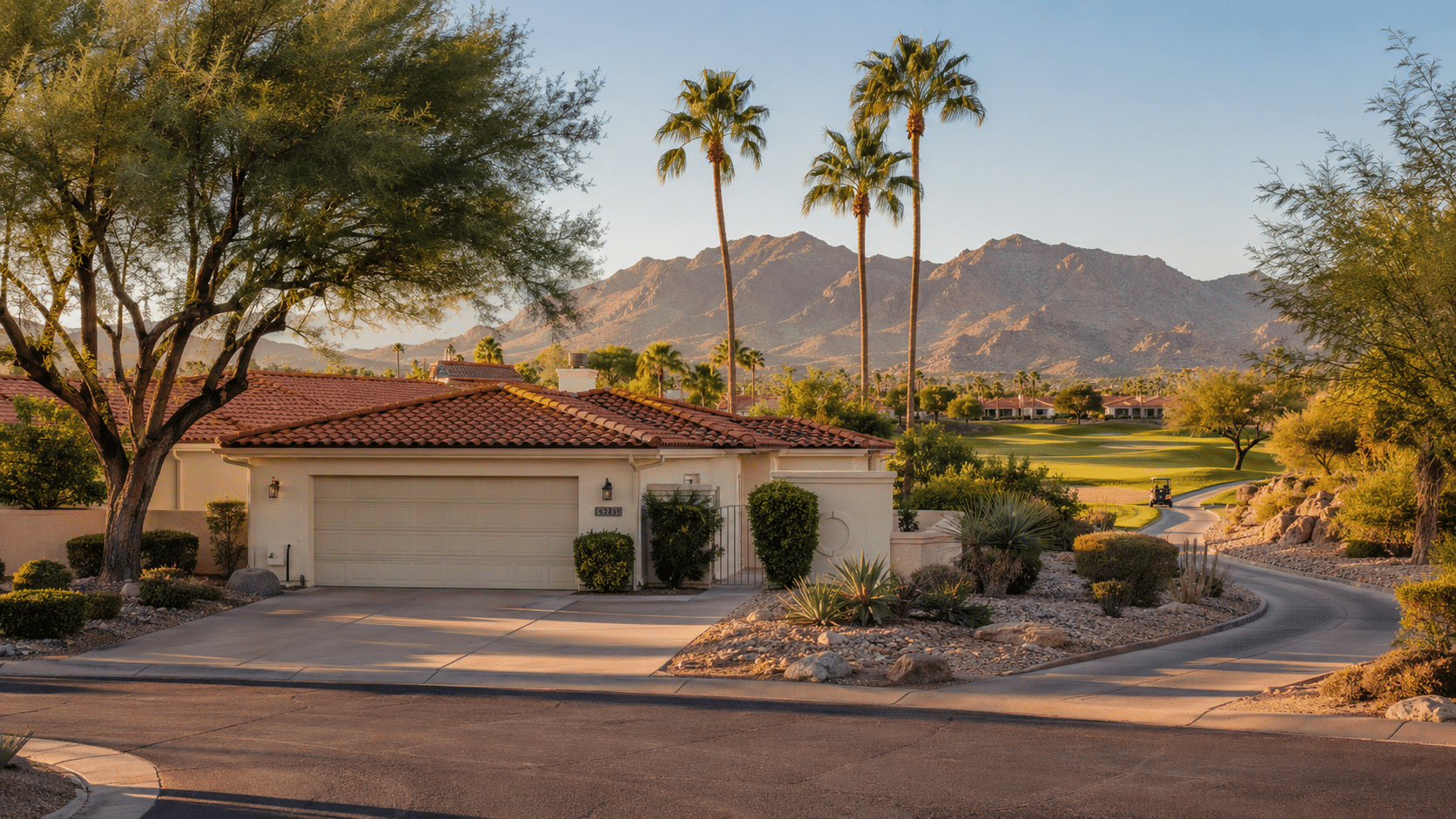
The housing stock at Ahwatukee Retirement Village is, by design and circumstance, a study in 1970s and 1980s Phoenix suburban architecture. The 1,686 homes built between 1974 and 1987 fall into two broad categories: detached single-level homes set on individual lots, and attached patio homes and townhomes clustered around shared landscaping.
Sizes range from compact two-bedroom plans near nine hundred square feet to larger four- and five-bedroom homes approaching twenty-seven hundred square feet. Most have one- or two-car attached garages, and most are single-story. Resale is the entire market here. The original developer wound down its operations decades ago, and every transaction now involves a renovated or renovation-eligible home. That gives the inventory a distinctive character buyers should learn to read on a tour.
A meaningful slice of the detached-home stock backs to the Ahwatukee Country Club golf course. The course is operated separately from the retirement village, and membership is a separate decision from the home purchase, but the visual benefit is part of why those streets carry a premium.
Buyers describe the appeal in practical terms: the back wall opens onto green fairway and irrigation views rather than another rooftop. Course-adjacent homes also tend to have larger lots and more mature landscaping. Many date to the late 1970s and benefit from kitchen and bath updates by previous owners. A buyer focused on golf-course views should plan tours that prioritize these streets specifically, since the sightlines vary block by block.
The attached side of the housing stock serves a different buyer. Smaller lots and shared exterior maintenance suit owners who travel often, who spend the warmer months elsewhere, or who want fewer hours spent on yard care. Floor plans typically run two bedrooms with one or two bathrooms, often single-level with a small private patio.
The patio-home cluster makes up a meaningful share of resale inventory at any given time. Buyers shopping the attached side tend to prioritize ARC walking distance over course adjacency, since the calendar of classes and clubs becomes the primary daily anchor rather than tee times. The trade-off is straightforward and well understood inside the community.
The ARC is not one building. It is three. The campus at 5001 East Cheyenne Drive holds a main social building, a dedicated arts complex, and a wellness wing connected to the outdoor pool deck. Together, the buildings give Ahwatukee Retirement Village a footprint of dedicated 55+ amenity space that punches well above the size buyers expect from a community of 1,686 homes.
The amenity stack also explains why the community functions year-round despite the embedded-village design that, on paper, could have thinned participation. Residents describe the ARC the way a small town describes its civic center: not as a venue, but as the place where the community recognizes itself.
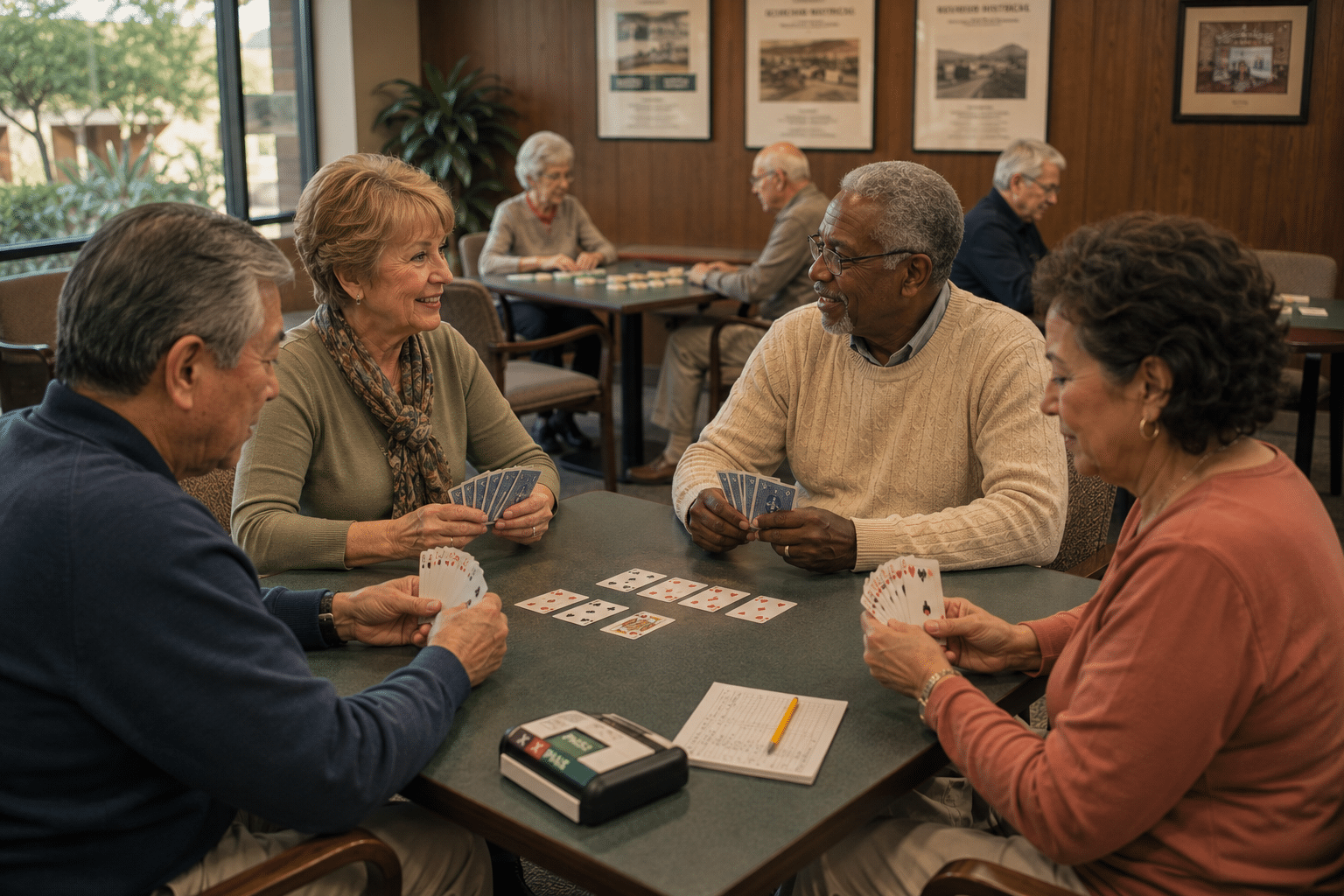
The main ARC building anchors the social calendar. A grand ballroom hosts dances, holiday parties, large-format club meetings, and special events. A community library holds hundreds of titles plus comfortable reading space. A network of multipurpose rooms supports cards, games, and small-group meetings throughout the day.
On a typical winter afternoon, several rooms run simultaneously: bridge in one, mahjong in another, a board meeting in a third. The main building is also where the coffee hour gathers, where club presidents post sign-up sheets, and where new residents typically take their first ARC tour. It functions as the community’s living room rather than just an event space.
The arts building sits a short walk from the main social building. It holds a woodshop, a stained-glass studio, a ceramics room, and dedicated space for painting and other fine-art work. Each studio runs on a posted weekly calendar, with open-studio hours, instructor-led classes, and member project nights.
The woodshop is well-equipped and supports furniture-scale projects rather than only small pieces. The stained-glass and ceramics rooms run year-round but see their busiest weeks from October through April. Residents who joined for the pool and the cards often find themselves ending up in the arts building within a season or two. That cross-pollination is part of the design intent and one reason the community feels smaller than its home count would suggest.
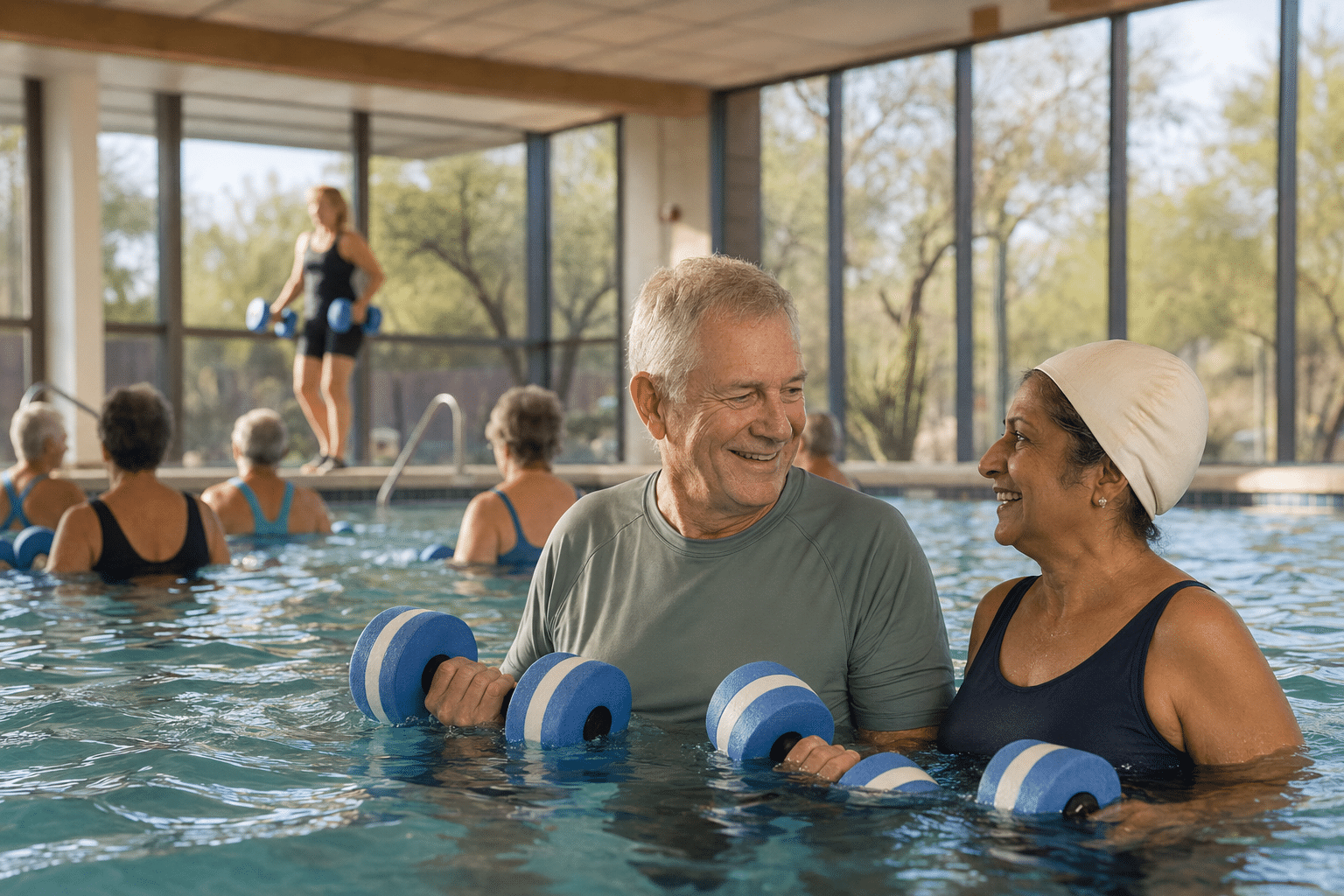
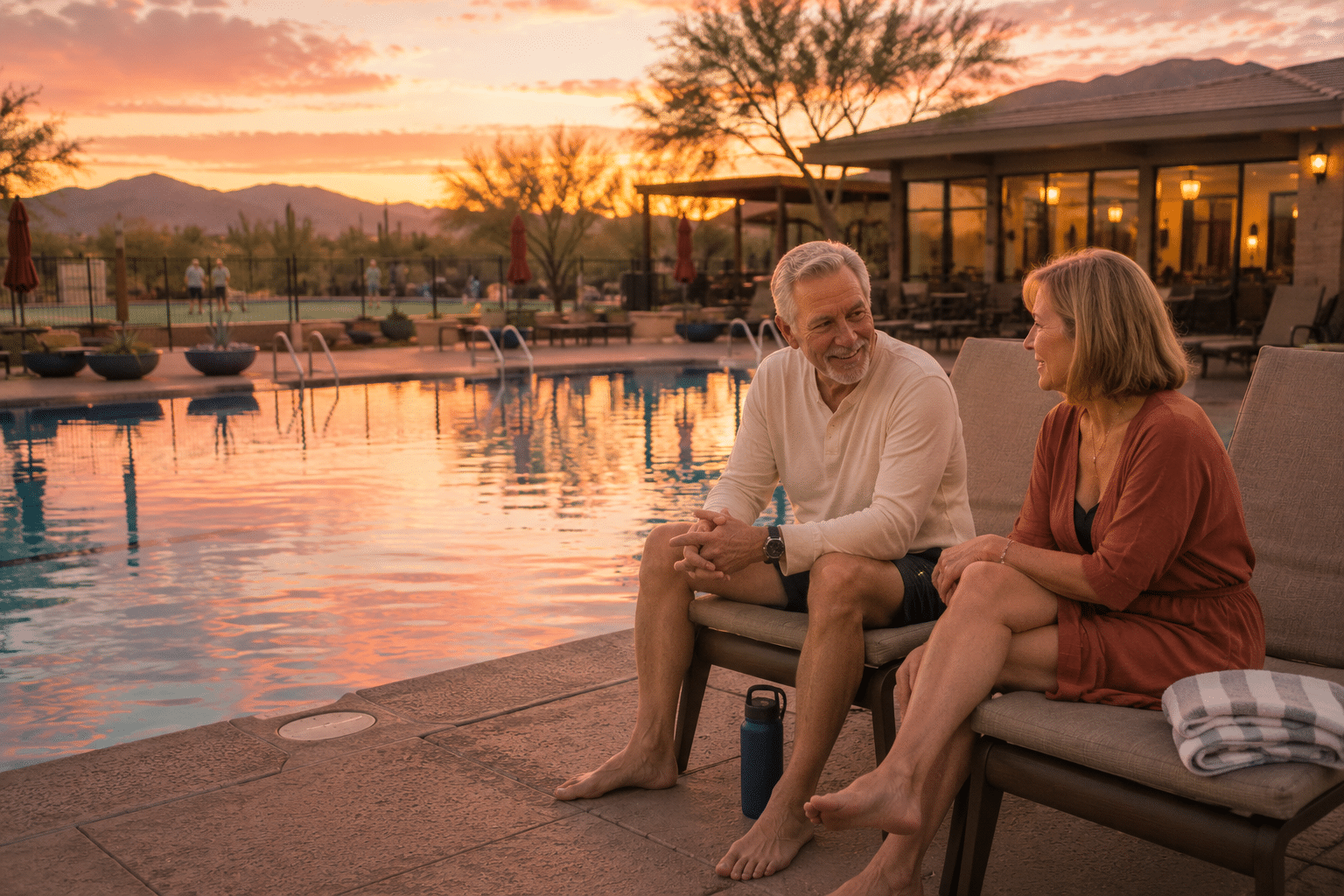
The wellness side of the ARC pairs an indoor pool with a sauna and an outdoor pool with a sun deck. The indoor pool runs aqua aerobics most weekday mornings; the outdoor pool fills in for lap swimming and afternoon socializing.
Outside, the campus holds ten shuffleboard courts arranged in a row, a bocce court, and a lawn-bowling green. The court games are part of why the calendar holds together. Leagues run for each, with year-round play and a roster of regulars. Tennis and pickleball play also takes place on community courts located within walking distance of the ARC, giving the racket-sport contingent a steady weekly anchor.

The clubs are how the community feels its size. With 1,686 homes and a master plan that does not fence the 55+ subdivision off from the rest of Ahwatukee Foothills, the community could easily feel large and impersonal. The clubs prevent that.
Specific-interest groups proliferate. Residents repeatedly describe the calendar the same way: it is full enough that nobody participates in everything, and selective enough that the people who join a club tend to know each other by name within a season. The result is a recognizable face culture inside a sizable community, which buyers tend to underestimate until they spend a morning at the ARC.
The bedrock of the calendar is the standing daily activity. Aqua aerobics runs in the indoor pool. Card-room sessions for bridge, canasta, bunco, and pinochle fill afternoon slots most days of the week. The morning coffee hour rotates through the main building and serves as the lowest-friction onboarding for new residents.
Cardio stretch and boot camp run for those who prefer land-based work. Billiards, ceramics, and the woodshop hold regular open-studio hours. Most of these are walk-in activities. A new buyer can show up at the ARC the day after closing and find a place to sit by the second visit.
Beyond the daily standing activities, the special-interest roster reflects the wider Ahwatukee character. ARC Singers gives a performance home to residents who arrived as choir members and conductors. Hiking groups run regular outings into South Mountain Park’s trail system, taking advantage of trailheads only minutes away.
Other clubs cover photography, cooking, books, and travel. Bocce ball and lawn-bowling leagues run their own competitive seasons. The club roster shifts year to year as residents propose new groups, but the architecture is stable: dedicated rooms, posted schedules, member-led organization, and minimal staff overhead. That design is why activities tend to outlast the people who started them.
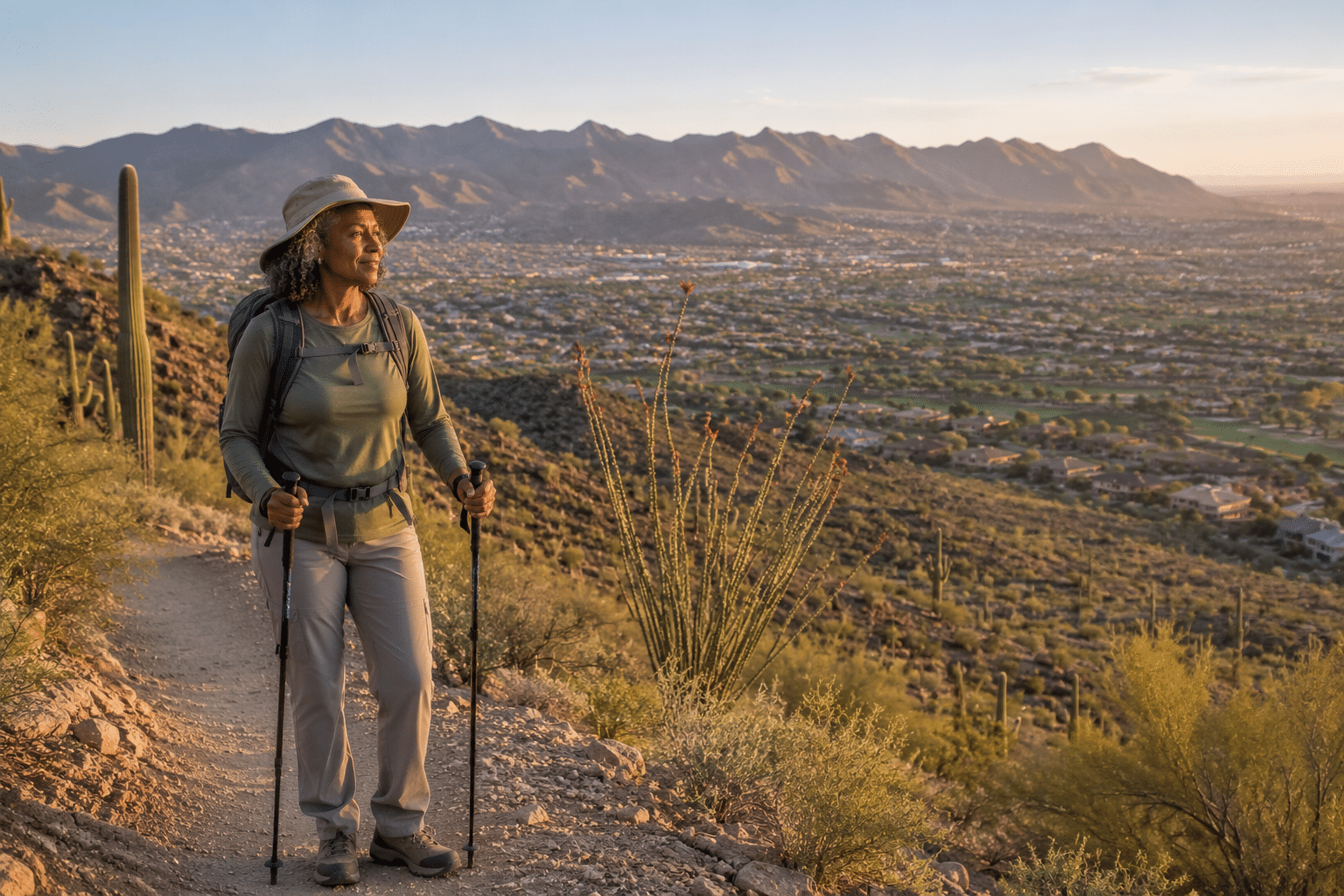
Geography is the single most distinctive thing about Ahwatukee Retirement Village. The community sits on the south side of the South Mountains, separated from the rest of Phoenix by the rugged ridge that gave the urban village its name. Crow words awe chuuke — meaning “land on the other side of the hill” — traveled into local naming through the Presley-era marketing materials and stuck.
Ahwatukee functions in many ways like a small town with its own retail and school district inside the larger metropolitan footprint. South Mountain Park frames the northern skyline and contains some of the longest-running trail networks in the city, putting hiking access inside a fifteen-minute drive from the ARC. Residents looking to compare Ahwatukee against options on the other side of the metro often turn next to Mesa 55+ community options in the East Valley.
Despite the south-of-the-mountain feel, Ahwatukee is closer to the metro core than most active-adult communities in the Phoenix area. Phoenix Sky Harbor International Airport sits roughly nine miles to the north and is reachable in fifteen to twenty minutes via Interstate 10 or the Loop 202 South Mountain Freeway. Downtown Phoenix is similarly close. The East Valley cities of Tempe, Mesa, and Chandler are all within a twenty-minute drive, putting major medical centers, performing-arts venues, and sports complexes within practical reach. The Ahwatukee Foothills Towne Center, with grocery, theater, and dining, sits roughly two miles from the ARC.
The Loop 202 South Mountain Freeway corridor, which opened in 2019 and reshaped southwest valley travel patterns, is part of why drive-time logic at Ahwatukee works for current buyers. The route bypasses the downtown bottlenecks and provides a clean line west toward Goodyear and the West Valley. For residents with adult children in those areas, that single freeway has materially shortened the family-visit drive. Geography that once felt isolated now feels efficient.

Healthcare access at Ahwatukee Retirement Village reads as two layers. The first is routine primary care, kept inside the urban village wherever possible. The second is acute or specialty care, which sits within a fifteen- to twenty-minute drive on Interstate 10 and the Loop 202 corridor.
Most residents settle into a routine that anchors primary care close to home and routes specialty appointments north over the mountain to the larger Phoenix-area systems. The result is a healthcare profile that resembles an East Valley address more than a south-of-the-mountain one. That layered access is one reason this 55+ lifestyle community has aged well for residents managing chronic conditions, even though the original 1974 plan predates most modern senior-housing healthcare benchmarks.
HonorHealth medical group offices operate a primary-care presence inside Ahwatukee. The nearest medical group office sits roughly four miles from the ARC, which keeps annual visits, lab draws, and minor episodic care close to home. Independent primary-care practices and urgent-care storefronts also operate within the urban village, providing same-day options when the primary appointment is not the right route. For residents managing chronic conditions, follow-up appointments rarely require a freeway drive. The mountain-and-freeway barrier that complicates other south Phoenix logistics does not apply to routine care.
The community’s own wellness footprint sits inside the ARC. The fitness center holds cardio and strength equipment with hours that span morning to evening. The aerobics studio runs scheduled classes including yoga, Zumba, Tai Chi, cardio stretch, and boot camp.
The indoor pool with adjacent sauna runs aqua-aerobics sessions most weekdays and supports lap-swim and recovery use throughout the week. For residents managing joint concerns or chronic-condition recovery, the indoor pool is the most-used wellness asset by a wide margin. Residents tend to combine the on-site fitness footprint with their primary-care provider’s recommendations rather than treating the two systems as separate tracks. The result is a community where wellness is woven into the weekly calendar rather than scheduled around it.
Cost at Ahwatukee Retirement Village divides into two pieces a buyer should consider separately: the home purchase and the recurring obligation tied to ARC membership and any homeowner-association fee that applies to the specific home.
Home pricing reflects an established resale market with a mid-1970s-to-mid-1980s housing stock and an inventory of homes in varying renovation states. Some have been substantially updated by recent owners; others remain closer to their original finishes and condition. The pricing band reflects that variation. Buyers willing to take on a renovation tend to find the most efficient entry points into the community, which is part of why the resale market remains active.
A practical way to read the price range is by renovation state rather than by floor plan. A two-bedroom patio home in original condition will price differently from the same plan with a remodeled kitchen, updated electrical, and a new HVAC system.
Buyers entering the community in 2026 should expect to budget separately for likely near-term work on systems that are now several decades old: roofs, water heaters, single-pane windows in some original homes, and dated wiring in early-1970s construction. The community’s resale specialists routinely help buyers compare a slightly more expensive turn-key home against a less expensive renovation candidate, and the right comparison depends on the buyer’s appetite for project management. For a deeper pre-purchase look at this trade-off, see the guide to renovating older 55+ resale homes.
The ARC operates on a membership model that funds operations and capital improvements. Membership for residents fifty-five and older provides full access to the buildings, pools, courts, classes, studios, and clubs. The dues structure is the practical answer to how a single recreation center supports 1,686 homes worth of programming over five decades.
Buyers should review current dues, any homeowner-association fees attached to the specific home, and ARC capital-assessment policies as part of their pre-purchase financial review. A specialist familiar with the community can walk through the line items in detail and explain how the membership-style structure differs from the typical master-association dues structure used in newer 55+ lifestyle communities like PebbleCreek in Goodyear or Sun Lakes country-club retirement. For broader cost benchmarking, the 55+ community fee comparison guide sets out the major categories side by side.
Ahwatukee Retirement Village is an age-restricted 55+ community. The Ahwatukee Recreation Center and its membership are reserved exclusively for residents fifty-five and older.
The community contains 1,686 homes built between 1974 and 1987, including a mix of detached single-level homes and attached patio homes and townhomes. Resale is the entire current market.
The Presley Company of Arizona developed the larger Ahwatukee master plan beginning in 1971 and opened the dedicated 55+ Ahwatukee Recreation Center on East Cheyenne Drive in 1974.
The ARC operates three buildings holding a ballroom, library, card rooms, fitness center, aerobics studio, indoor pool with sauna, outdoor pool, woodshop, ceramics studio, stained-glass studio, shuffleboard courts, a bocce court, and a lawn-bowling green.
HonorHealth operates a primary-care presence inside Ahwatukee, roughly four miles from the ARC. Acute and specialty care sits within a fifteen- to twenty-minute drive via Interstate 10 and the Loop 202 South Mountain Freeway.”
The most efficient way to evaluate Ahwatukee Retirement Village is to start at the ARC. Walk the three buildings during active hours — mornings for the pool and the woodshop, afternoons for the card rooms and the ballroom — to see the community at full participation.
From there, drive the residential streets at a relaxed pace. The course-adjacent streets along the Ahwatukee Country Club fairways tell one story; the patio-home and townhome clusters tell another. A serious buyer can cover both halves of the community plus the ARC tour in a single morning, then meet with a resale-experienced agent in the afternoon to walk through current inventory matched to budget and renovation tolerance. The right tour rhythm makes the embedded-village design legible in a way that a brochure cannot.
Resale-only communities reward an agent who has tracked the inventory across multiple seasons. A Phoenix-area 55+ specialist familiar with Ahwatukee Retirement Village can flag homes priced for renovation versus homes priced for finish quality, identify the patio-home clusters with the strongest shared-maintenance arrangements, and explain how recent course-adjacent sales have set the comparable benchmarks.
The right specialist also coordinates the ARC walkthrough with the membership office, so first-day buyers see the community at the right time of day. If you want to see Ahwatukee Retirement Village in person, the next step is to schedule a tour with a Phoenix-area 55+ specialist and let the embedded-village design make its own case. You can also browse all Arizona active adult communities if you would like to compare Ahwatukee against other communities in the metro before committing to a visit.
We use cookies to improve your experience on our site. By using our site, you consent to cookies.
Manage your cookie preferences below:
Essential cookies enable basic functions and are necessary for the proper function of the website.
CloudFlare provides web performance and security solutions, enhancing site speed and protecting against threats.
Service URL: developers.cloudflare.com (opens in a new window)
Google Tag Manager simplifies the management of marketing tags on your website without code changes.
These cookies are used for managing login functionality on this website.
Statistics cookies collect information anonymously. This information helps us understand how visitors use our website.
Google Analytics is a powerful tool that tracks and analyzes website traffic for informed marketing decisions.
Service URL: policies.google.com (opens in a new window)
You can find more information about our Cookie Policy and Privacy Policy.